

Simplifying VAT Return Filing in the UAE (including changes in 2026 and how to prepare)
VAT has been part of doing business in the UAE since January 1, 2018, and…
Have you ever found yourself knee-deep in invoices trying to reconcile a supply with payments received? A simple solution to this common problem would be assigning unique identifiers to invoices. These identifiers can then be referenced by your clients when they process payments. This will improve your ability to track outstanding dues. Such identifiers are also helpful from an audit perspective and form part of the UAE’s existing tax-invoice requirements.
That’s what this article is all about!
We will discuss the benefits of a well-designed invoice numbering system. The article also discusses how businesses can formulate and implement an invoice number system that meets VAT requirements and keeps up with your business’s operations.
Invoice numbers are unique identifiers assigned to each invoice. To lower the number of digits in a company’s invoice numbering system and to comply with regulations, alphanumeric codes may be used as invoice numbers.
The immediate benefit of a consistent numbering system is that you avoid confusion when sifting through financial records to reconcile payments with invoices and calculate accounts receivable. Auditors trying to verify the accuracy of financial statements and/or tax returns also enjoy the same benefit.
The benefits of an effective invoice numbering system are:
A well-designed invoice numbering system is one factor that contributes to easy-to-read financial records. Another factor is a well-organized chart of accounts. In a previous article, we discussed how businesses in the UAE should design their charts of accounts.
A well-designed invoice number will typically include the following elements:
| Element | Description |
|---|---|
| Prefix | Abbreviations or category identifiers to help the reader identify the type of invoice, client, or branch |
| Date | Year and month added as numbers to quickly match invoices with the correct tax or review period |
| Sequential numbering | Each subsequent invoice should be assigned the next invoice number to maintain traceability |
| Consistent format | The order in which the prefix, date, and sequential number are written should be consistent across all invoices |
| Zero-padding | Invoice numbers should include additional digits to avoid disrupting the consistency in numbering when your business grows and the sales volume increases suddenly |
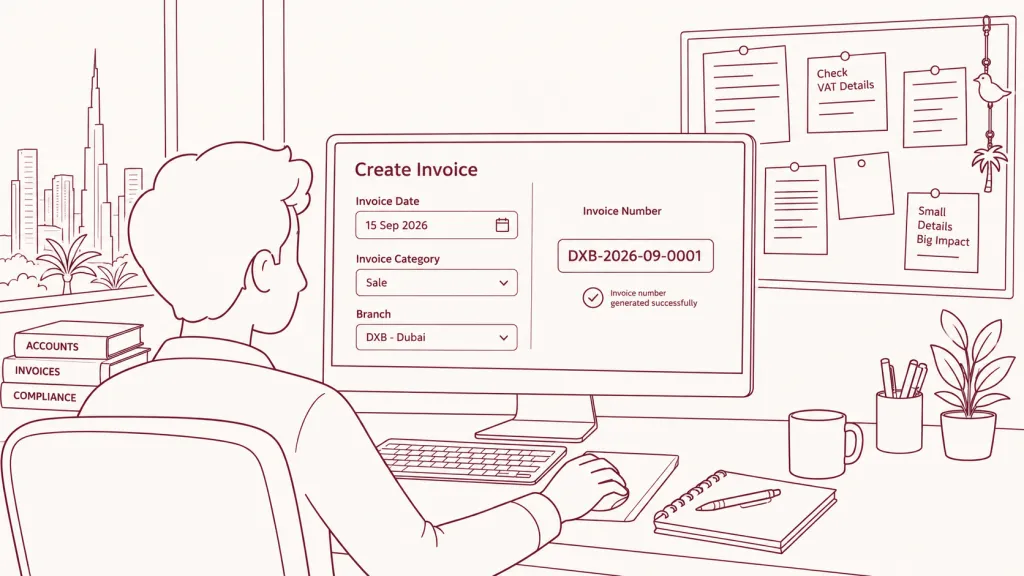
Suppose you decide to have a year-month date component, have 4 digits, and define prefixes as COM for commissions and SAL for sales. Then, your first invoice of the 2027 tax period, which relates to a sale in January 2027, should have SAL-2027-01-0001 as the invoice number. Such a numbering system would help you avoid duplicate invoice numbers across different tax periods because of the date component.
Here’s how you can assign invoice numbers in a manner that simplifies bookkeeping and enables faster financial analysis.
Apply a consistent numbering logic within each invoice series. A consistent format will reduce confusion. If the numbering logic is clearly defined, you can understand the nature of the deliverable connected to the invoice just by looking at the invoice number. This can be a valuable hint in fraud/error detection.
You must not skip any invoice numbers. For instance, if your previous invoice number was 5425, the next one should be 5426 and not 5427 or any other number. If a number is voided, cancelled, or otherwise unused, retain appropriate records explaining the gap.
Assigning invoice numbers after considerable time has passed since order placement can lead to errors. It can lead to duplication of invoice numbers, non-sequential numbering, or numbers being skipped entirely.
Manually tracking and assigning invoice numbers across different customers and product categories is challenging and error-prone. The invoice numbering process should therefore be automated with clearly defined logic that addresses all possible edge cases and not just typical business transactions.
Your e-invoicing software, accounting software, and invoice numbering system should not be running in parallel. The invoice numbering system should be clearly defined within the e-invoicing software that directly feeds into the accounting software.
UAE businesses within the scope of e-invoicing will be required to issue electronic invoices through an Accredited Service Provider (ASP) once their applicable mandatory implementation date begins. PDFs, paper invoices, and other forms of unstructured documents are not considered e-invoices. During the phased rollout, a regular tax invoice may also be required for buyers that have not yet implemented e-invoicing.
Under the e-invoicing regime, you must assign unique and sequential invoice numbers. Take the following steps to keep up with these requirements:
Note
The UAE is rolling out mandatory e-invoicing in phases. The Ministry of Finance’s published specification lists 51 mandatory fields (including invoice numbers) for an electronic tax invoice and 49 mandatory fields for a commercial electronic invoice, with requirements applying according to the relevant invoice type and implementation phase.
If your business falls under the scope of e-invoicing requirements, you will need to issue invoices as well as credit notes electronically. UAE VAT rules do not prescribe a sequential numbering requirement for Tax Credit Notes in the same way they do for Tax Invoices. However, an Electronic Credit Note under the UAE e-invoicing specification must contain a unique invoice/document number and a UUID.
Also, an electronic tax credit note must include sufficient information for identifying which invoice and deliverable it relates to.
A credit note should use a numbering system that uniquely identifies the document and should include the required reference to the underlying invoice or supply. Using a related prefix, such as ‘CN’, is an optional convention rather than a compliance requirement.
For example, if the relevant invoice’s identifier is INV-2026-7-0031, the credit note number could be CN-2026-7-0031. Or better yet, the tax credit note number could be C1-2026-7-0031 to denote that this is the first credit note relevant to this particular invoice. For subsequent credit notes relevant to the same invoice, you could use C2, C3, and so on.
Curious about how businesses in the UAE should issue credit notes? We cover all such queries regarding tax credit notes in our comprehensive guide.
Here are some of the best practices that help businesses avoid some of the common mistakes in invoice numbering.
| Common mistake | Best practice that addresses this mistake |
|---|---|
| Duplicate numbers | Add prefixes and other components to the invoice number format |
| Skipped invoice numbers | Automate invoice number generation based on the product category, client, geography, or any other key characteristic |
| Disconnect between credit notes and invoices | Reference invoice numbers in tax credit note numbers |
| Duplication of prefixes or other components | Maintain a glossary explaining all invoice number components and share it with all sales and finance team members |
Designing and implementing a well-organized invoice numbering system is very important for tax and accounting purposes. From an auditor’s perspective, it simplifies retrieving and reconciling invoices. From the management’s perspective, it enables client-, category-, and period-based analysis of settlement cycles.
That being said, the invoice number is just one mandatory field in the new invoice format. Under the current MoF specification, an electronic Tax Invoice has 51 mandatory fields, while a commercial Electronic Invoice has 49.
If you are starting from scratch, making sense of all 51 fields and developing appropriate systems to fill these fields can be extremely time-consuming. Instead, consider relying on Skrooge. We offer invoice automation as part of our Accounting and Tax package, which also includes Corporate Tax and Value Added Tax (VAT) return filing support. Learn more about our Accounting and Tax package.
An invoice number is a unique identifier assigned to each invoice. It isn’t just a compliance requirement in the UAE but also enables easy retrieval of invoices, simplifies payment tracking, and helps avoid duplication.
In the UAE, Tax Invoices must have a sequential number or another unique number that enables the invoice and its order within the relevant invoice sequence to be identified.
Invoice numbers may be restarted as part of a new numbering series, provided the numbering system continues to uniquely identify invoices and enables their order to be established. Using a year or other series identifier can help maintain uniqueness and traceability.
Tax Invoices are generally not required for exempt supplies, and may not be required for wholly zero-rated supplies where sufficient records are available. However, once a business becomes subject to UAE e-invoicing, certain transactions that do not require a VAT Tax Invoice may still require a Commercial Electronic Invoice with a unique invoice number.
If an invoice number is missing, external auditors and/or tax authorities may see it as a sign of misreporting, fraud, or some other wrongful act. Duplicated numbers will cause confusion for your team as well as your clients and will make payment tracking challenging.
Thank you!
We've received your request and will get back to you shortly.

Loading...
 Thank you!
We've received your request and will get back to you shortly.


 Contact Us


