

How To Assign Invoice Numbers Correctly in UAE?
Have you ever found yourself knee-deep in invoices trying to reconcile a supply with payments…
In the course of business, situations may arise where the goods or services you’ve supplied don’t meet your customer’s expectations. A customer might over-order and return part of their purchase. Or if you are in the service industry, you may sometimes need to deal with service cancellations. At times, you may simply issue a wrong invoice.
In all these cases, an adjustment to the original tax invoice becomes necessary.
However, if the necessary correction reduces the tax value or output VAT, the supplier will generally need to issue a tax credit note rather than simply replacing the original invoice. If the correction increases the output VAT, the supplier must generally issue a new or additional tax invoice.
This article explains what a tax credit note is, the correct format to use, its impact on your VAT returns, and how to prepare one in line with UAE VAT regulations.
In the UAE, as per Federal Decree-Law No. 8 of 2017, suppliers must issue tax credit notes to inform the recipients of reductions in the VAT due on a particular supply. The UAE VAT law defines a tax credit note as a written or electronic document that records the key details regarding a reduction or cancellation of a supply.
When the value of supplies changes, the VAT payable also changes. Similarly, if a supply is invoiced as a standard-rated supply, but it turns out to be exempt or zero-rated as the project progresses, once again, the output tax for the supplier and the input tax for the recipient will change. A tax credit note is a formal document issued to communicate any such changes that lead to a reduction or adjustment of the total VAT liabilities.
Essentially, you will need to issue tax credit notes when:
So, a tax credit note can be seen as a negative invoice since it reduces the value of the original invoice.
A tax invoice is the original document demanding payment for the supplies, and it contains the original tax obligations. Businesses should usually not delete or replace the original invoice once issued; they should preserve the audit trail and issue the correct adjustment document. Any changes in the value or nature of the supplies that also lead to a change in tax obligations must be communicated via tax credit notes and additional tax invoices. In the UAE context, the additional invoice takes the place of a debit note.
A tax credit note is the formal VAT document issued when the correct VAT is lower than the amount previously charged. If the correct VAT is higher than the amount originally calculated, the supplier must generally issue a new or additional tax invoice. A debit note may be used as a commercial document, but it does not replace the VAT requirement to issue a proper tax invoice.
If the VAT charged in the previously issued tax invoice was lower than the actual VAT, you need to raise an additional tax invoice for the additional tax amount instead of issuing tax credit notes.
Then, the output tax for the supplier and the input tax for the recipient will increase in the period in which the mistake was recognized and the additional tax invoice was issued.
Under the VAT law, UAE businesses must issue tax credit notes if the value of the invoiced supplies decreases or the applicable VAT decreases due to changes in the VAT treatment of the invoiced supplies. A tax credit note informs the recipient of the reductions in invoice value and VAT amount.
When the UAE VAT law was amended through the Federal Decree-Law No. 18 of 2022, the 14-day deadline for issuing a tax credit note was introduced. So, tax credit notes must be issued within 14 calendar days from the date the relevant Article 61 event occurs for the invoiced supplies.
For instance, suppose you own a real estate business and, on 31 May 2026, make a sale of AED 1 million for an office building.
On this sale, you charged a 5% VAT of AED 50,000.
However, before you can begin development or even start procurement of building materials, on 14 June 2026, the client changes the order. Instead of buying an office building, the client now only wants to receive the bare land, which is priced at AED 500,000.
As a result, two changes must be communicated. Firstly, the invoice amount must be reduced to AED 500,000. Secondly, the supply is now VAT-exempt and not standard-rated. Bare land is exempt from UAE VAT. This supply carries no VAT, unlike commercial buildings, which are standard-rated supplies with a 5% VAT rate.
These changes must be communicated through a tax credit note no later than 28 June 2026, which is the 14th day after the day on which the client changed the order. This tax credit note reverses the AED 50,000 VAT charged in the original tax invoice.
If the tax credit note is not issued within this deadline, you will have to pay AED 2,500 in fines to the Federal Tax Authority (FTA).
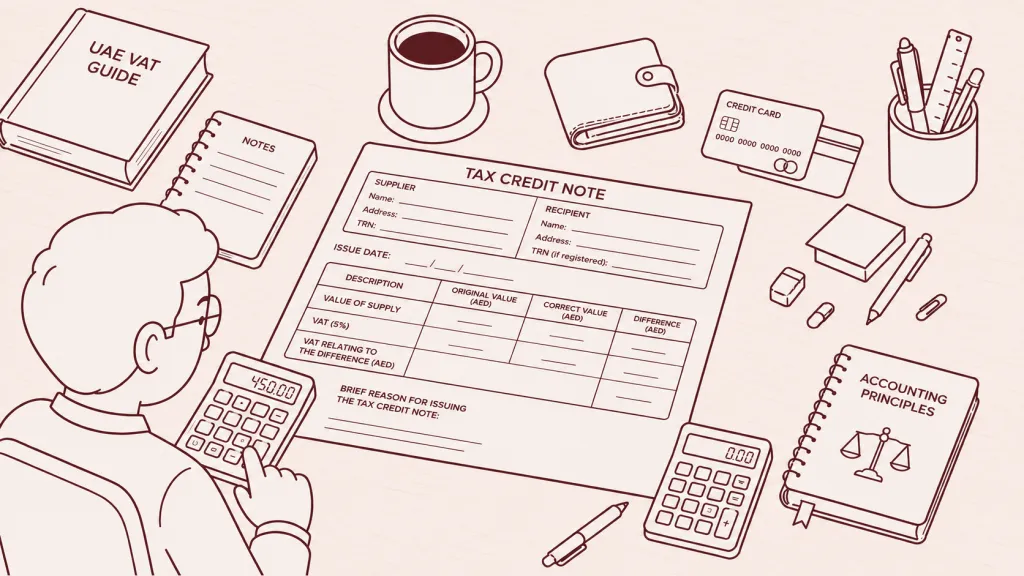
In this section, we will go over how businesses can issue UAE VAT law-compliant tax credit notes. The key requirements of tax credit notes are laid out in the Executive Regulation of the Federal Decree-Law No. 8 of 2017 on Value Added Tax. To begin with, the document should clearly show the words “Tax Credit Note”. Other required fields of a tax credit note specified under Article 60 of this regulation are:
Here’s a tax credit note sample.
Download Template for Tax Credit Note
Is issuing tax invoices another one of your billing pain points? In a previous article, we provided templates for VAT-compliant tax invoices.
A tax credit note decreases the VAT amount on a previously issued invoice, and as a result, it impacts the VAT returns of the supplier as well as the recipient. From a supplier’s perspective, a tax credit note will reduce the output VAT. On the other hand, the same tax credit note will reduce the input VAT for the recipient.
The supplier must make the appropriate VAT adjustments in the relevant VAT return in accordance with the output-tax adjustment rules. The recipient, on the other hand, must record and report the input VAT reduction in the period in which the credit note is received.
Businesses must issue tax credit notes when the VAT component of an invoice changes due to changes in the nature of supply or reductions in the value of supply. However, you must not assume that all reductions in invoice value trigger a tax credit note. Writing off an invoice, partially or fully, as a bad debt does not change the original value or nature of the supply in the same way as a cancellation, return, or price reduction.
However, bad debt adjustments must be recorded in a different manner.
As a supplier, you can reduce the output VAT in the current period to adjust the VAT paid in any previous tax periods if:
On the other hand, the recipient must reduce the input VAT claimed for the current period to adjust the VAT claimed in any previous tax periods if:
In the UAE, the e-invoicing regime was introduced through the Federal Decree-Law No. 16 of 2024 and, later, through Ministerial Decisions No. 243 and 244 of 2025; an operational framework for the same was introduced.
The UAE e-invoicing system is being introduced in phases. Businesses with annual revenue of AED 50 million or more must implement the system from 1 January 2027, while businesses below that threshold must generally implement it from 1 July 2027. Any government entities that fall within the scope of the e-invoicing laws must follow suit from 1 October 2027. The framework generally applies to B2B and B2G transactions conducted by persons doing business in the UAE, subject to specific exclusions.
Under the e-invoicing regime, businesses must appoint an accredited service provider (ASP) and issue electronic tax invoices and electronic tax credit notes in the standardized PINT AE format.
While e-invoicing is a regulatory requirement, you may not necessarily find it burdensome. Since the UAE’s VAT system forces businesses to digitize invoices and credit notes, it improves data integrity by enabling digital reconciliation in your accounting systems.
Not sure if your business currently falls under the scope of e-invoicing regulations? We cover all such queries in our guide on e-invoicing.
Through Cabinet Decision No. 40 of 2017, the UAE government introduced two penalties with respect to electronic tax credit notes. Firstly, if you do not issue an electronic tax credit note or the permitted alternative document within the legally specified period when the situation calls for it, you must pay a penalty of AED 2,500 for each detected case to the Federal Tax Authority (FTA). Secondly, if you do not issue an electronic tax credit note or a tax invoice as per the stipulated conditions and procedures, you must pay a penalty of AED 2,500 for each detected case to the FTA.
Tax credit notes are a legal requirement that ensures accurate records. Whether you are dealing with returned goods, cancelled services, or a change in VAT treatment, getting the format right and meeting the 14-day deadline is essential to avoid penalties.
Tax credit notes, however, are just one piece of the broader recordkeeping puzzle. UAE businesses must also correctly apply and record import-related taxes, follow the arm’s length principle for related-party transactions, and prepare audited financial statements, among other things.
Recordkeeping and accounting obligations pulling focus away from your core business? Consider Skrooge’s Accounting & Tax Package, which combines AI-powered automation with the oversight of experienced accountants.
In the UAE context, a VAT credit note and a tax credit note are the same thing. Tax credit notes are issued by a supplier to officially inform the recipient of the reductions in the VAT component of a particular invoice due to changes in the nature or value of a supply.
UAE businesses are required to issue a tax credit note when the VAT component of an invoice falls due to a change in the tax treatment of supply or its taxable value. So, even if the value of a supply stays the same, a tax credit note must be issued if the supply changes from being a taxable supply to an exempt supply.
The penalty for not issuing a tax credit note within 14 days of the event that triggers a change in the VAT component of an invoice is AED 2,500 for each detected case.
Suppliers must issue a tax credit note when a change in the value of a supply or its nature reduces the VAT component. However, when such changes increase the VAT component for an invoice, the supplier must issue an additional tax invoice, which takes the place of a debit note in the UAE context.
You must preserve a clear audit trail and correct the invoice and VAT records using the appropriate document. If the incorrect tax credit note has already affected a submitted VAT return, you will need to assess whether the return must be corrected through the applicable FTA procedure or a Voluntary Disclosure.
Thank you!
We've received your request and will get back to you shortly.

Loading...
 Thank you!
We've received your request and will get back to you shortly.


 Contact Us


