
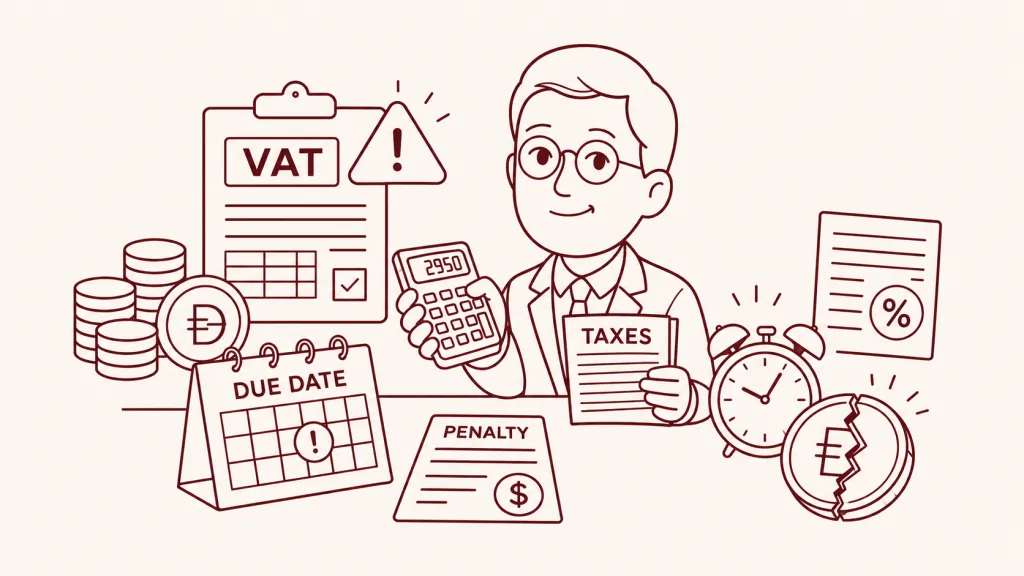

Simplifying VAT Return Filing in the UAE (including changes in 2026 and how to prepare)
VAT has been part of doing business in the UAE since January 1, 2018, and…
The UAE VAT penalty framework was amended and in effect by April 2026 through the Cabinet Decision No. 129 of 2025, which reduced several penalties and encouraged voluntary correction and compliance. The Federal Tax Authority (FTA) applies these penalties to VAT-related violations, including issues involving VAT returns, payments, registration and tax records.
For businesses, understanding how VAT works is the first step. VAT charged on taxable supplies becomes output tax, while eligible VAT paid on business purchases may be recovered as input tax.
The difference between output tax and recoverable input tax generally determines the VAT a business must account for and pay to the FTA.
In other words, VAT collected from customers is not considered as business revenue; it becomes part of the tax liability that must be reported and settled within the applicable deadline.
VAT penalties in the UAE occur as administrative fines imposed for specified violations under the UAE VAT Law and Tax Procedures Law.
VAT penalties can arise from violations involving:
Note
A business can technically file its monthly VAT returns or quarterly VAT returns (whichever applies) on time and still incur a penalty if the outstanding VAT liability is not paid by the payment deadline.
VAT and Corporate Tax have separate penalty frameworks in the UAE, even though both are administered by the Federal Tax Authority.
VAT late-payment penalties apply when payable VAT is not settled by the payment deadline, while Corporate Tax has its own late-payment penalty scheme. They should not be treated as interchangeable, so businesses need to track the separate filing and deadline for each tax.
To understand and avoid penalties associated with corporate tax, read our guide here.
The general rule is:
For those on a monthly schedule, businesses need to pay by the 28th of the following month for the month before (e.g. You need to pay by May 28th for the month of April).
For VAT registered businesses following the quarterly VAT period (which is the more common schedule), make sure to pay by the 28th of the month after the three-month period ends.
If the 28th falls on a weekend or public holiday, the deadline moves to the next working day.
Bank transfers can take a few days, so pay early to make sure funds clear the Federal Tax Authority on time.
Failing to pay VAT on time triggers automatic administrative penalties calculated monthly on the unpaid amount.
A late-payment administrative penalty of 14% per annum applies to the unpaid tax amount, calculated for each month (or part of a month) from the day following the payment due date.
The rate works out to approximately 1.1667% of the unsettled tax amount per month.
The 14% per annum rate applies for each month or part of a month, beginning on the day following the payment due date and on the corresponding date monthly thereafter.
The penalty is calculated on the unsettled Payable Tax amount. If part of the VAT is paid, future monthly penalties should be calculated on the remaining unsettled amount, not on the original balance.
A 14% per annum administrative penalty applies to unsettled VAT for each month or part of a month after the payment due date.
For example, on AED 10,000 of unsettled VAT, a simplified illustration would be approximately:
| Time | Penalty |
|---|---|
| First monthly penalty date | AED 116.67 |
| Business pays AED 5,000 of the outstanding VATRemaining unpaid VAT: AED 5,000 | |
| At the end of Month 2 | AED 58.33 |
| At the end of Month 3 + each subsequent month | AED 58.33 |
| If the business pays AED 5,000 at the end of the 6th month, total penalties amount to: | AED 408.32 |
| In total, the business pays penalties + VAT amount | AED 10,408.32 |
Businesses do not necessarily need to submit a Voluntary Disclosure immediately after discovering the error.
The applicable correction route depends on when the error is discovered and the amount by which payable tax was understated.
If a business discovers an error before the VAT return’s filing deadline, the Federal Tax Authority (FTA) allows the submitted return to be edited and corrected before that deadline. The FTA states that corrections made before the filing due date can be made without penalties.
Submission of an incorrect Tax Return carries an AED 500 penalty, unless the registrant corrects the return within the filing deadline or submits a Voluntary Disclosure that does not result in a Due Tax difference.
For an error discovered after the return has been submitted, the AED 10,000 threshold becomes important:
For VAT liabilities arising through a Voluntary Disclosure or Tax Assessment, the relevant payment period is within 20 business days.
Failure to submit the voluntary disclosure before being notified of a tax audit can result in:
Promptly submitting a Voluntary Disclosure when required can help businesses avoid the additional 15% fixed penalty that may apply when an error is not disclosed before an audit notification.
Filing a VAT return and paying the VAT due are two separate obligations. A business can submit its VAT return correctly but still face a late-payment penalty if the VAT payable is not settled on time. Conversely, failing to submit the VAT return within the required timeframe can trigger a separate late VAT filing penalty.
Overall lack of awareness about VAT obligations can cause late payments. Common operational causes of late payment include:
Tip
Businesses should segregate VAT funds into a separate bank account to avoid merging with operational cash flow.
Businesses should set reminders for VAT filing and payment deadlines. Engaging a tax consultant can help ensure timely VAT compliance. Additionally, using automated payment channels can help avoid delays when processing VAT payments.
VAT registration is mandatory for UAE-resident businesses whose taxable supplies and imports exceed AED 375,000 over the previous 12 months, or are expected to exceed AED 375,000 in the next 30 days.
Failure to register after crossing the AED 375,000 can result in an AED 10,000 administrative penalty. Note that the threshold worked as a rolling 12-month basis, with a separate prospective test for the next 30 days.
Late VAT return filing fines in the UAE are AED 1,000 for the first offense and AED 2,000 for repeat offenses within 24 months. Remember that these are filing penalties. They are separate from the late VAT payment penalty.
Ideally, regular reconciliations of accounts can help catch discrepancies early. Maintaining organized records facilitates liability verification and prevents bottlenecks during filing.
However, in the event the business fails to keep required records, the following administrative fines apply:
Failure to inform the FTA of a change requiring amendment to tax-record information:
The FTA currently provides a specific Requests for Installment, Waiver, and Refund of Administrative Penalties service through EmaraTax.
The FTA service distinguishes reconsideration from a penalty waiver request.
A taxpayer can log into EmaraTax and access the relevant penalty waiver request. Supporting documents should be attached to the application.
The FTA says it may take up to 110 business days to review and respond to a completed waiver or instalment application.
The FTA may grant installments on paying administrative penalties upon request. The administrative penalties being requested for the payment plan must generally be at least AED 50,000. The payment schedule is approved by the Committee. If the taxpayer fails to pay an installment, the Committee can revoke their decision.
To become eligible, the taxpayer must not have payable tax outstanding for the tax period covered by the request.
The penalties must also not be under dispute before the Tax Disputes Resolution Committee, competent courts, or another body handling tax objections/appeals. The FTA specifically notes an exception for a dispute pursued through the reconsideration mechanism.
Thank you!
We've received your request and will get back to you shortly.

Loading...
 Thank you!
We've received your request and will get back to you shortly.


 Contact Us


