

How To Assign Invoice Numbers Correctly in UAE?
Have you ever found yourself knee-deep in invoices trying to reconcile a supply with payments…
A chart of accounts (COA) is the foundation of a business’s accounting system. Before transactions can be recorded, every asset, liability, equity item, source of revenue, and expense must have a designated account within the general ledger. The chart of accounts provides this structure by organizing financial accounts into logical categories and assigning each one a unique numerical code.
A well-designed COA makes bookkeeping more consistent, improves the accuracy of financial statements, and allows businesses to generate meaningful management reports as they grow. It also forms the basis for VAT and Corporate Tax reporting in the UAE by ensuring that transactions are classified correctly from the outset.
In this guide, we’ll explain how a chart of accounts works, how account numbering is structured, look at a practical example, and discuss how to design a UAE-ready chart of accounts together with common best practices and mistakes to avoid.
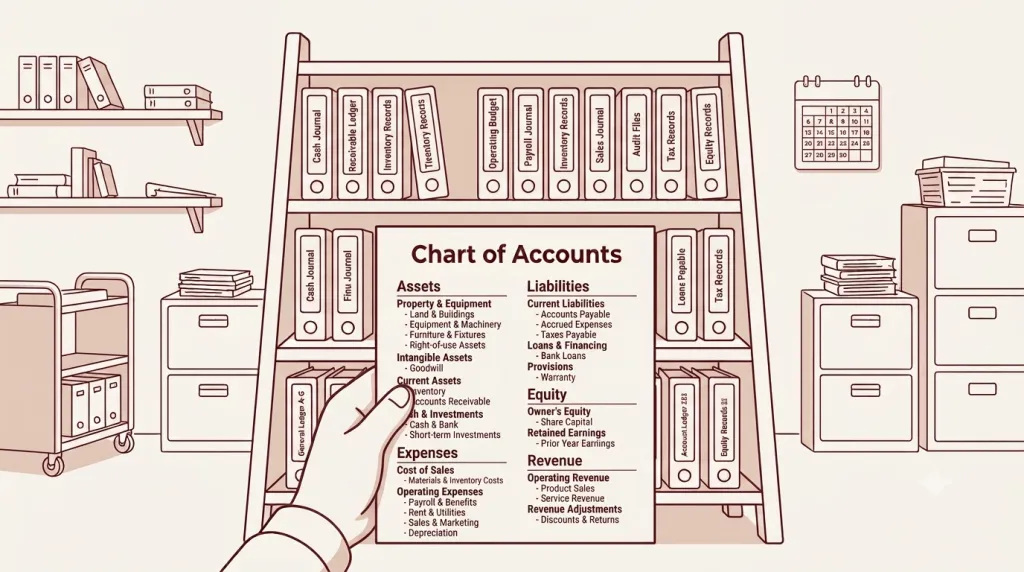
A chart of accounts (COA) is a structured list of every account in a company’s general ledger. It organizes accounts into categories and assigns each account a unique numerical code. This standardized structure makes transactions easier to record, financial statements easier to prepare, and accounting records easier to navigate.
Every account ultimately appears either on the balance sheet or the income statement. For that reason, the chart of accounts groups accounts similar to each other into one of five primary categories, which are assets, liabilities, equity, revenue, and expenses. Assets, liabilities, and equity accounts are often called balance sheet accounts, while revenue and expense accounts are called income statement accounts.
| Category | Description |
|---|---|
| Assets | Fixed assets and other resources controlled by the business to create value and/or support operations |
| Liabilities | Present obligations that the business must settle in the future |
| Equity | The residual interest in the business after deducting liabilities from assets |
| Revenue | Income generated through business operations |
| Expenses | Costs incurred as part of business operations |
The numbering system is what allows a chart of accounts to remain organized as a business grows. Rather than assigning random numbers, businesses use numbering conventions that reveal both the account category and its position within the reporting hierarchy.
So far, we have discussed the first layer of categories, which are assets, liabilities, equity, revenue, and expenses. The first digit of an account number signifies the account category. If you use a 3-digit numbering system, this would be the hundreds place.
The remaining digits usually indicate the account’s sub-category and position within the reporting hierarchy. The exact logic depends on the numbering convention chosen by the business.
The number of digits in an account number depends on the complexity of business operations.
For instance, most companies may adopt a 3-digit numbering system where asset accounts are 100 to 199, liability accounts are 200 to 299, equity accounts are 300 to 399, revenue accounts are 400 to 499, and expense accounts are 500 to 599. In this numbering system, the first digit signifies the account category. The second digit reflects the account sub-category, and the last digit reflects the individual account.
However, a company with a more complex operational structure may need an additional layer of sub-accounts. In such cases, the company can choose a 4-digit numbering system where asset accounts are 1,000 to 1,999, liability accounts are 2,000 to 2,999, equity accounts are 3,000 to 3,999, revenue accounts are 4,000 to 4,999, and expense accounts are 5,000 to 5,999.
The following example illustrates how categories, sub-categories, and account codes fit together within a practical chart of accounts.
| Account | Depth | Code |
|---|---|---|
| Assets | 0 | 100 |
| Property & Equipment | 1 | 110 |
| Land & Buildings | 2 | 111 |
| Equipment & Machinery | 2 | 112 |
| Furniture & Fixtures | 2 | 113 |
| Right-of-use Assets | 2 | 114 |
| Intangible Assets | 1 | 120 |
| Goodwill | 2 | 121 |
| Software | 2 | 122 |
| Intellectual Property | 2 | 123 |
| Current Assets | 1 | 130 |
| Inventory | 2 | 131 |
| Accounts Receivable | 2 | 132 |
| Prepayments | 2 | 133 |
| Tax Receivable | 2 | 134 |
| Cash & Investments | 1 | 140 |
| Cash & Bank | 2 | 141 |
| Short-term Investments | 2 | 142 |
| Liabilities | 0 | 200 |
| Current Liabilities | 1 | 210 |
| Accounts Payable | 2 | 211 |
| Accrued Expenses | 2 | 212 |
| Taxes Payable | 2 | 213 |
| Deferred Revenue | 2 | 214 |
| Loans & Financing | 1 | 220 |
| Bank Loans | 2 | 221 |
| Lease Liabilities | 2 | 222 |
| Other Borrowings | 2 | 223 |
| Provisions | 1 | 230 |
| Warranty & Customer Provisions | 2 | 231 |
| Legal & Other Provisions | 2 | 232 |
| Equity | 0 | 300 |
| Owner’s Equity | 1 | 310 |
| Share Capital | 2 | 311 |
| Additional Paid-in Capital | 2 | 312 |
| Retained Earnings | 1 | 320 |
| Current Year Earnings | 2 | 321 |
| Prior Year Earnings | 2 | 322 |
| Revenue | 0 | 400 |
| Operating Revenue | 1 | 410 |
| Product Sales | 2 | 411 |
| Service Revenue | 2 | 412 |
| Revenue Adjustments | 1 | 420 |
| Discounts & Returns | 2 | 421 |
| Other Revenue Adjustments | 2 | 422 |
| Expenses | 0 | 500 |
| Cost of Sales | 1 | 510 |
| Materials & Inventory Costs | 2 | 511 |
| Direct Labor & Production Costs | 2 | 512 |
| Operating Expenses | 1 | 520 |
| Payroll & Employee Benefits | 2 | 521 |
| Rent & Utilities | 2 | 522 |
| Sales & Marketing | 2 | 523 |
| Professional Services | 2 | 524 |
| Software & Subscriptions | 2 | 525 |
| Office & Administrative Expenses | 2 | 526 |
| Depreciation & Amortization | 2 | 527 |
| Other Income & Expenses | 1 | 530 |
| Interest Income & Expense | 2 | 531 |
| Other Income & Expenses | 2 | 532 |
The example demonstrates an important principle: account numbers communicate accounting structure as much as identification. By reading the digits, you can immediately determine both the reporting category and where the account sits within the chart of accounts hierarchy.
The following steps help ensure that your chart of accounts supports VAT reporting, Corporate Tax compliance, and future business growth.
Every UAE business registered for VAT should maintain dedicated VAT accounts within its chart of accounts. At a minimum, your chart of accounts should include:
The VAT Input account records VAT paid on business purchases that is recoverable under the UAE VAT regime. Businesses that make both taxable and exempt supplies should further divide the VAT input account into recoverable VAT input and non-recoverable VAT input accounts.
The VAT Output account records VAT charged on taxable sales. Although businesses collect this VAT from customers, the amount does not belong to the business. It represents a liability the company owes to the FTA until the relevant VAT return is filed and payment is made.
Every taxable sales invoice should record the revenue and, where VAT is charged, the corresponding VAT Output. Maintaining this account separately from revenue ensures that reported turnover and VAT liabilities remain accurate and simplifies reconciliation between sales records and VAT returns.
At the end of each VAT period, the balances in the VAT Input and VAT Output accounts are offset against one another. If output VAT exceeds recoverable input VAT, the business records a VAT Payable balance. Conversely, where recoverable input VAT exceeds output VAT, the business may have a VAT Receivable balance that can be refunded, subject to the applicable rules.
Many businesses maintain a single control account that reflects either a payable or receivable balance, while others maintain separate payable and receivable accounts. Either approach is acceptable provided it produces clear and accurate reporting.
It is generally advisable to maintain a dedicated account for VAT penalties and administrative charges imposed by the FTA. Recording these amounts separately from operating expenses improves financial reporting and allows management to monitor compliance-related costs over time.
| Account | Purpose |
|---|---|
| VAT Input | Records VAT paid on eligible business purchases that can be recovered from the FTA |
| VAT Output | Records VAT charged on taxable sales and collected on behalf of the FTA |
| VAT Payable/Receivable | Records the net VAT liability or refund after offsetting input and output VAT for a tax period |
| VAT Penalties & Late Payment Charges (optional) | Separately records administrative penalties and late payment charges imposed by the FTA |
Beyond the core VAT accounts, UAE businesses often benefit from structuring their revenue and expense accounts to support VAT reporting.
For revenue, separate accounts may be maintained for standard-rated supplies, zero-rated supplies, exempt supplies, and supplies outside the scope of UAE VAT where applicable. This structure simplifies VAT return preparation and reduces the need for manual analysis at the end of each tax period.
Similarly, businesses that incur both recoverable and non-recoverable VAT may choose to classify expenses based on whether they relate to taxable or exempt activities.
Made a mistake in your last VAT return? We go over how businesses can inform the FTA of incorrect VAT returns to reduce penalty exposure in a recently published article on VAT voluntary disclosures.
Where applicable, UAE businesses should create dedicated Corporate Tax accounts to simplify financial reporting and annual tax compliance. In such cases, ideally, your chart of accounts should include:
This account records the current Corporate Tax expense recognized in the income statement. It reflects the tax attributable to the accounting period after applying the relevant Corporate Tax rules and adjustments.
Before the tax is paid, businesses typically recognize a current Corporate Tax liability based on their estimated Corporate Tax obligation for the period. Recording this separately allows management to monitor expected tax obligations and ensures liabilities are reflected in the financial statements.
Once the Corporate Tax liability becomes due, it is transferred to the Corporate Tax Payable account until payment is made. This account functions as the primary control account for outstanding Corporate Tax obligations.
Businesses applying IFRS and recognizing temporary differences may also need Deferred Tax Asset and Deferred Tax Liability accounts. These accounts recognize the future tax effects of temporary differences between accounting values and tax values of assets and liabilities.
| Account | Purpose |
|---|---|
| Corporate Tax Expense | Records the current Corporate Tax expense for the financial year |
| Corporate Tax Provision | Records the estimated Corporate Tax liability before payment |
| Corporate Tax Payable | Records the amount payable to the FTA |
| Deferred Tax Asset (where applicable) | Records future tax benefits arising from deductible temporary differences |
| Deferred Tax Liability (where applicable) | Records future tax obligations arising from taxable temporary differences |
Certain businesses may require additional reporting classifications within their chart of accounts. For example, Qualifying Free Zone Persons often distinguish qualifying income from non-qualifying income, while many businesses separately identify deductible and non-deductible expenses for Corporate Tax purposes. Incorporating these distinctions into the chart of accounts can significantly reduce year-end tax adjustments and improve reporting accuracy.
Curious about how Corporate Tax liabilities are calculated and reported? We explore all such queries in a prior article on Corporate Tax.
A well-structured chart of accounts provides the foundation for accurate bookkeeping, reliable financial reporting, and informed business decisions. As your business grows, your chart of accounts should evolve with it.
The key lies in keeping it simple, leaving room for future expansion, and using sub-categories only when they add clarity.
Review your chart of accounts periodically and document each account’s purpose when you introduce it.
If you can achieve that while avoiding pitfalls like failing to separate VAT and Corporate Tax accounts or using vague account names, you will have a strong foundation for financial reporting and analysis in the long-term.
However, designing a chart of accounts that continues to meet your business’s needs as it grows is challenging, even with modern accounting software and AI at your disposal.
That’s why Skrooge combines AI’s agility with the reliability of human experts to ensure that your books are recorded correctly right from day one. Learn more about our Accounting & Tax Package, which includes an initial chart of accounts design and support later on.
A chart of accounts is a structured list of all accounts in a company’s general ledger. Each account is assigned a unique code, making it easier to record financial transactions and reference financial records for analysis and reporting.
The five primary categories are Assets, Liabilities, Equity, Revenue, and Expenses. The first three are balance sheet accounts, while revenue and expenses appear on the income statement.
Most businesses use a 3- or 4-digit numbering system. The first digits identify the account category and sub-category, while the remaining digits identify the specific account.
A typical chart groups accounts into categories such as Assets, Liabilities, Equity, Revenue, and Expenses, with each account assigned a unique numerical code.
It should include dedicated accounts for Recoverable VAT, VAT Collected, and VAT Payable/Receivable. You should also introduce a layer of sub-categories for zero-rated, standard-rated, and exempt supplies on the revenue accounts, and a layer of expense account sub-categories for expenses attributable to taxable and exempt supplies.
Thank you!
We've received your request and will get back to you shortly.

Loading...
 Thank you!
We've received your request and will get back to you shortly.




 Contact Us


