
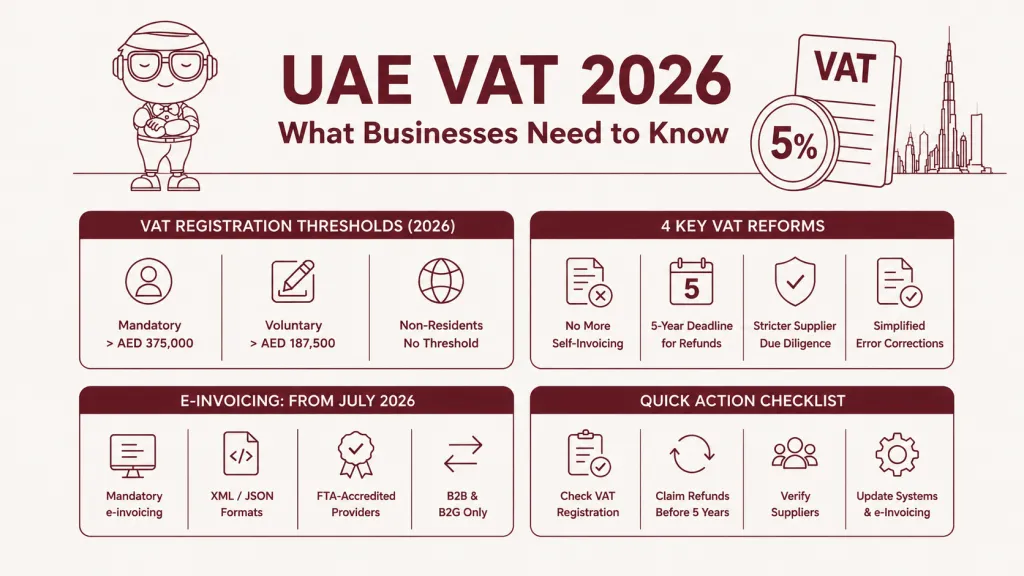

Simplifying VAT Return Filing in the UAE (including changes in 2026 and how to prepare)
VAT has been part of doing business in the UAE since January 1, 2018, and…
The UAE VAT framework is being updated under Federal Decree-Laws No. 16 and 17 of 2025, with most changes taking effect from 1 January 2026. These amendments aim to tighten timelines, clarify procedures, and place greater emphasis on documentation and transaction verification.
For businesses filing VAT returns in 2025 and beyond, understanding what applies before and after 2026 is key to staying compliant and protecting cash flow.
| Area | Before 2026 | From 1 January 2026 | Why it matters |
|---|---|---|---|
| Claiming excess input VAT / refunds | No clearly defined long-stop deadline for claiming excess recoverable VAT in practice, leading many businesses to carry forward balances for extended periods. | Excess recoverable VAT must generally be claimed or used within five years from the end of the relevant reporting period, or the right to claim may lapse. | Delayed reconciliations could now result in lost refunds if claims are not made in time. |
| Reverse charge invoicing | In some reverse-charge scenarios, businesses were required to issue self-invoices to account for VAT. | Taxable persons will no longer be required to generate self-invoices for reverse-charge transactions, provided they retain appropriate supporting documentation. This simplifies compliance. | Less paperwork, but stronger supporting documentation is still required to justify VAT treatment. |
| Input VAT recovery conditions | Input VAT could generally be recovered if invoices and basic conditions were met. | The FTA may deny input VAT recovery where transactions are linked to tax evasion and the business did not take reasonable steps to verify the transaction. | Greater focus on supplier due diligence and transaction substance. |
| VAT audits and limitation periods | Audit and assessment timelines were not always clearly aligned with refund claims and carried-forward balances. | Limitation periods for audits and assessments are more clearly defined to the last 5 years, particularly in relation to VAT refunds and excess credits. Exception to the rule: for example, where a refund claim is filed in the final year of the five-year period, the FTA can extend the audit period to complete the assessment related to that claim (typically within two years of submission) | Better certainty on how far back the FTA can review VAT positions, especially where refunds are involved. |
| Voluntary Disclosure and Limitations | Taxpayers had to use Voluntary Disclosure for many errors, even when those errors had no impact on the tax due. | You no longer need to submit a Voluntary Disclosure for every mistake. In certain cases defined by the tax authority, it will still be required—but smaller or routine errors can now be fixed directly in the tax return. | This streamlines the process, making corrections faster and simpler. |
| Administrative penalties framework | Penalties applied under earlier Cabinet Decisions, with some inconsistencies across tax types. | Updated administrative penalties framework (with some provisions effective in 2026) aligns penalties across VAT and other federal taxes. | Reinforces the importance of timely filing, accurate reporting, and proper records. |
With the last of this year’s reporting approaching, you must plan your 2025 reporting with these in mind:
Thank you!
We've received your request and will get back to you shortly.

Loading...
 Thank you!
We've received your request and will get back to you shortly.


 Contact Us


