
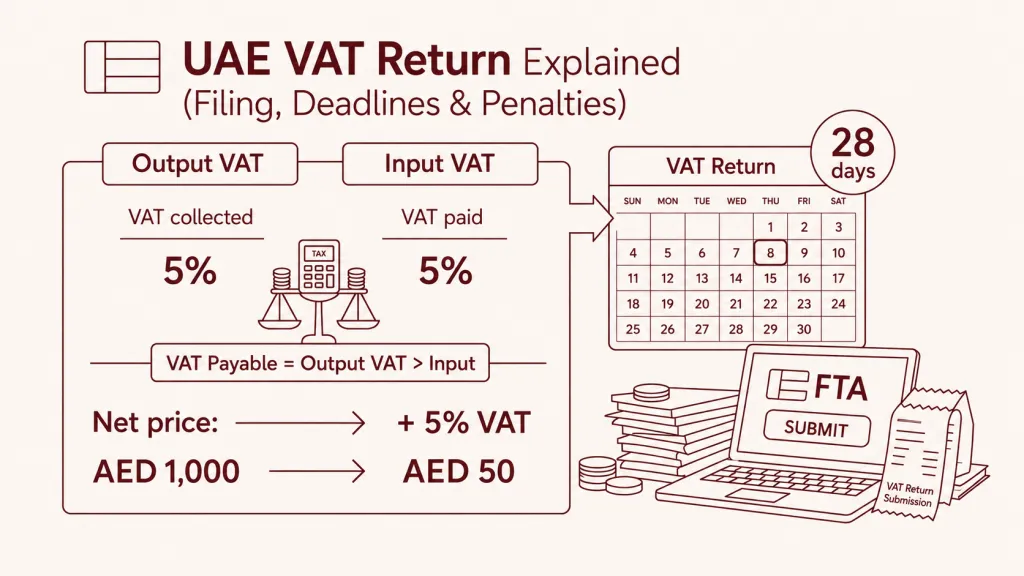

Simplifying VAT Return Filing in the UAE (including changes in 2026 and how to prepare)
VAT has been part of doing business in the UAE since January 1, 2018, and…
A tax period is a specific time frame for which the applicable tax and its transactions shall be calculated and paid.
The standard tax period is defined as three calendar months ending on the specific date determine by the FTA.
The FTA may also, at its own discretion, assign a different tax period other than the standard one, to a certain group of taxpayers (i.e. in some business cases, business owners may be required to file tax returns on a monthly basis.)
| Filing Frequency | Who Qualifies | Deadline example |
| A quarterly tax period covers three calendar months. You file four VAT returns per year. | Most VAT-registered businesses in the UAE Small and medium enterprises (SMEs) Businesses with annual taxable turnover below AED 150 million Quarterly filing is the default unless the FTA assigns otherwise. | If your assigned quarter is: January–March → VAT return due by 28 April April–June → VAT return due by 28 July |
| A monthly tax period covers one calendar month. You file 12 VAT returns per year. | Large or high turnover businesses with annual taxable turnover exceeding AED 150 million Businesses specifically assigned to monthly filing by the FTA due to: -> size of operations -> transaction volume -> compliance considerations | For monthly: January → VAT return due by 28 February February → VAT return due by 28 March |
IMPORTANT NOTES:
Current tax period refers to the period you are reporting on right now. All filing must be for transactions dated during this period and must be prepared accordingly.
Sometimes, you might see instructions for “previous tax period,” which usually refers to the period that ended before the current one. The filing must already be completed and filed promptly.
For example, assuming your VAT reporting periods are quarterly, this is what filing in the second quarter will look like:
| Period | Status |
|---|---|
| Jan–Mar | Previous tax period |
| Apr–Jun | Current tax period (being filed now) |
| Jul–Sep | Next tax period |
This clarification is to make sure that you are not confused and subject to penalties due to avoidable or technical errors.
For VAT, it does not change how often you file returns, but it does affect how your tax periods are grouped and scheduled. The FTA assigns VAT-registered businesses to a stagger (different quarterly cycles) to help spread filing deadlines across the year, avoid system overload, align VAT reviews with financial reporting, and overall help create a predictable compliance cycle.
Example for Quarterly filers:
If your tax year end is 31 December, your VAT periods may look like:
If your tax year end is 31 March, your VAT periods may look like:
NOTE: Planning Tip (amended to 2026 rules)
Because refund claim windows are tightening (5-year limit), ensure your filing schedule lets you reconcile and claim input tax amount well before this window lapses.
Thank you!
We've received your request and will get back to you shortly.

Loading...
 Thank you!
We've received your request and will get back to you shortly.


 Contact Us


