

Simplifying VAT Return Filing in the UAE (including changes in 2026 and how to prepare)
VAT has been part of doing business in the UAE since January 1, 2018, and…
The United Arab Emirates is often listed alongside Switzerland, Monaco, Qatar, and Kuwait as a tax-friendly destination for individuals as well as businesses. Hence, businesses often choose these countries as their regional bases, and individuals migrate here in search of a high standard of living.
That being said, moving to the UAE does not automatically end your tax obligations in another country. Whether you need to make tax payments to your home country depends on the tax laws and residency rules of the relevant jurisdiction.
From a tax authority’s perspective, tracking a taxpayer’s income becomes challenging when they cross international borders. That’s where international tax regulations like the Common Reporting Standard (CRS) for Automatic Exchange of Information (AEOI) and the Foreign Account Tax Compliance Act (FATCA) play a key role. These frameworks set standards for financial data collection and reporting for financial institutions.
A financial data point that must be captured, since it ties everything together, is the taxpayer identification number (TIN).
In this article, we will explore the meaning of TINs in the UAE context, how to obtain TINs, and who needs TINs.
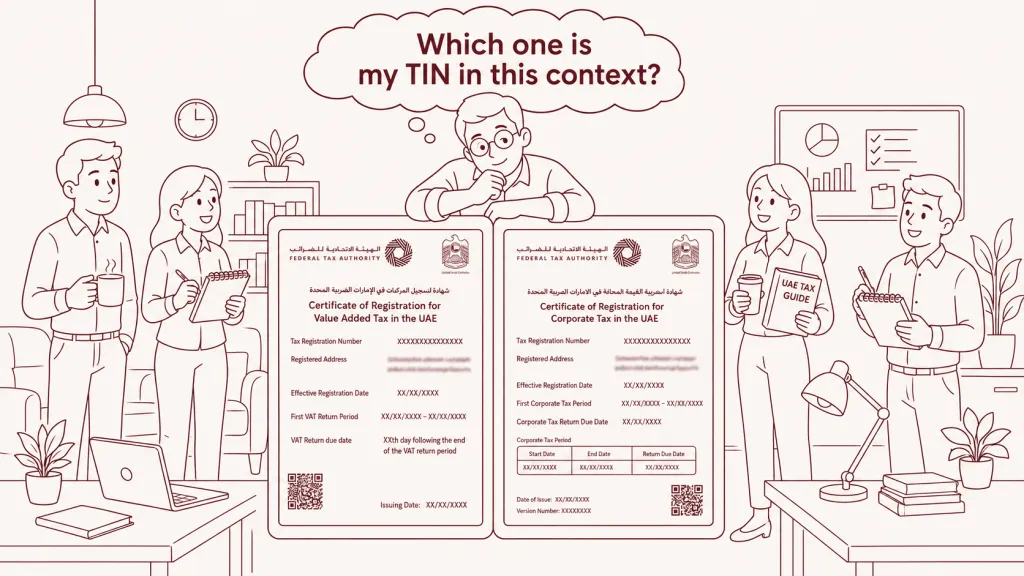
A taxpayer identification number (TIN) is an internationally used term for unique numbers assigned to taxpayers by government agencies. In the UAE, businesses receive Tax Registration Numbers (TRNs) when they register for taxes such as Value Added Tax (VAT), Corporate Tax, or Excise Tax, as applicable.
The UAE does not issue a separate standalone Taxpayer Identification Number, or TIN, in the way some other jurisdictions do. For UAE businesses, the closest practical tax identifier is usually the Tax Registration Number, or TRN, issued by the Federal Tax Authority for Corporate Tax, VAT, or Excise Tax, depending on the business’s registration status and the form being completed.
Under the FATCA framework, reporting financial institutions will also ask for a business’s Employer Identification Number (EIN) where a US taxpayer identification number is relevant. A UAE company normally provides a US EIN only if it has actually obtained one from the IRS. Where a form asks for a foreign taxpayer identification number or local tax registration number, the UAE company may provide its FTA-issued TRN, depending on the context.
You can obtain the relevant Tax Registration Numbers (TRNs) when you register for the applicable taxes with the Federal Tax Authority (FTA) through EmaraTax.
However, in the UAE, there’s no personal income tax. Instead, tax is collected through Corporate Tax and Value Added Tax (VAT) at a company level, and through customs. Hence, the UAE government does not assign individual taxpayer identification numbers (TINs). Where a financial institution requests a TIN, individuals typically state that the UAE does not issue one and may provide an Emirates ID or passport number if requested as an alternative identifier.
Under frameworks like the Common Reporting Standard (CRS), which has been adopted by various jurisdictions, and the Foreign Account Tax Compliance Act (FATCA), a US reporting framework focused on identifying US persons and certain US-owned foreign entities through financial institutions, the collection of TINs and reporting financial activity tied to the TINs of reportable persons is an obligation for reporting financial institutions.
These frameworks are meant to tackle tax evasion through enhanced cross-border reporting. When a company or person crosses international borders, these frameworks help the home country’s tax authority to keep track of the taxpayer’s income and assets. In turn, this increases the accuracy of tax collection.
Taxpayer identification numbers (TINs) and tax registration numbers (TRNs) are not the same. A TRN is a 15-digit number issued by the Federal Tax Authority (FTA) when you register for VAT, which is compulsory if your taxable supplies exceed AED 375,000 over the previous 12 months, or are expected to exceed that threshold within the next 30 days. The Federal Tax Authority also issues tax registration numbers for Corporate Tax and Excise Tax registrations.
TIN is an internationally used umbrella term for tax IDs.
In practice, when a foreign authority, bank, or financial institution asks a UAE business for its taxpayer identification number, the business will usually provide the relevant Tax Registration Number (TRN) issued by the Federal Tax Authority. Depending on the context, this may be a Corporate Tax TRN, VAT TRN, or Excise Tax TRN.
When a reporting financial institution requests a taxpayer identification number for CRS due diligence procedures, UAE businesses generally provide the FTA-issued TRN requested or appropriate for the form. Individuals generally state that the UAE does not issue personal TINs and may provide an Emirates ID or passport number as an alternative identifier if requested.
If your business operates across multiple tax jurisdictions, banks and financial institutions may require taxpayer identification numbers as part of cross-border tax reporting and due diligence requirements. Banks and financial institutions may ask you to provide taxpayer identification details during onboarding, account opening, or CRS/FATCA due diligence.
At such a stage, you should provide the relevant FTA-issued TRN if the institution asks for a foreign taxpayer identification number or local tax registration number. If the form specifically asks for a US Employer Identification Number (EIN), you should only provide one if your company has actually obtained an EIN from the US Internal Revenue Service (IRS).
As for individual taxpayers, you will be subject to cross-border reporting if you are a foreign citizen residing in the UAE. However, the UAE generally does not issue personal TINs. If a foreign financial institution requests a TIN, individuals will typically state that the UAE does not issue one and may provide their Emirates ID or passport number if requested as an alternative identifier.
It is worth noting that natural persons conducting business or business activities in the UAE may be required to register for Corporate Tax if their annual business turnover exceeds AED 1 million. Employment income, personal investment income, and personal real estate investment income are generally excluded from this threshold.
As a business operating in the UAE, you may need to obtain one or more Tax Registration Numbers (TRNs) from the Federal Tax Authority depending on the taxes for which you are required to register. These TRNs are commonly used when foreign institutions request a taxpayer identification number or local tax registration number. Below is how you can obtain the relevant registrations.
Here’s how you should go about your Corporate Tax registration process.
How much time do you have until the Corporate Tax registration deadline? We go over the registration deadlines for foreign businesses and application best practices in our article on Corporate Tax registration.
Here’s a step-by-step breakdown of the VAT registration process:
Did you know that, during VAT registration, you need to provide a sample of signed and stamped sales tax invoices? We go over the mandatory documents for VAT registration and other key related considerations like the VAT registration thresholds in our article on VAT registration.
VAT-registered businesses must file VAT returns on a quarterly or monthly basis in addition to the Corporate Tax returns that must be filed annually. For small operations, this tax reporting burden can be overwhelming, not just because of the frequency of VAT filings but also because of how detailed your financial records have to be. VAT regulations require you to go over all your tax invoices and calculate recoverable input VAT for every return you file. This is completely different than preparing financial statements annually and simply declaring your income for Corporate Tax filings. That being said, being VAT registered allows you to recover VAT paid to produce taxable supplies. Hence, before applying for voluntary registration, you should weigh the benefits of reclaiming VAT versus the VAT compliance burden.
Some foreign financial institutions may request evidence of your taxpayer identification number. VAT and Corporate Tax Registration Certificates can be downloaded online. These tax-related documents will include your TRN, legal name, and registration date.
In some cases, you may be asked for a Tax Residency Certificate (TRC), which is connected to your Corporate Tax registration but different from your Corporate Tax Registration Certificate.
We have already discussed how to register for Corporate Tax and get your Registration Certificate earlier in the article. Let’s discuss how to get a Tax Residency Certificate.
Confused about how Tax Residency Certificates (TRCs) can be renewed? We answer all such queries in our article on how to apply for a TRC.
Here are some of the common mistakes that you must avoid as far as TINs are concerned:
The UAE does not issue a separate standalone Taxpayer identification number (TIN). Instead, businesses receive Tax Registration Numbers (TRNs) from the Federal Tax Authority when they register for taxes such as Corporate Tax, VAT, or Excise Tax. When a foreign authority or financial institution requests a taxpayer identification number or local tax registration number, UAE businesses generally provide the relevant FTA-issued TRN depending on the context. Individuals generally state that the UAE does not issue personal TINs and may provide an Emirates ID or passport number if requested as an alternative identifier.
As a foreign business expanding operations into the UAE, you should complete the tax registrations that apply to your circumstances. Corporate Tax registration and, where applicable, VAT registration will provide the relevant TRNs needed for tax compliance and for dealing with banks, payment platforms, and foreign counterparties.
At Skrooge, we help businesses register for VAT and Corporate Tax and also provide accounting and tax reporting support post-registration. Consider going through our accounting and tax package details to judge whether we’re the right partner for getting started in the UAE.
The UAE does not issue a separate standalone Taxpayer Identification Number (TIN). When you register for the relevant taxes (Corporate Tax, Value Added Tax, and/or Excise Tax), you will receive Tax Registration Numbers (TRNs). When asked for a TIN, you must generally provide the relevant FTA-issued TRN. Individual taxpayers, on the other hand, must generally state that the UAE does not issue personal TINs and, if requested, may provide an Emirates ID or passport number.
TIN is an internationally used term for unique numbers assigned to identify taxpayers. TRN is a specific tax registration number issued by the UAE Federal Tax Authority. Although UAE businesses commonly use the relevant TRN when a foreign institution requests a taxpayer identification number, the two terms are not technically the same.
The government doesn’t assign TINs to individuals. If asked for a TIN, you should normally state that the UAE does not issue one and provide an Emirates ID or passport number only if the institution requests an alternative identifier.
TIN is a term used internationally for unique numbers assigned to taxpayers. A TRN is the identifier issued by the UAE Federal Tax Authority when a business registers for taxes such as Corporate Tax, VAT, or Excise Tax. Since the UAE does not issue standalone TINs, businesses commonly use the relevant FTA-issued TRN when a foreign authority or institution requests a taxpayer identification number.
The UAE does not issue a separate TIN certificate. Businesses can provide their VAT Registration Certificate or Corporate Tax Registration Certificate, depending on the context, as evidence of their FTA-issued TRN. Where proof of UAE tax residency is required, businesses may instead need to obtain a Tax Residency Certificate (TRC).
Thank you!
We've received your request and will get back to you shortly.

Loading...
 Thank you!
We've received your request and will get back to you shortly.


 Contact Us


