

Simplifying VAT Return Filing in the UAE (including changes in 2026 and how to prepare)
VAT has been part of doing business in the UAE since January 1, 2018, and…
In this article, we highlight why founders should understand Tax Residency Certificates in the UAE and what it can do for taxpayers looking to setup businesses internationally.
Understanding TRCs also helps founders structure records properly, particularly their accounting records, management reports, operational capabilities and efficiencies, and other supporting documents that support application or treaty review.
A tax residency certificate in the UAE is especially relevant when foreign clients withhold taxes overseas. This is common during international expansion, opening of overseas bank accounts, investor due diligence and cross-border service contracts.
Most founders postpone a TRC application, but it usually becomes relevant earlier than many founders expect. For UAE companies, an official document supporting tax residency can support banking relationships, audit readiness, international credibility, and certain cross-border tax documentation requirements.
A Tax Residency Certificate (TRC) is an official document issued by the UAE Federal Tax Authority (FTA) confirming that a natural person or juridical person is treated as a UAE tax resident for a selected tax period or another 12-month period.
Note
Previously, the Tax Residency certificate was referred to as the Tax Domicile Certificate. Details about getting a tax residency and conditions for individuals and juridical persons can be found in the UAE’s Cabinet Decision No. 85 of 2022.
Applying for visa residency and tax residency must be done separately. A TRC may be requested for Double Taxation Agreement purposes or for other purposes where evidence of UAE tax residency is required.
A TRC is issued for the selected tax period or another 12-month period. It cannot cover a future period that has not yet started, or a period longer than 12 months. A new application is required for each new period.
The application process for a Tax Residency Certificate (TRC) in the UAE is fully digital and can be completed online through the EmaraTax portal managed by the Federal Tax Authority. The TRC is available for natural persons/ registered individuals and legal persons/companies
To apply for a TRC, individuals must provide proof of residency, such as tenancy agreements or utility bills. For natural persons, UAE tax residency may be established through different tests. A person may qualify if they are physically present in the UAE for 183 days or more in a relevant continuous 12-month period. Some individuals may also qualify under a 90-day test if they have a legal right to reside in the UAE and either a permanent place of residence or employment/business in the UAE.
Companies must maintain a valid trade license and active business operations in the UAE to be eligible for a TRC.
A UAE Tax Residency Certificate (TRC) enables businesses to leverage over 140 Double Taxation Avoidance Agreements (DTAAs) to reduce or eliminate withholding taxes on foreign income.
The primary implication of obtaining a TRC is the ability to claim treaty benefits under the UAE’s extensive double tax treaty network, which can include reduced withholding tax rates or exemptions from taxation in another jurisdiction.
Without a valid Tax Residency Certificate, foreign tax authorities may deny treaty benefits, even if the company is incorporated in the UAE.
The TRC, as a result, helps establish a company’s tax jurisdiction and supports compliance with regulations related to international financial operations.
The Ministry of Finance (MoF) oversees the UAE’s broader tax framework and liaises on international tax policies with other countries.
The Federal Tax Authority (FTA) is the main operational tax authority in the UAE. They administer and enforce UAE tax rules, including issuing TRCs.
The Organisation for Economic Co-operation and Development (OECD) is the global organization that develops international tax standards. They influence how UAE tax residency and treaty rules are structured.
These organizations work together as the government entity and foreign authorities behind the tax treaty framework.
A UAE TRC covers a selected tax period or another 12-month period. The certificate cannot cover future tax periods that have not yet started or future periods exceeding 12 months.
Additionally, if your requested period is between January to December 2026, you can already apply around April 2026 onward (3 months into the period) or after the whole period (i.e. the year 2026 ends).
A juridical person must generally be incorporated or established for at least 12 months before applying for a TRC.
As a general rule, residency is determined and tied to:
The stronger your business presence and supporting documents in the UAE, the stronger your tax residency position is likely to be.
Note for individuals applying for a TRC
While a UAE Tax Residency Certificate covers a 12-month period, some natural persons may still qualify for UAE tax residency under the 90-day presence rule if additional residency and economic connection conditions are met.
Certificates issued based on 90 days of presence are often limited to domestic purposes and may not always be accepted by foreign tax authorities for treaty claims.
The business may then elect to apply during the selected period or after the period ends, depending on the applicant type. All supporting forms and documents must match that same period.
Note
A Corporate Tax Group is not an incorporated, established or otherwise recognized entity. It cannot be regarded as a UAE Tax Resident (and no discounted fees shall apply under the use of the tax group credentials).
Members of the group shall be able to apply individually for the issuance of a Tax Residency Certificate, subject to meeting the requirements and conditions.
Both mainland and free zone companies can apply for a TRC provided that they satisfy the residency and documentation requirements.
Foreign tax authorities can assess whether the company can claim treaty benefits regardless of issuance of a TRC. Residency determination may consider whether the entity is truly conducting its business activities from the UAE.
Therefore, simply being a free zone company does not guarantee your tax residency status.
You can use the following checklist when applying:
| Type of Registration | Documents required |
|---|---|
| For legal persons: | ✔️ Trade license ✔️ Valid passport / Emirates ID of authorized signatory ✔️ UAE visa or immigration documents ✔️ Audited financial statements (where applicable) ✔️ Banking statements ✔️ Proof of address ✔️ Lease agreement or tenancy contract ✔️ Memorandum / incorporation documents ✔️ Proof of effective management and control in the UAE (where applicable) |
| For natural persons: | ✔️ Valid passport ✔️ Emirates ID ✔️ UAE residence visa copy ✔️ Proof of residential address and certified tenancy contract ✔️ Source of income evidence and financial records ✔️ UAE Banking statements |
Documents must be in pdf or jpeg format.
An entry and exit report is an immigration record showing when a person entered the UAE, when they left, and the total number of days physically spent in the country. It is commonly used as supporting evidence during TRC application for natural persons.
The report helps verify physical presence and travel history. It does not, by itself, prove that the individual’s centre of financial and personal interests is in the UAE; that may require separate evidence such as residence documents, income evidence, UAE bank records, or a written statement with supporting documents.
To apply for a Tax Residency Certificate, businesses must define the certificate’s purpose and select the financial period for which the certificate is requested.
The FTA states very clearly in the terms and conditions that applicants must meet eligibility requirements before applying.
Issuance of the TRC is subject to certain fees based on the Cabinet Decision No. 65 of 2020 on the Fees for the Services Provided by the FTA.
The cost of a Tax Residency Certificate in the UAE varies depending on the company’s tax registration status and whether a hard copy of the certificate is requested.
The applicable fees are as follows, and shall not be refundable in case of rejection of the Application:
| Purpose | Amount in AED | Baseline or optional fees? |
|---|---|---|
| Submission Fee | AED 50 | ✔️ Required |
| Fees for each hard copy certificate requested | AED 250 | 🅇 Optional |
| Review of the application and issuance of an electronic TRC→ for Tax Registrants with a CT TRN | AED 500 | ✔️ Required based on profile |
| Review of the application and issuance of an electronic TRC → for Natural persons without a CT TRN | AED 1,000 | ✔️ Required based on profile |
| Review of the application and issuance of an electronic TRC → for Juridical persons without a CT TRN | AED 1,750 | ✔️ Required based on profile |
The FTA takes about 5 business days to review the application after submission.
For applicants requiring a hard copy or applicants with an International form requiring FTA attestation, it takes around 5 business days from the date the completed form is received and relevant fees have been paid.
If the International Form is not submitted or the required fee is not paid within 30 business days, the request will not be processed. The applicant will then need to submit a new application and pay the fees again.
A Tax Residency Certificate must be reapplied for each subsequent financial year, as it does not automatically renew beyond the selected year.
Renewal applications are processed through the EmaraTax platform. Applicants need to resubmit updated supporting documents and pay the applicable fees again.
The FTA may then reassess whether the applicant still meets the residency requirements for the new period being requested.
For companies and registered taxpayers, maintaining proper compliance records may help support TRC applications and renewals.
The FTA can stamp an international tax form required by foreign jurisdictions. The form must:
This often matters when founders claim treaty benefits overseas, respond to foreign tax authority requests, or reduce withholding taxes abroad.
A Tax Residency Certificate (TRC) for DTAA purposes will be issued based on Ministerial Decision No. 247 of 2023 on the “Issuance of Tax Residency Certificate for the Purposes of International Agreements.”
The TRC serves as proof that the bearer is a resident of the UAE for tax purposes and is essential for claiming benefits under the UAE’s extensive network of Double Taxation Avoidance Agreements (DTAAs).
The UAE has an extensive Double Taxation Agreement network, negotiated through the Ministry of Finance, covering many major trading partners. Businesses should check the latest MoF treaty list before relying on a specific country or treaty position.
Holders of a Tax Residency Certificate can enjoy reduced withholding taxes on dividends, interest, royalties, and other income types as per the relevant DTAA provisions.
The UAE’s Double Taxation Avoidance Agreement are bilateral tax treaties signed with other countries to help reduce the risk of the same income being taxed twice.
These agreements are designed to support cross-border trade and investment, as well as international business activities in coordination with tax avoidance prevention mechanisms between certain jurisdictions.
The UAE has an extensive DTAA network negotiated through the Ministry of Finance, with many treaty principles influenced by international standards developed by the OECD.
A TRC does not automatically eliminate taxes abroad. A UAE-issued TRC can be used to support treaty claims under the Double Taxation Agreement.
Foreign tax authorities may request a UAE TRC to confirm that:
This is beneficial for individuals and companies to align their financial and personal interests as they expand their operations.
TRC applications and international form attestations can be delayed or rejected if the supporting documents and application details do not match.
Knowing these typical issues beforehand can help businesses avoid unnecessary resubmissions and processing delays with the FTA.
For example, if a free zone entity applies for a TRC, the supporting documents, international forms, and treaty claims should generally align with:
Mismatch between documents may lead to delays, clarification requests, or rejection of related treaty documentation.
If a TRC-related request is rejected, applicants may need to:
The request may not be processed and a new application is required.
Good record keeping and organized documents can significantly reduce TRC processing issues and resubmission delays.
In the case of UAE, both documents refer to the same thing.
The UAE Federal Tax Authority officially renamed the Tax Domicile Certificate to the Tax Residency Certificate (TRC). Both terms refer to the official government document used to prove tax residency when claiming benefits under Double Taxation Avoidance Agreements (DTAAs).
Typically, processing to get a Tax Residency Certificate in the UAE takes around 5 business days, provided the documentation is complete and consistent.
For those requesting printed certificates or international form attestation from the FTA, the TRC may be processed around 5 business days after payment has been completed.
Common documents for individuals may include:
✔️ Emirates ID for UAE citizens
✔️ Passport copy and UAE residence visa
✔️ Entry and exit report
✔️ Salary certificate or proof of income
✔️ Banking statements
✔️ Lease agreements or title deed as proof of residence
✔️ Tax Registration number (if applicable)
Common documents for companies may include:
✔️ Trade license
✔️ Memorandum or incorporation documents
✔️ Audited financial statements (where applicable)
✔️ Lease or tenancy contract
✔️ UAE banking statements
✔️ Passport and Emirates ID of authorized personnel to sign
✔️ Corporate Tax TRN (if applicable)
The government fee for TRC is as follows, depending on the nature of the applicant:
→ Submission Fee (automatic) : AED 50
→ Fees for each printed copy if requested: AED 250
→ Review of the application and issuance of an electronic TRC to a Registrant with the FTA for Tax Registrants with a CT TRN : AED 500
→ Review of the application and issuance of an electronic TRC for individuals without a CT TRN : AED 1,000
→ Review of the application and issuance of an electronic TRC for Juridical persons without a CT TRN : AED 1,750
The UAE has DTAA agreements to avoid double taxation on cross-border income and support international trade and investment.
The UAE’s DTAA network includes countries across:
Europe
Asia
Africa
the Americas
the Middle East
Examples include:
India
United Kingdom
France
Germany
Singapore
China
Saudi Arabia
South Africa
Canada
Turkey
Philippines
Pakistan
Netherlands
Switzerland
Luxembourg
You can find more details about the DTAA in the official Ministry of Finance website.
Yes. A TRC is issued for the selected tax period or another 12-month period. It cannot be issued for a future period that has not yet started, or for a period longer than 12 months.
The TRC is not subject to automatic renewal by the FTA. To maintain continuous tax residency documentation, businesses must meet the eligibility requirements.
The renewal process for a Tax Residency Certificate is the same as the initial application process, requiring updated documentation.
Note that a TRC cannot be issued for a future period that has not yet started.
If a TRC application is rejected, the applicant must review the reason for rejection and identify any missing, inconsistent, or incorrect information in the submission.
For international form attestation requests, the FTA may require a completely new application if:
→ The required documents were not submitted on time, or
→ The applicable fees were not paid within the required period.
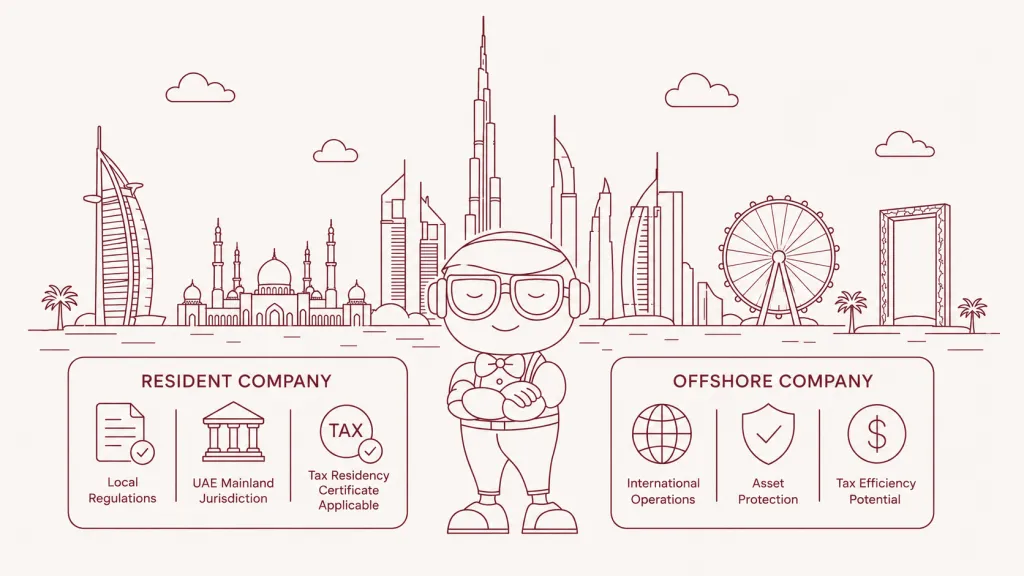
Offshore companies registered under certain jurisdictions are generally not eligible for a TRC and must apply for a Tax Exemption Certificate instead.
Thank you!
We've received your request and will get back to you shortly.

Loading...
 Thank you!
We've received your request and will get back to you shortly.




 Contact Us


