

Simplifying VAT Return Filing in the UAE (including changes in 2026 and how to prepare)
VAT has been part of doing business in the UAE since January 1, 2018, and…
It helps to understand that corporate tax is a direct tax levied on the net profit of companies covered by Federal Decree-Law No. 47 of 2022. The Federal Tax Authority (FTA) oversees the administration, collection and enforcement of federal corporate tax law in UAE.
Compared to VAT, which is an indirect tax on consumption, Corporate Tax determines a business’s corporate tax liability based on its taxable income.
Resident persons are generally taxed on their worldwide taxable income, while certain non-resident companies engaged in business in the UAE may be taxed on UAE sourced income or income attributable to a permanent establishment in the UAE.
This framework also applies to certain sectors, including foreign banks. Businesses should also monitor fiscal letters and other guidance issued by the FTA, as these may clarify how the law applies in practice or explain specific criteria for certain tax treatments.
Note
Navigating the UAE’s complicated corporate tax structure as a first-time founder doesn’t have to be stressful. We outline the whole process of calculating your corporate tax liabilities including some helpful examples for freelancers, mainland-based startups, and free zone companies.
Generally, new businesses operating in the UAE are required to register within 3 months of incorporation. For businesses already established before 1 March 2024 (including controlled UAE subsidiaries), registration deadlines are determined by the month the trade license was issued.
Natural persons conducting business in the UAE are required to register before 31 March of the following calendar year once their total annual turnover from business activities for the current financial year exceeds AED 1 million.
Resident taxable persons and non-resident juridical persons are required to file for their corporate tax returns in every tax period, regardless if they have no taxes owed.
Most businesses begin preparing their corporate tax return using the net profit (or loss) reported in their financial statements.
Accounting income (also called accounting profit, net income, or net profit) is derived from your business activities, and measures how profitable the business was during a financial period. Profit includes all recognized revenue and expenses calculated using accepted accounting standards (e.g. International Financial Reporting Standards or IFRS).
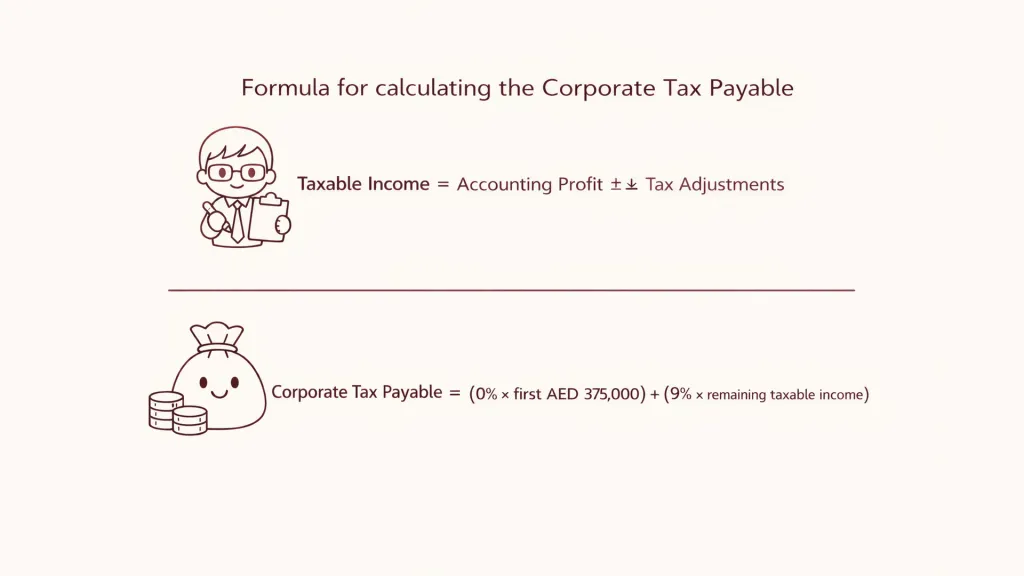
Taxable income is the amount that is multiplied to the appropriate tax rates. Before arriving at taxable income, businesses must make various tax adjustments required under the UAE Corporate Tax Law.
These adjustments include:
Understanding these adjustments explain why the taxable income reported often differs from the profit shown in audited financial records.
Not everyone calculates taxable income in the same way. For example:
| Category or Provisions | Exempt Income? | Notes |
|---|---|---|
| Dividends from UAE resident companies | ✅ Yes | If a UAE holding company owns shares in another UAE company, and it received AED 2 million in dividends -> considered as exempt income |
| Profit distributions from UAE resident companies | ✅ Yes | |
| Participation exemption (qualifying shares/interests) | ✅ Yes | Includes: – capital gains on disposal of shares – impairment gains – foreign exchange gains relating to the participation – certain other gains connected with the ownership interest The exemption is intended to avoid taxing the same corporate profits multiple times across a group |
| Foreign Permanent Establishment income (on election) | ✅ Yes | A UAE Resident Person may elect to exclude the income of a qualifying foreign branch from UAE taxable income. If the election is made, the following are excluded: profits of the foreign PE related expenses losses of that foreign PE foreign tax credits relating to that PE Important: This is an election, not an automatic exemption. |
| Non-resident aircraft/ship international transport income | ✅ Yes | It generally applies where: – the non-resident operates ships or aircraft in international transport – reciprocity and other statutory conditions are satisfied This exemption is unlikely to affect most SMEs, but it is still one of the four exempt income provisions contained in Chapter Seven. |
| Qualifying Free Zone Income | ❌ No | Subject to a 0% tax rate. Non qualifying income must meet de minimis rule to be elect for Qualifying Free Zone Person (QFZP) status Not treated as exempt income |
| Small Business Relief | ❌ No | Relief; does not qualify as exempt income As of publishing this is only available until 31 December 2026 |
| Tax losses | ❌ No | Deduction mechanism for future taxable income under tax loss carry-forward |
| Group Relief or Business Restructuring Relief | ❌ No | Tax relief on qualifying transfers or reorganizations for corporate tax groups. They or remove certain tax consequences but are not classified as exempt income. |
Remember that the formula is:
Accounting Profit ± Corporate Tax Adjustments = Taxable Income
But what exactly is allowed in practice?
Taxable persons are typically subject to 9% tax rate for taxable income exceeding AED 375,000. For example:
For large multinational enterprise (MNE) groups, the UAE has introduced a Domestic Minimum Top-up Tax (DMTT) that aligns with the OECD Pillar Two framework. The regime ensures that qualifying multinational groups are subject to a minimum effective tax rate of 15% on their UAE profits, provided they meet the applicable threshold for consolidated global revenues.
When calculating revenue and expenses arising from transactions with Related Parties or Connected Persons, ensure they comply with the UAE’s transfer pricing rules, including the arm’s length principle. These transactions must be supported by the right documentation since it can affect your taxable income.
Businesses can deduct expenses that are incurred wholly and exclusively for business purposes. Expenses must be supported by proper accounting records and documentation.
If an expense has both business and personal purposes, only the business portion may be deductible using a fair and reasonable allocation.
A tax loss arises when allowable deductions exceed taxable income for a tax period. A tax loss is different from an accounting loss. The tax loss is calculated after applying the necessary adjustments.
Eligible tax losses may be carried forward to offset future taxable income, subject to conditions on rules of ownership and business continuity. A tax loss relief is capped at 75% of taxable income in the future period.
A tax loss does not reduce accounting profit. It can only be used to reduce future taxable income.
Free zone entities are generally required to register and file corporate tax. Certain Free Zone Persons may qualify as Qualifying Free Zone Persons (QFZPs) if they satisfy all prescribed conditions. QFZPs are generally required to maintain audited financial statements as part of the qualifying conditions.
Important
Qualifying free zone persons are not automatically exempt from UAE corporate tax.
Similarly, electing for QFZP would automatically disqualify you from Small Business Relief (SBR). Businesses that elect Small Business Relief are disqualified from QFZP treatment for the relevant tax period and the following four tax periods.
A QFZP is a free zone entity that satisfies all conditions, including maintaining adequate substance requirements, earning qualifying and non-qualifying income within the de minimis threshold, and meeting transfer pricing documentation and filing requirements.
QFZPs can only benefit from the 0% tax rate on the qualifying income. Non-qualifying income is still taxed at 9%. It is best practice for businesses to actively track qualifying and non-qualifying income throughout the year.
Failure to meet the qualifying conditions immediately disqualifies your business for the current and next four taxable periods.
A tax group is treated as a single taxable person. The parent company is responsible for corporate tax obligations for the member firms, including filing one corporate tax return for the whole tax group.
Intra-group transactions may receive specific tax treatment to prevent double taxation.
A Voluntary Disclosure allows taxpayers to notify the FTA of errors or omissions in previously submitted tax returns, tax assessments, or refund applications within the UAE corporate tax regime.
Businesses need to maintain sufficient records and supporting documentation for at least 7 years in accordance with record-keeping requirements.
If this is your first tax period navigating UAE’s corporate landscape, it helps to have professionals who can advise your tax strategy. Simply reach out to us and our expert team will get back to you.
Thank you!
We've received your request and will get back to you shortly.

Loading...
 Thank you!
We've received your request and will get back to you shortly.




 Contact Us


