

Company Registration Number (CRN) in the UAE: What It Is and Where to Find It
Banks, suppliers, and customers may request your Company Registration Number (CRN) or trade license number…
When people think about corporate tax planning, they often assume it means setting aside enough money to pay their taxes at the end of the year, or worse, finding ways to avoid paying them altogether.
Many founders also assume there is little to plan for when the corporate tax rate is a straightforward 9%. But knowing your tax rate is not the same as knowing how to manage your tax liability.
The difference between a well-managed financial year and a poorly managed one can affect a business’s tax liability, cash flow and ability to reinvest in growth.
In short, this guide is especially relevant to UAE SMEs, from businesses with taxable income near the AED 375,000 threshold to those generating a few tens of millions in annual revenue.
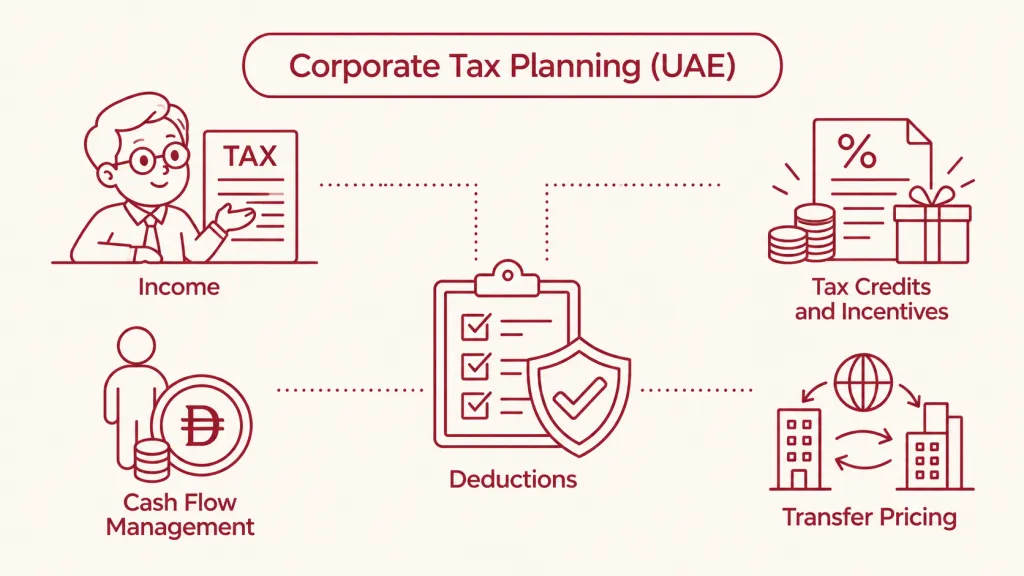
This guide explores five practical corporate tax planning levers, from Small Business Relief and free zone structures to deductible expenses, tax losses and transfer pricing, to help you understand which strategies may apply to your business.
Corporate tax planning is about making informed decisions to maximize available tax benefits and make use of available elections within the UAE Corporate Tax Law. Businesses are responsible for determining and applying the correct tax treatment and managing the resulting tax liabilities.
Lawful planning uses available deductions, exemptions, reliefs and elections while meeting UAE regulations. Businesses involved in tax planning can improve their cash flow and allow for reinvestment.
Tax avoidance is arranging transactions or business structures to obtain a tax advantage in ways that may conflict with the purpose of the law.
Under the UAE’s General Anti-Abuse Rule (GAAR), the FTA can challenge arrangements that meet the conditions for an abusive tax advantage.
Tax evasion means deliberately concealing taxable transactions, misrepresenting financial information, or submitting knowingly inaccurate tax returns to evade tax. These are not legitimate tax planning strategies and may result in penalties or other consequences under UAE law. Tax compliance is necessary to avoid penalties and maintain good standing with tax authorities.
Timely submission of tax returns is essential for compliance.
Note
Moving everything to a free zone is not a good tax plan as it does not automatically reduce your corporate tax liability.
The 0% rate applies to qualifying income earned by a qualifying free zone person (QFZP) that meets the relevant conditions. Business structure should follow genuine commercial needs, not just the expectation of paying less tax.
The corporate tax rate for taxable persons under CT Law depends on the taxable income. Taxable income up to AED 375,000 is taxed at 0%, and taxable income above that amount is taxed at 9%.
(Note that taxable income is not the same as accounting profit or total revenue.)
An eligible UAE tax-resident person may elect to be treated as having no taxable income for a tax period if revenue is no more than AED 3 million in that period and in every previous tax period, subject to the applicable rules. The election must be made for each tax period through the tax return. It is not applied automatically.
Under Ministerial Decision No. 131 of 2026, the Ministry of Finance announced an extension to tax periods ending on or before 31 December 2029, subject to applicable conditions.
SBR means the taxpayer is treated as having no taxable income for that period, but certain deductions, other reliefs and tax-loss provisions are unavailable for that period.
Electing for Small Business Relief is a business choice within a specific deadline.
Monitor revenue as the financial year progresses, especially when approaching AED 3 million. Revenue forecasts are useful for operational planning, but do not assume that delaying an invoice or shifting a transaction automatically changes the legal period in which the revenue belongs.
Your business structure can affect how UAE corporate tax applies, but choosing the right setup involves more than comparing tax rates. Consider your activities, where your income comes from, how your entities operate, and the cost of maintaining the structure.
The goal is to choose a structure that supports your business and meets the relevant tax requirements, without adding unnecessary complexity or compliance costs.
To calculate your business’s taxable income, start with accounting profit and adjust it for the items required under UAE corporate tax rules.
Before calculating taxable income, review adjustments for exempt income, tax losses, reliefs and non-deductible expenses. The goal is to identify potential deductions without claiming expenses that do not qualify under UAE tax rules.
Review your ledger to identify potential deductions and account for non-deductible expenses before calculating taxable income under UAE corporate tax rules.
Here are some expenses you may have overlooked:
Keep invoices and supporting documents for claimed deductions.
Charitable donations may qualify as deductible expenses under UAE Corporate Tax, but the treatment depends on who receives the contribution and how the payment is structured.
Businesses may deduct donations made to entities listed under the applicable Cabinet Decision, provided the relevant corporate tax requirements are met. Donations to other organisations do not automatically qualify for this specific deduction.
A genuine sponsorship involving advertising, marketing or other commercial benefits may be treated as a business expense rather than a charitable donation, subject to the applicable deductibility requirements.
Cash donations are generally outside the scope of VAT. However, donating goods or inventory may trigger deemed-supply rules, depending on the circumstances.
Timing plays a role in effective tax planning. Your financial year, accounting method and treatment of losses can all affect your UAE corporate tax position.
For one, your tax period generally follows your financial year. Choosing a year-end should account for your business cycle and reporting needs, not simply an expectation of lower taxes.
Accrual accounting is the default, although eligible businesses may use the cash basis where permitted. This option is available for businesses with revenue not exceeding AED 3 million.
Additionally, revenue and expenses must be recognized according to the applicable accounting standards rather than shifting transactions between periods solely to change the tax outcome.
If your business has a difficult financial year, eligible tax losses can generally be carried forward to offset future taxable income. For small businesses, a bad year is still worth documenting properly. An accounting loss does not automatically qualify as a tax loss.
The amount used is generally limited to 75% of taxable income in the relevant period. Losses cannot be carried back to previous tax periods, and ownership-continuity or business-continuity conditions may apply.
Before year-end, forecast profits, review available losses and assess whether Small Business Relief is appropriate. Businesses electing for this relief cannot claim tax loss relief for that period, so consider the implications before making the election.
Understanding the rules for carrying losses forward can help you plan ahead rather than leaving eligible relief unused.
When your business transacts with related parties, the prices you charge and pay must reflect the arm’s-length principle. In practice, this means setting prices as if the parties were independent businesses operating under comparable circumstances.
Common examples of related party transactions include management fees between group companies, loans between a business and its owner, payments to directors or relatives, and shared costs for employees, office space or intellectual property.
These transactions should have a clear commercial purpose, fair pricing and supporting documentation. Payments to connected persons are deductible only to the extent that they meet the relevant market-value and business-purpose requirements.
Transfer pricing rules can also apply to domestic transactions, not just cross-border arrangements. Businesses operating across mainland and free zone entities should not assume that transactions within the UAE are automatically exempt from these requirements.
Note
Transfer pricing documentation is part of tax planning.
Businesses should retain contracts, invoices and other appropriate evidence of services provided, together with records explaining how prices were determined and why the transactions make commercial sense.
Make sure to document this as the transaction happens, and not as an afterthought.
Corporate tax returns and payment are generally due within nine months of the end of the relevant tax period. For example, a company with a 31 December 2025 year-end generally had a deadline of 30 September 2026.
The FTA has stated that relevant records must generally be retained for at least seven years after the end of the tax period.
| Period | Planning actions within the tax year | Why it matters |
|---|---|---|
| Q1: Start of financial year | Confirm the financial year, tax registration details, business structure and likely eligibility for SBR or QFZP treatment. Review relevant elections and prior-year losses. | Elections and eligibility can affect the tax treatment of the entire period. |
| Q2: Mid-year review | Reconcile the ledger, check supporting documents, review owner payments and related-party transactions, and update the profit forecast. | Identifies missing evidence and potential tax adjustments before year-end. |
| Q3: Forecast and review | Reassess revenue against the SBR threshold, estimate taxable income, review interest deductions and track potential R&D incentive eligibility. | Gives the business time to make informed operational decisions and reserve cash. |
| Q4: Year-end preparation | Review accruals, fixed assets, provisions, expected losses, related-party balances and financial statements. Confirm that transactions are recorded in the correct period. | Reduces the risk of unsupported deductions, incomplete records and avoidable adjustments. |
| After year-end | Finalise accounts, calculate taxable income, verify reliefs and elections, prepare the return, and arrange payment. | Creates a clear audit trail and helps meet the filing deadline. |
Accounting software and document-management workflows can help categorize transactions, reconcile accounts, flag missing evidence and track deadlines.
Digital tools can support the process but do not replace the need for correct tax treatment and professional review.
Skrooge combines AI-assisted accounting workflows with experienced accountant review to help businesses assess their corporate tax position, review business structures and free zone eligibility, evaluate transactions, and maintain supporting documentation.
Whether you’re evaluating your business structure, reviewing free zone eligibility or assessing the tax treatment of related-party transactions, our corporate tax advisory services also can help you make informed decisions and maintain compliance with UAE tax requirements.
A tax-saving strategy can create problems when it relies on artificial arrangements rather than genuine business activity. The UAE’s General Anti-Abuse Rule allows the Federal Tax Authority (FTA) to challenge arrangements where the applicable legal conditions for an abusive tax advantage are met.
Red flags include:
Accurate and timely corporate tax returns are just as important. Incorrect reporting or missing evidence can lead to tax adjustments or penalties.
To maintain compliance with tax laws, make sure your business arrangements have a genuine commercial purpose and meet applicable requirements.
Tax deadlines are easier to manage when financial decisions are planned well before filing season.
Tax planning strategies vary across countries, so advice should reflect the local rules in the UAE. Corporate tax is only part of the picture: businesses must also assess their VAT registration obligations under UAE law.
Businesses seeking professional guidance can work with experienced tax professionals and together, assess opportunities to reduce your tax bill without compromising compliance.
With skrooge.ai, AI-assisted workflows and accountant review support your financial planning, from maintaining accurate records to tracking key deadlines through our accounting services.
With the right planning, you can spend less time chasing paperwork and more time building your business.
Yes. Tax planning is legal in the UAE when businesses use legitimate tax strategies within applicable federal tax regulations.
It helps businesses manage tax liabilities through eligible deductions and reliefs while maintaining compliance. However, arrangements designed to obtain abusive tax advantages may be challenged by the Federal Tax Authority.
Small businesses can manage their UAE corporate tax liability by claiming eligible tax deductions, keeping accurate financial records, and checking whether they qualify for available reliefs.
Before tax season, review business expenses and plan for upcoming tax obligations. Charitable contributions may be tax-deductible when made to qualifying entities and subject to applicable UAE corporate tax rules.
Yes. Small Business Relief can offer tax relief to eligible UAE resident businesses with revenue of no more than AED 3 million in the current and every previous tax period, subject to the applicable conditions.
The relief is available for tax periods ending on or before 31 December 2029. Businesses must elect for it and should consider whether doing so is beneficial.
When a business elects for Small Business Relief, it cannot use tax losses or claim certain other deductions and reliefs for that specific tax period. However, this restriction does not automatically prevent the business from using eligible tax losses in subsequent periods.
A salary paid by a company to its owner may reduce taxable profits if the payment is for genuine services, reflects market value and meets the applicable deductibility requirements. However, a natural person operating a sole proprietorship cannot deduct personal withdrawals as a business expense simply by classifying them as salary.
As part of your tax-saving strategies, compare salary payments with profit distributions and consider their effect on your financial position and personal finances.
While you may plan when to receive income to optimize cash flow, simply choosing to defer income does not automatically reduce corporate tax. Keep salary arrangements commercially justified and properly documented.
Don’t wait to plan closer to tax filing deadlines. Start corporate tax planning at the beginning of your financial year.
Review your company’s financial health regularly, track income and eligible expenses. Regular check-ins give you time to refine your financial strategies, manage cash flow, and prepare the records needed for filing.
Thank you!
We've received your request and will get back to you shortly.

Loading...
 Thank you!
We've received your request and will get back to you shortly.











 Contact Us


