

Direct and Indirect Tax in the UAE: Corporate Tax, VAT and FTA Explained
The UAE has both direct and indirect tax, but they work in very different ways.…
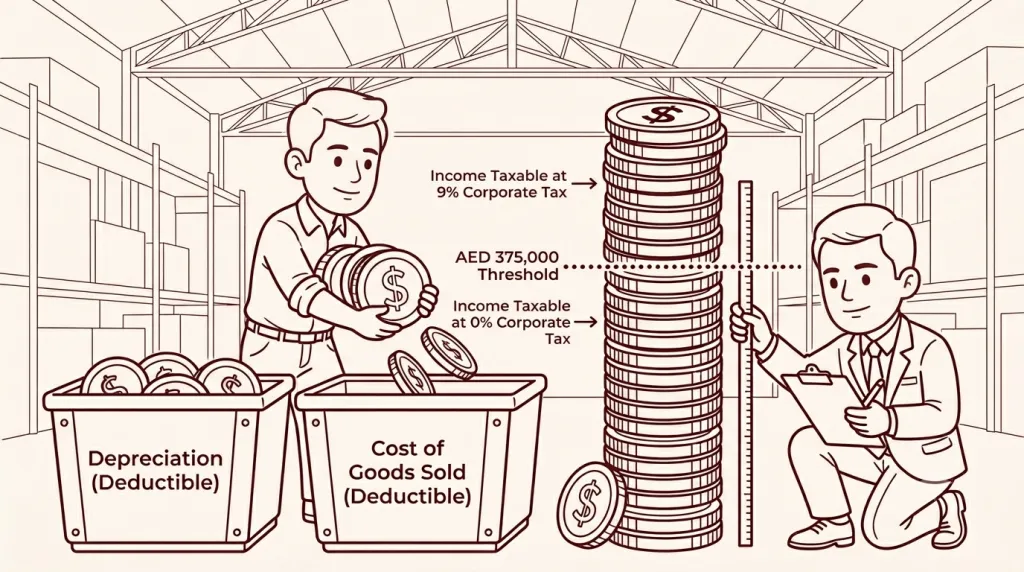
The UAE government introduced Corporate Tax through the Federal Decree-Law No. 47 of 2022 as part of a broader plan to diversify the country’s income. As a result, for all financial years starting on or after 1st June 2023, businesses and individuals involved in specified activities are required to file Corporate Tax returns and pay any applicable Corporate Tax dues.
A key part of Corporate Tax compliance relates to which expenses can be subtracted from the earned revenue for computing taxable income, i.e., which expenses are deductible and which ones are non-deductible expenses.
For instance, travel expenses incurred for business purposes will be seen as deductible expenses under the Corporate Tax rules and hence can be subtracted from your revenue. However, fines, penalties, and personal expenses are considered non-deductible expenses.
Additionally, certain expenses are only partially deductible.
In this article, we will explore such nuances of non-deductible expenses in the context of the UAE Corporate Tax law.
Most non-deductible expenses fall in the following categories:
It stands to reason that any expenses covered by the business for the benefit of its owners, shareholders, or partners cannot be used to reduce the taxable income. Corporate Tax is payable on a business’s taxable income, and subtracting personal expenses from business revenue would have the same effect as transferring taxable business income without paying Corporate Tax. Personal travel, rent, and medical expenses are examples of non-deductible personal expenses.
Penalties and fines imposed by regulatory bodies for non-compliance or code violations are non-deductible as per Article 33 of the Federal Decree-Law No. 47 of 2022.
The UAE Corporate Tax laws clearly state that business-related entertainment expenses are 50% deductible. However, entertainment expenses that are not incurred for business purposes are non-deductible.
Any amount that can be recovered as VAT input is non-deductible. The idea is simple. These expenses are recovered through VAT filings. It doesn’t make sense to allow tax deductions for such expenses that, ultimately, have a net-zero impact on the business’s income.
Dividends are transfers of business income to shareholders/owners. In the UAE, Corporate Tax applies before such transfers. Hence, dividends paid cannot be deducted from your taxable income.
Learning only about non-deductible expenses will give you a lopsided understanding of Corporate Tax compliance requirements. It is equally important to understand what qualifies as a deductible expense. Understanding the distinction will help you avoid penalties due to non-compliance.
Hence, in this section, we will focus on the definitions of deductible and non-deductible expenses. In general, deductible expenses are those that are:
On the other hand, non-deductible expenses are defined as:
Note
In the case of Qualifying Free Zone Persons, expense allocation may depend on whether the expenses relate to qualifying income or taxable income.
If the government allows fines, penalties, and legal sanctions to be deducted from taxable income, the offenders will be incentivized to be non-compliant. So, during tax calculations, any such expenses must be included in the taxable income.
Any fines or penalties levied by the government cannot be deducted from taxable income as per the UAE’s corporate tax laws because Article 33 specifically disallows the deduction of such expenses. Here are some examples of non-deductible fines and regulatory penalties:
The Federal Tax Authority (FTA UAE) disallows the deduction of such penalties and fines from the taxable income. Failing to adhere to this regulation attracts further penalties and fines.
Regulatory fines and penalties are non-deductible under Article 33. However, amounts awarded as compensation for damages or breach of contract are specifically carved out from this disallowance. Their deductibility should be assessed under the general deduction rules, including whether the expense was incurred wholly and exclusively for the business and is properly supported.
Under Article 32 of the Federal Decree-Law No. 47 of 2022, businesses can claim a deduction for entertainment expenses incurred during a tax period. The definition of entertainment expenses includes admission fees, transportation fees, meals, accommodation, other related expenses, and expenses specified by the Minister of Finance.
The entertainment expenses deduction is limited to 50%. This provision exists to ensure that business-related entertainment and hospitality bills are not overstated to claim tax relief. By limiting the deductible amount to 50%, the Ministry of Finance aims to prevent excessive or non-business entertainment claims.
However, you must note that the 50% limit does not apply to entertainment costs incurred for the benefit of company staff.
For instance, the cost of lunch with clients at a restaurant is 50% deductible. However, the cost of lunch provided to employees is 100% deductible. In case of mixed events, the 50% limit applies to entertainment expenses incurred for the benefit of clients but not to entertainment expenses incurred for the benefit of staff. Hence, accurate tracking of such expenses is important for compliance.
Business-related entertainment and hospitality costs must be supported by valid documentation to claim deductions. You can use the following documents to prove to the FTA UAE that the expenses were incurred for valid business purposes:
These documents must be properly maintained and presented when required to substantiate the expenses.
Capital expenditures are investments in long-term assets whose benefits are felt over multiple years. Hence, such expenses must be capitalized and deducted through depreciation over the period in which the asset provides value to the business.
Some examples of capital expenditure include:
By spreading the deductible amount of capital expenditure across multiple financial years, businesses can get a more accurate picture of their financial health.
An important consideration when it comes to the Corporate Tax treatment of capital expenditure deduction is clearly distinguishing repairs from capital improvements
The Federal Tax Authority (FTA) UAE permits deductions of repair and maintenance expenses from the taxable income, without the capitalization and depreciation steps.
While repairs and maintenance expenses incurred to ensure normal business operations are deductible, any expense incurred to significantly add to the value of the asset is not. Here are some examples of deductible maintenance and repair costs:
Capital improvements, on the other hand, include expenses incurred to extend the useful life of the asset or to significantly improve/alter its performance. The FTA clearly states that such expenses must be capitalized rather than fully deducted from taxable income in the same financial year. Here are some examples of capital improvements:
It is important to classify repairs, maintenance, and capital improvements accurately to prevent non-compliance.
Depreciation schedules are breakdowns of how capital expenditures are capitalized and deducted via depreciation over the useful life of the asset. Businesses are generally expected to set depreciation schedules consistently and in line with the International Financial Reporting Standards (IFRS).
For tax periods starting on or after 1 January 2025, Ministerial Decision No. 173 of 2025 allows a taxable person that prepares financial statements on an accrual basis, elects realization-basis treatment, and holds investment property at fair value under the applicable accounting standards to make an irrevocable election for a tax depreciation adjustment. The deduction is generally the lower of 4% of original cost, prorated where relevant, or the tax written-down value at the start of the tax period. This treatment applies to investment properties held at fair value and does not include land.
Needless to say, personal expenses like personal utility bills, commuting costs, and family expenses cannot be deducted from a business’s taxable income. That would mean transferring profits to owners without paying the Corporate Tax dues.
In practice, this is easier said than done. Certain assets are used for personal as well as business purposes. Sometimes, businesses may use the owner’s residential property. In such cases, allocating utility expenses to personal and business costs is an important consideration.
Dividends are not the only payouts made to owners. In many businesses, the owner contributes capital as well as time and effort. In some businesses, some owners may contribute capital while others contribute capital as well as time and effort. In such cases, distributing profits by a profit distribution ratio can be extremely difficult. That’s why some owners are paid in dividends as well as salaries. Another type of distribution would be withdrawals made by owners.
It is very important to divide distributions to owners into personal withdrawals and compensation for actual work performed. This is because only compensation paid for actual work performed can be deductible where supported by the legal structure of the business and consistent with arm’s-length principles.
Mixed-use expenses must be clearly allocated into personal and business expenses to claim deductions. The Federal Tax Authority states that for mixed-use expenses, reasonable allocation keys must be applied to separate legitimate business expenses from personal costs.
The business portion can generally be claimed as a deduction, while the latter cannot. The apportionment calculation must be backed by documents such as mileage logs (for vehicles), floor area ratio (for home offices), and call records (for phone bills).
Transactions with Related Parties and Connected Persons require particular care. Expenses paid to Related Parties should be consistent with the arm’s-length principle, and payments or benefits to Connected Persons should reflect market value and be incurred wholly and exclusively for the business. The FTA may adjust taxable income where related-party pricing does not meet the arm’s-length standard.
Not just in the UAE but all over the world, businesses are required to record related party transactions at arm’s length. This means that you must treat the two parties as unrelated, independent entities acting under similar conditions.
Not all expenses lead to benefits in the same year. We explored this logic in the section on capital expenditure. It is important to recognize expenses when their benefits are felt and revenues when the services/goods are supplied to understand the business’s profitability. This type of accounting is called accrual basis accounting. Most businesses follow the accrual basis to determine taxable income, but eligible businesses with revenue up to AED 3 million may use the cash basis, subject to applicable conditions. Cash basis accounting involves recording revenue and expenses when money changes hands.
When businesses create provisions for future expenses or losses, they can deduct these provisions from their taxable income, as long as the outflow of resources is probable and the provision was:
If such provisions are reversed, no special adjustments are necessary. The same mechanism applies to writing off bad debts and their recovery.
Under Article 33, donations or charitable contributions to entities that are not Qualifying Public Benefit Entities (QPBEs) are non-deductible expenses. QPBEs are exempt from Corporate Tax. An entity attains this status through Cabinet Decisions instead of registrations.
But before that, the entity’s scope of operations should be limited to altruistic purposes or public-benefit advocacy. Furthermore, the income and assets must be used only for the entity’s objectives, and no personal benefit should come to members/shareholders/trustees.
This definition of QPBEs does not cover political parties, and hence, political donations are non-deductible expenses.
Donations, grants, or gifts are non-deductible if made to an entity that is not a QPBE. Where a payment is made to a listed QPBE, deductibility should be assessed under the Corporate Tax rules and supported by proper documentation.
You can deduct sponsorship expenses if it provides advertising or marketing exposure, but any sponsorship that doesn’t bring quantifiable commercial benefits cannot be deducted from the business’s taxable income.
For instance, if your business sponsors an event without any branding rights or promotional gains, the expense is considered a charitable donation, which is generally non-deductible under the Corporate Tax regulations.
Under the Federal Decree-Law No. 47 of 2022, withholding tax is a mechanism by which tax can be deducted at source from certain payments made to non-residents and remitted to the Federal Tax Authority.
However, the UAE currently applies a 0% withholding tax rate, so no actual tax is generally withheld.
If withholding tax is imposed in the future, the withheld amount may generally be available as a tax credit against future Corporate Tax liability.
Separately, foreign taxes paid outside the UAE on the same income may also qualify for a foreign tax credit, but only up to the amount of UAE tax attributable to that income. Unlike withholding tax credits, unused foreign tax credits cannot be carried forward or refunded.
Classifying expenses as deductible and non-deductible largely centers around the intended purpose and when the benefit is felt. That being said, certain categories like entertainment expenses can often be for the benefit of staff as well as clients.
In case of payments to owners or when the business bears the owner’s personal costs, it becomes extremely important to determine whether the expense can be classified as compensation for the owner’s time and effort, and whether the amount matches the market value of said contributions.
These are just two examples of the many complications that can arise in determining taxable income for businesses.
If such Corporate Tax compliance challenges are distracting you from your core business, Skrooge’s tax professionals can handle all aspects, right from Corporate Tax registration to periodic filings and support for communications with the FTA. Contact us to know more!
Personal expenses, bribes, fines, penalties, dividends, recoverable input VAT, and non-business entertainment are core categories of non-deductible expenses in the UAE’s Corporate Tax regime.
Yes, only 50% of entertainment expenses incurred for business purposes can be deducted from the taxable income.
No, government fines and penalties cannot be deducted from the corporate tax as they are not incurred directly for generating taxable income.
Accurate apportionment, backed by mileage logs, must be used to separate business use from personal use. Only the portion of expenses associated with business activities is deductible for corporate tax purposes.
Instead of claiming the entire amount spent on purchasing or building equipment and capital assets in the same financial year as the cash flow, businesses must capitalize said expenses and claim tax deductions through depreciation over the useful life of the asset.
Businesses should maintain evidence supporting the commercial purpose, pricing, and benefit received. Formal transfer pricing documentation may be required depending on the taxpayer’s circumstances, thresholds, and FTA requirements.
Bad debts and provisions are deductible if the estimation is reliable, the outflow (or loss) of resources is probable, and the expense is recorded as per IFRS or IFRS for SMEs, whichever is applicable.
To support expense deduction claims, you will need documents like invoices, receipts, contracts, bank statements, and accounting books.
Thank you!
We've received your request and will get back to you shortly.

Loading...
 Thank you!
We've received your request and will get back to you shortly.





 Contact Us


