
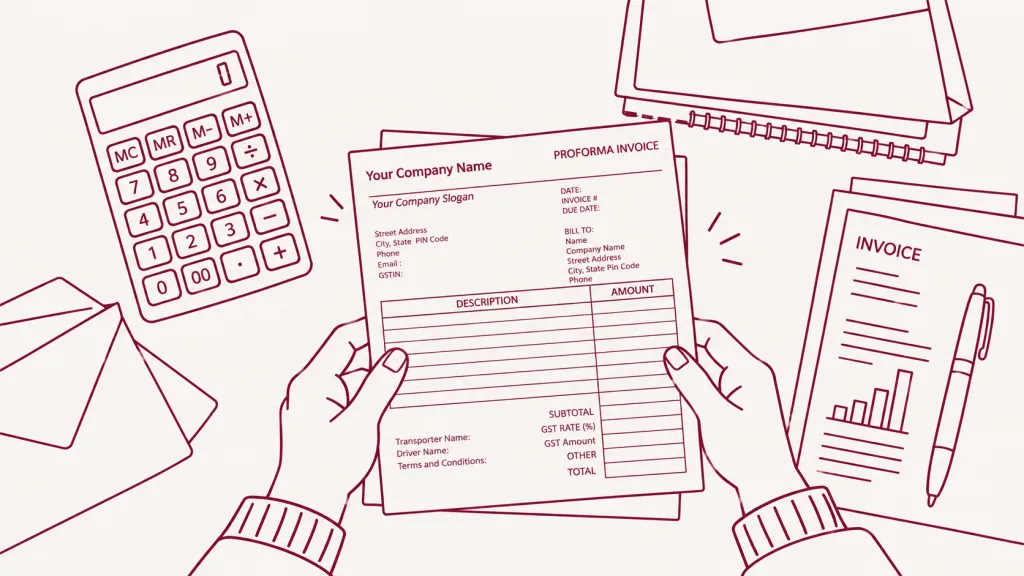

Liquidation Report in the UAE: Guide for Closing your Business in 2026
Saying goodbye to a company you worked hard on is already hard without having to…
A proforma invoice is an initial document sent out by businesses, outlining proposed prices, quantities and transaction terms before the sale is finalized.
Businesses issue proforma invoices every day, but some mistakenly treat them as tax invoices and claim input VAT using documents the FTA does not recognize as valid tax invoices.
For SMEs, finance managers, and businesses with international transactions, understanding how proforma invoices work is essential to keeping transactions properly documented.
This guide explains what a proforma invoice is, when to use one, what to include in your template, and how it differs from a UAE tax invoice.
Note
Although both documents may contain similar information, a proforma invoice and tax invoice serve different purposes.
A proforma invoice includes a detailed breakdown of a proposed transaction, while a UAE tax invoice documents a transaction for VAT purposes and must meet the applicable requirements under UAE VAT legislation.
Treating a proforma invoice as a substitute for a required tax invoice can create compliance issues, particularly when a business receives an advance payment before delivering goods or services.
A proforma invoice is a preliminary commercial document that outlines the expected price, quantity, and terms of a proposed sale.
Businesses commonly send one to customers before confirming an order, arranging delivery, or requesting an advance payment. It allows both parties to review the proposed costs, confirm the scope of work or goods, and agree on the terms before proceeding.
Unlike a final sales invoice, a proforma invoice outlines the proposed terms of a transaction. It may be used to communicate an expected advance payment, but it does not, by itself, establish a completed sale, or earned revenue for accounting purposes.
A proforma invoice may also be useful when a customer needs a preliminary cost breakdown for arranging financing, including budgeting, internal approvals, or import and shipping arrangements.
For example, a UAE-based supplier selling office equipment to a corporate customer might issue a proforma invoice listing the furniture. The customer then confirms all the details and arranges the necessary approvals before confirming the order.
Note
We often see “performa invoice” used as a misspelling of “proforma invoice.” The correct term comes from the Latin pro forma, meaning “for the sake of form” or “as a matter of form”.
A business can specify how long its quoted prices and commercial terms remain valid. There is no standard validity period for proforma invoices prescribed under UAE VAT legislation. The issuer can state a validity date or period on the document, depending on the nature of the transaction and the agreement with the buyer.
A proforma invoice is generally a preliminary commercial document rather than a final tax invoice. However, once accepted by the buyer, it may form the basis of a contractual agreement, depending on the terms and circumstances of the transaction.
Proforma, tax, and commercial invoices serve different purposes. A proforma invoice outlines a proposed transaction, a tax invoice documents a supply for VAT purposes, and a commercial invoice supports trade and shipping.
Note
The underlying supply and applicable tax-point rules determine VAT treatment and liability. A tax invoice may be required before delivery if a tax point arises earlier, such as when an advance payment is received.
For a closer look at the particulars, see our guide to UAE tax invoice format requirements.
| Feature | Proforma Invoice | UAE Tax Invoice | Commercial Invoice |
|---|---|---|---|
| Main purpose | Preliminary bill of sale outlining proposed transaction terms | Document a supply for VAT compliance | Document a commercial sale, particularly in trade and shipping |
| When issued | Usually before finalizing the transaction | According to the applicable UAE VAT tax-invoice rules | Usually when documenting the actual sale or shipment |
| Binding effect | Generally preliminary; context matters | Formal tax document; does not alone determine every contractual right | Used as evidence of the commercial transaction; legal effect depends on context |
| Creates VAT liability? | Not by itself | The underlying supply and applicable tax-point rules determine liability | The document’s label alone does not determine VAT liability |
| Supports input VAT recovery? | No, not on its own | Can support input VAT recovery if the applicable documentation and eligibility requirements are met | Not automatically; document status and applicable VAT requirements matter |
| Accounting treatment / recorded in the books? | Does not establish earned revenue on its own | Any resulting advance payments, receivables, or completed supplies should be recorded appropriately. | Used as transaction evidence, subject to the applicable accounting treatment |
| Required fields | Commercially useful details; no need for fields under Article 59 (or tax invoice requirements) | Mandatory particulars under Article 59 of UAE VAT rules | Fields depend on the commercial, shipping, and customs requirements |
A proforma invoice does not, by itself, create a tax point or trigger VAT liability. Issuing one does not automatically require the supplier to account for output VAT.
However, the actual transaction determines the VAT treatment. The date of supply is generally the earliest applicable date among the events specified in the legislation. These include the transfer or receipt of goods, completion of services, receipt of payment, or issuance of a tax invoice.
When a supplier receives an advance payment for a taxable supply, the payment establishes a tax point for the amount received. Under Article 19 of the VAT Executive Regulation, VAT becomes due to the extent of the payment made. The supplier must account for the VAT and issue the required tax invoice within the applicable deadline.
A proforma invoice also cannot support input VAT recovery on its own. The buyer generally needs a valid tax invoice and must meet the applicable VAT recovery conditions.
A standard invoice or regular invoice is not necessarily a VAT invoice.
A UAE tax invoice must contain the particulars required under the applicable VAT rules.
These may include the following, depending on whether a full or simplified tax invoice is permitted:
Watch out for VAT on advance payments. For example, a UAE business issues a proforma invoice for AED 10,000 plus 5% VAT (AED 500), giving a total of AED 10,500.
If the customer pays a 50% advance of AED 5,250, the payment creates a tax point for the amount received, assuming it relates to a taxable supply subject to the standard 5% VAT rate. This means the supplier must account for AED 250 in VAT on the advance payment.
A supplier must then issue the tax invoice within 14 calendar days of the date of supply. If the customer makes an advance payment and this triggers the date of supply, the 14-day period starts from the date the payment is received, even if the goods have not yet been delivered or the services completed.
To avoid gaps between payment records and VAT documentation, review how your business handles advances, tax invoices, and bookkeeping.
Automated invoicing for UAE businesses can help organize your invoicing workflow and keep transaction records together.
The structure of a proforma invoice usually mirrors that of a final invoice. However, the invoice should be clearly labelled and should not imply that it is a compliant tax invoice.
IMPORTANT
A proforma invoice should give the customer enough information to understand the proposed transaction. Make sure the words ‘Proforma Invoice’ are clearly displayed.
The invoice must NOT be labelled ‘Tax Invoice’ and should carry a line such as ‘This is not a tax invoice‘.
Although its format can vary by business and industry, the document commonly includes:
These details help both parties establish a shared understanding of the proposed transaction. Businesses should distinguish between an estimated amount and a confirmed charge, particularly when the final quantity, delivery cost, or other commercial terms may change.
Skrooge Accounting Tip
A proforma invoice number should also be distinguishable from the numbering system used for final tax invoices. This helps finance teams track preliminary documents without confusing them with invoices issued for actual supplies.
The following example illustrates what a pro forma invoice looks like:
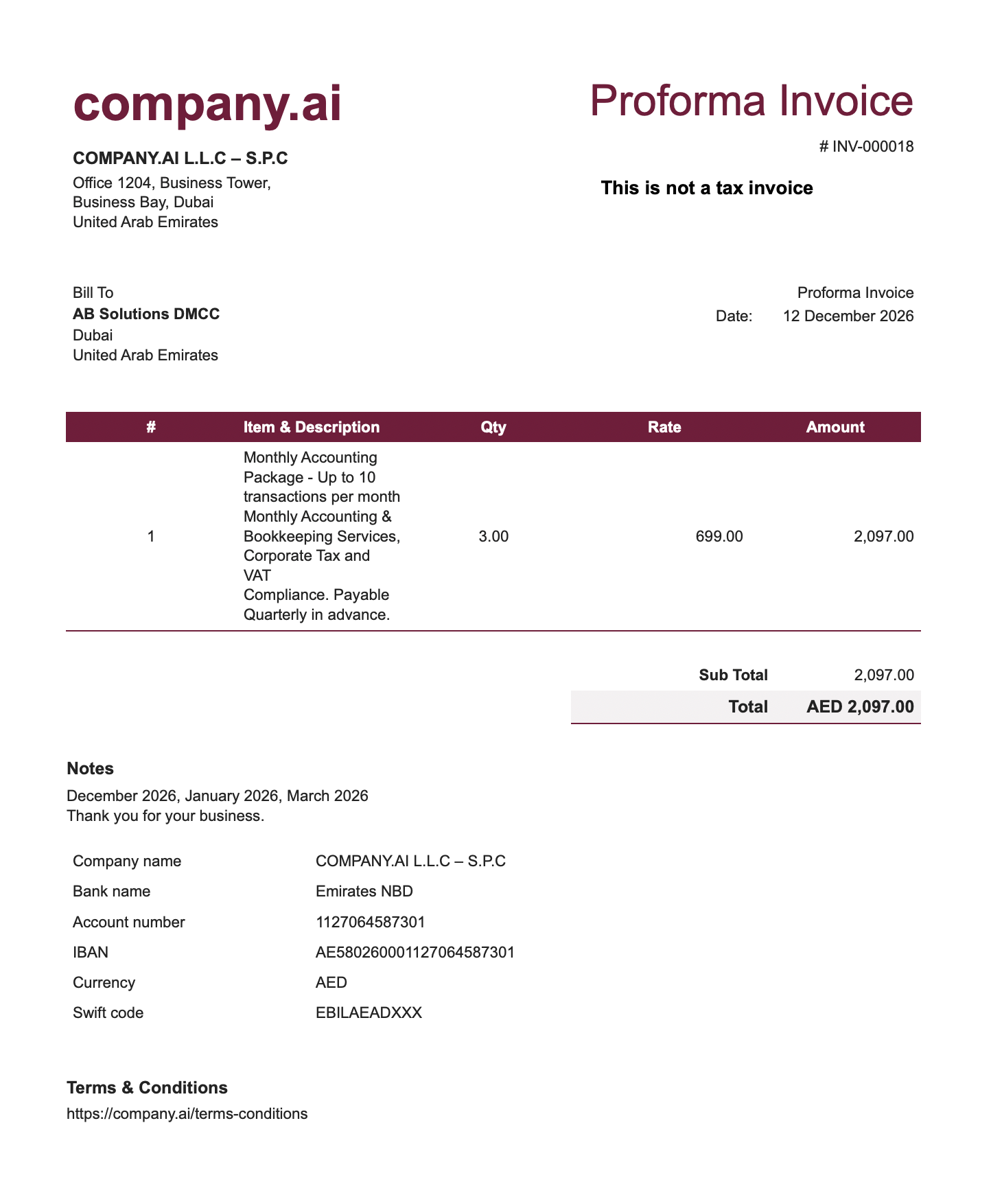
Your proforma invoice should clearly state whether quoted amount includes or excludes VAT.
When issuing the final tax invoice, make sure the actual supply and applicable VAT treatment are reflected.
Generally, proforma invoices assist in negotiating deals and obtaining necessary approvals. A proforma invoice streamlines the sales process, and reduces errors in final billing.
Common commercial uses include:
Proforma invoices are relevant to UAE businesses involved in international trade, including importers, exporters, and general trading companies. Businesses working with international clients can use them to communicate proposed prices, quantities, and delivery terms before confirming an order.
For international shipments, a proforma invoice can provide preliminary information for customs purposes, including goods descriptions, quantities, and estimated values. Shipping details such as shipping weight may also be included when relevant to logistics planning and customs documentation.
Businesses operating through Jebel Ali or other free zones may use them for commercial purposes. However, a proforma invoice is not universally sufficient for customs clearance. The documents required depend on the shipment details and applicable customs procedures.
Once the transaction is confirmed, businesses must distinguish the proforma invoice from the official tax invoice and follow the correct invoicing and bookkeeping steps.
The UAE is introducing a mandatory electronic invoicing system in phases. Under Ministerial Decisions No. 243 and 244 of 2025, the pilot program and voluntary adoption began on 1 July 2026. Mandatory implementation depends on a business’s annual revenue and whether it falls within the system’s scope.
The implementation deadlines are as follows:
| Business Category | Deadline to appoint an ASP | Mandatory implementation |
|---|---|---|
| Annual revenue of AED 50 million or more | 30 October 2026 | 1 January 2027 |
| Annual revenue below AED 50 million | 31 March 2027 | 1 July 2027 |
| Government entities | 31 March 2027 | 1 October 2027 |
The appointment deadline for businesses with annual revenue of AED 50 million or more was extended from 31 July to 30 October 2026 under Ministerial Decision No. 66 of 2026. As of November 2026, this deadline has passed.
Under the new system, in-scope businesses must issue and exchange structured electronic invoices through an Accredited Service Provider (ASP). These invoices are also reported electronically to the Federal Tax Authority.
Importantly, an ordinary PDF, Word document, scanned invoice, or invoice sent by email does not qualify as an e-invoice under the UAE system. The requirement is for structured invoice data that can be processed and exchanged electronically.
Business-to-consumer (B2C) transactions are currently excluded from the mandatory system under Article 5(2) of Ministerial Decision No. 244 of 2025. Businesses that exclusively make B2C supplies are also outside the current scope, until further determination by the Minister.
A proforma invoice helps businesses communicate proposed transaction terms, but it does not replace a tax invoice when VAT documentation is required. Understanding when a payment creates a tax point, issuing the correct invoice, and keeping supporting records are all important parts of managing business finances.
Skrooge.ai combines AI-assisted workflows with accountant oversight to support businesses with invoicing, VAT compliance, and bookkeeping. Whether you need help organizing financial records or managing your ongoing compliance requirements, Skrooge can help you keep your accounting processes clear and organized.
Explore our accounting and bookkeeping services in the UAE to learn more.
A proforma invoice acts as a preliminary invoice rather than a final tax invoice.
A proforma invoice can be commercially binding with respect to the agreed transaction terms, depending on the agreement between the buyer and seller and the circumstances of the transaction.
However, it is not a substitute for a tax invoice where an official document is required under UAE VAT rules.
No, a proforma invoice alone is not sufficient to support input VAT recovery.
The buyer must meet the applicable UAE VAT recovery conditions and hold the required supporting documentation
A proforma invoice is issued with the proposed terms of a transaction. The invoicing process typically begins when the seller proceeds with a proposed sale and shares the expected prices, quantities, and payment terms. This estimated invoice helps ensure that the buyer and seller are on the same page before finalizing the transaction.
A UAE tax invoice, by contrast, is an official tax document that must meet the applicable UAE VAT requirements. It records the supply for tax purposes and supports the buyer’s input VAT recovery, provided the relevant documentation and eligibility conditions are met.
Make sure to use “proforma invoice” as the standard spelling. “Performa invoice” is a common misspelling.
A proforma invoice is generally treated as a formal quotation, not a completed sales transaction, so it is not recorded as sales revenue for accounting purposes.
Even if accepted as part of a legally binding agreement, the proforma invoice alone does not establish that revenue has been earned.
Sales teams can use proforma invoices to confirm proposed terms before an order proceeds. However, any deposits, advance payments, or completed supplies must be recorded according to the applicable accounting and VAT requirements.
You don’t always need it for customs clearance or international shipping.
A proforma invoice can prepare the transaction for customs by providing a foreign buyer with a detailed description of the goods, quantities, and estimated value. It may also support a formal request for shipping or import documentation before the sale is finalized.
However, a proforma invoice does not replace the final commercial invoice in every situation. The required documents depend on the destination, shipment, and applicable customs procedures. The final invoice amount should reflect the actual transaction.
Thank you!
We've received your request and will get back to you shortly.

Loading...
 Thank you!
We've received your request and will get back to you shortly.











 Contact Us


