

VAT Registration Requirements & Process: Beginner-Friendly Guide
Hey there! We know that VAT registration might be a real headache, so we’ve prepared…
A founder may choose to incorporate with different corporate structures, including incorporating as a Limited Liability Company (LLC) or a sole establishment.
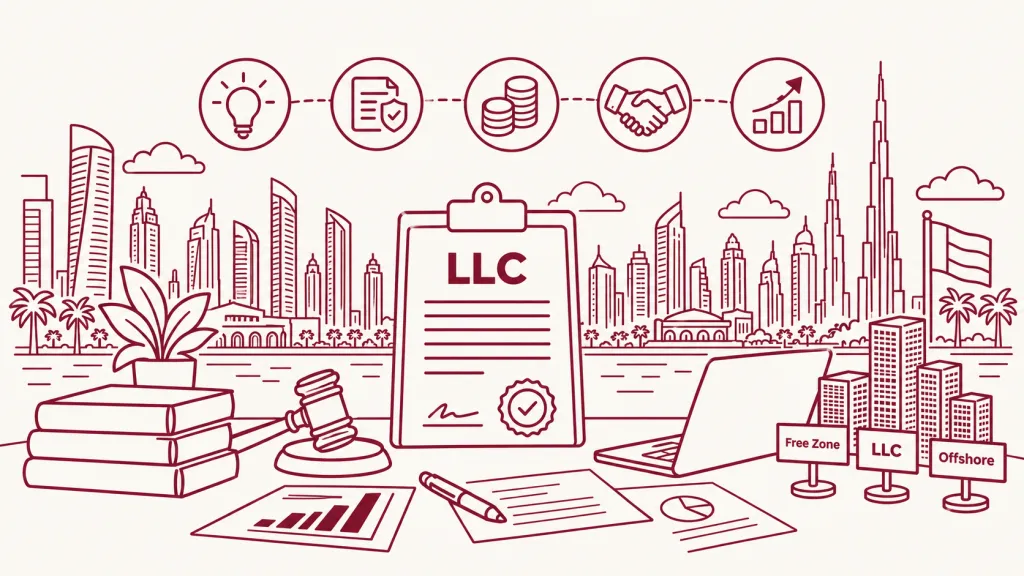
You often see LLC in most UAE trade licenses, but what does it actually entail? This guide is for founders to better understand what it actually protects, what the law obliges them to do, and whether a sole establishment or a free zone company would have served them better.
A mainland LLC is a company with a legal identity separate from its shareholders. It can hold assets, enter into contracts, and incur obligations under its own name. LLCs must adhere to corporate governance rules under the Commercial Companies Law, including accounting and annual license renewals. LLCs can operate within the UAE mainland and access local markets.
The LLC structure is commonly used by trading businesses, service providers, retailers, manufacturers and other commercial enterprises.
By the end of this article, you’ll understand LLCs in depth with a real comparison between different structures and a decision checklist on whether it’s the right choice for your business growth.
LLC stands for Limited Liability Company, which is a mainland legal entity whose owners’ liability is capped at their share of the capital. The founder generally benefits from limited liability protection, meaning the company’s debts do not immediately become the founder’s personal debts.
The legal framework behind LLCs is outlined under Federal Decree-Law No. 32 of 2021 on Commercial Companies.
Shareholders’ liability is generally limited to their contributions to the company’s capital. This is not a guarantee that owners or managers can never incur personal liability.
The LLC can have between one and fifty shareholders. Shareholders can be individuals or legal entities.
Under Article 76 of the Commercial Companies Law, an LLC must have sufficient capital to achieve the purpose of its establishment. The Cabinet may issue a decision setting a minimum capital requirement. The company’s capital must also be fully paid upon incorporation. Additional capital or licensing conditions may apply to specific regulated activities.
An LLC’s capital is generally divided into shares of equal value, representing each partner’s ownership interest.
However, following the 2025 amendments to the Commercial Companies Law, the Memorandum of Association may provide for different classes of shares with varying values, voting rights, redemption rights, or priorities in profit distribution and liquidation. These rights and classifications must be recorded in the commercial register, subject to the applicable rules.
With regard to licensing, there are some activity-specific conditions that apply. Regulated activities may carry additional capital or licensing requirements, including government approvals.
For example, health-related activities may require approval from the relevant local health authority.
Lastly, an LLC must have a Memorandum of Association (MoA), and once set up, a mainland LLC can generally operate across the UAE market within its licensed activities.
An LLC is governed by Federal Decree-Law No. 32 of 2021, also known as the UAE Commercial Companies Law. The law covers company ownership, capital, management, financial reporting, audit obligations, governance and dissolution.
The law was subsequently amended by Federal Decree-Law No. 20 of 2025, which came into force on 15 October 2025. The amendments introduced greater flexibility in LLC share structures, including different classes of shares and provisions for drag-along and tag-along rights in the company’s constitutional documents. They also introduced a mechanism allowing companies to transfer their registration between competent authorities, including between mainland and free zone jurisdictions, subject to the relevant authorities’ requirements and approvals.
However, the Companies Law does not replace local licensing rules, sector-specific regulation or UAE tax legislation.
A mainland LLC is licensed by the relevant emirate’s economic department or competent licensing authority. In Dubai, this is the Dubai Department of Economy and Tourism (DET). The applicable licensing requirements depend on the company’s intended business activities and the relevant authority.
For more information, see our guide on setting up a mainland LLC yourself, which covers an Abu Dhabi example.
The relevant government authority depends on where the company is established and what the business conducts.
For example:
| Authority | What it regulates or handles |
|---|---|
| Emirate’s economic department or licensing authority | Issues mainland commercial licenses and handles business registration. In Dubai, this is DET. |
| Central Bank of the UAE (CBUAE) | Regulates licensed banking and other financial activities that fall within its remit. Not every business providing a financial-related service is regulated by the Central Bank. |
| Securities and Commodities Authority (SCA) | Regulates securities and capital-market activities within its jurisdiction. |
| Dubai Health Authority (DHA) | Regulates healthcare services and professionals within its Dubai remit. Healthcare businesses elsewhere in the UAE deal with the relevant local health authority. |
| Other activity-specific authorities | Certain activities, including insurance, telecommunications, legal services and tourism, require approval or licensing from the relevant regulator. |
Note
Always bear in mind that the LLC’s company registration and commercial licensing are separate from the regulation of its business activity.
A company may obtain its license through the emirate’s licensing authority but still need approval from a sector regulator before conducting a regulated activity.
The law mandates the company’s obligations, including:
Under the UAE Commercial Companies Law, Article 92 addresses the General Assembly’s annual meeting, while Article 94 covers the agenda that the General Assembly would consider and discuss.
| Requirement | Details |
|---|---|
| Deadline | The manager or board must convene the General Assembly at least once a year, within the first four months after the financial year ends. |
| Notice Period | Give partners at least 21 days’ notice. The notice must include the agenda, venue, date and time of the first meeting and, if the first meeting lacks quorum, the second meeting, along with the other information required by Article 93. |
| Agenda | What partners review and decide: Under Article 94, the annual meeting considers: 1. The managers’ report on the company’s activities and financial position, the auditor’s report and any Supervisory Board report. 2. Approval of the balance sheet and profit-and-loss account. 3. Distribution of profits among partners. 4. Appointment and remuneration of managers. 5. Appointment of board of managers or Supervisory Board members, where applicable. 6. Appointment and remuneration of the auditor or auditors. 7. Sharia supervisory appointments, where applicable. 8. Other matters assigned to the General Assembly by the law or the Memorandum of Association. |
A mainland LLC can generally have full foreign ownership, which is favorable to foreign investors and international entrepreneurs.
The 100% foreign ownership structure has been allowed in many sectors since 2021. The earlier blanket requirement for a UAE national to hold at least 51% of many mainland companies was relaxed through amendments to the Commercial Companies Law.
However, strategic-impact activities and other specially regulated sectors may be subject to specific ownership, participation, approval or licensing requirements.
A founder should check that their licensed activity aligns with the applicable rules rather than assume either that a local partner is always required or that full foreign ownership is universally available.
Once you’ve confirmed that your business activity permits 100% foreign ownership, there’s still the financial side to get right.
From maintaining accounting records to meeting tax obligations, compliance continues long after your LLC is registered. It pays to have an expert team walk you through the accounting and annual compliance support you need so you understand the next steps after incorporation.
Apart from the LLC, the Ministry of Economy and Tourism identifies several other business structures and advises founders to select one that matches their business activity and its requirements.
| Legal form | Typical use and defining feature |
|---|---|
| Sole establishment | One individual conducts a business; the owner’s liability is generally personal rather than limited by an LLC structure. Often interchangeable when talking about sole proprietorship |
| Civil company | A professional-services structure for activities and ownership arrangements permitted under the applicable rules. |
| Limited Liability Company | A separate company with limited shareholder liability, commonly used for trading and service businesses. |
| General partnership | Partners may be personally liable for business liabilities, meaning the shareholders’ personal assets may be at risk under the applicable legal rules. |
| Limited partnership | Combines partners with management and liability responsibilities with limited partners whose liability is generally tied to their contribution. |
| Private joint stock company | A share-based structure suited to larger businesses, international investors and investor groups. |
| Public joint stock company | A share-based structure intended for larger capital-raising operations, subject to stricter requirements. |
| Branch of a foreign company | An extension of a foreign parent rather than an entirely separate subsidiary in the same sense as an LLC. |
| Free zone company | A company incorporated under the applicable free zone framework, using forms such as FZE, FZCO or FZ-LLC depending on the zone. |
These are some illustrative cases, and not necessarily a list of permitted activities. But generally, the following might benefit from forming an LLC to protect them from unlimited personal liability.
The appropriate legal form depends on the ownership arrangement, business activity and liability structure.
The main distinction between the two popular business structures depends on how they treat liability on business debts. A Limited Liability Company (LLC) in the UAE provides legal protection between the company and its shareholders.
A sole establishment may suit an independent professional with a narrow activity and limited business risk. It becomes less attractive if the business takes on substantial contractual obligations or plans to bring in investors.
Sole establishments may be simpler but limit growth potential. However, an LLC is not automatically better for growth plans. It creates a more formal company structure, but that also brings governance, accounting and compliance responsibilities.
To simplify, here are the key benefits and differences between a UAE mainland Limited Liability Company and a sole business legal structure.
| Factors for Comparison | Mainland LLC | Sole establishment |
|---|---|---|
| Legal identity | Separate legal entity | Generally the individual owner’s business, not a separate company with LLC-style liability protection |
| Liability | Shareholders’ liability generally limited to their capital contributions | Owner generally bears personal liability for business obligations |
| Number of owners | 1–50 shareholders | One owner |
| Foreign ownership | 100% generally permitted for eligible activities | Depends on the activity, license and applicable nationality or service-agent rules |
| Capital | Must have sufficient capital to achieve its business objectives. The Cabinet may prescribe a minimum, and the capital must be fully paid at incorporation. | The Commercial Companies Law’s LLC capital requirements do not apply. Any capital conditions depend on the relevant licensing authority and business activity. |
| Management | Managed under the Companies Law and the MoA | Generally managed directly by the individual owner |
| Accounting | Company records and financial statements required | Records and tax compliance depend on the activity and applicable rules |
| Audit | Must have its accounts audited annually and appoint one or more auditors through the General Assembly of Partners | The Commercial Companies Law’s LLC statutory audit requirement does not apply to a sole establishment as such. Other licensing or regulatory requirements may still apply. |
| Corporate Tax Rules | Generally treated as a juridical taxable person and required to register for Corporate Tax | The individual owner is subject to Corporate Tax on business activities only if the applicable conditions are met, including annual business turnover exceeding AED 1 million. |
| Adding an investor | Shares and ownership arrangements can be structured under the applicable company law | Bringing in a co-owner generally requires restructuring or a different legal form |
| Selling the business | Ownership interests may be transferred subject to the law, MoA and required approvals | The owner may transfer business assets or interests as legally permitted; it is not equivalent to transferring LLC shares |
| Running costs | Company governance, licensing, accounting and applicable audit costs | May involve a simpler operating structure, but exact savings depend on activity and licensing |
| Profit Sharing | An LLC’s partners share profits according to the arrangements set out in the Memorandum of Association. If the MoA does not specify each partner’s share of profits or losses, the UAE Commercial Companies Law provides a default rule based on capital contributions | Since it is owned by one individual, there are no separate shareholders to share profits with. |
| Suitable for | Shareholders needing limited liability protection | Sole Establishments are suitable for freelancers and consultants. |
In short, a sole establishment generally exposes the owner to personal liability for business obligations.
If you expect substantial contractual risk or plan to bring in partners or investors, an LLC may be worth considering, subject to the applicable licensing and legal requirements.
A ‘free zone LLC’ is a different legal form under free zone regulations, which is separate from a mainland LLC under the Commercial Companies Law.
Similarly, the following are defined as:
Note
A free zone company is not a mainland LLC with a “cheaper license”. It is formed within a different regulatory framework. This affects the corporate documents used to establish the company, its governance arrangements and the rules that apply to changes in ownership.
Neither structure guarantees bank account approval. Banks assess the company’s business model, ownership, transactions, documents, and risk profile regardless of where the company incorporates.
To illustrate further:
| Differentiating Factors | Mainland LLC | Free zone company |
|---|---|---|
| Governing law | Governed by the UAE Commercial Companies Law and applicable emirate licensing rules, subject to the law’s scope and exceptions. | Governed by the relevant free zone’s regulations and company framework. The exact rules vary by zone. |
| Licensing authority | Licensed by the competent economic department or licensing authority in the emirate. | Licensed and registered by the relevant free zone authority. |
| Legal identity | A company legally distinct from its owner or owners. A single-person LLC is permitted. | Usually incorporated as a separate legal entity under the free zone’s company framework. Each zone may offer specific forms. |
| Owner liability | Generally limited to the capital contribution, subject to statutory exceptions and personal guarantees or other obligations a partner may separately assume. | Generally limited under the applicable free zone company rules, subject to those rules and any separate guarantees or liabilities |
| Foreign ownership | 100% foreign ownership is permitted for many activities. Strategic-impact activities and specific regulatory requirements may impose conditions. | 100% foreign ownership is commonly available, subject to the relevant zone’s rules and any activity-specific regulation. |
| Ownership structure | Can be established by one or more partners. The Commercial Companies Law permits a single natural or legal person to own an LLC. | The available forms include Free Zone Establishment (FZE), Free Zone Company (FZ Co.) and Free Zone LLC (FZ-LLC), depending on the zone. Eligibility and shareholder limits vary. |
| Constitutional documents | Requires a Memorandum of Association and applicable registration and attestation formalities. | Free zone companies must follow the constitutional-document requirements of their respective free zone. The required documents vary. For example, DMCC’s 2024 regulations use Articles of Association that supersede the previous MoA and AoA structure. |
| Governance | Subject to statutory requirements for management, partner meetings, financial statements and auditor appointment under the applicable Commercial Companies Law. | Subject to the free zone’s company regulations, reporting obligations and license conditions. Do not assume the mainland rules apply identically. |
| Ongoing compliance | Includes license renewal, company records, applicable financial reporting and audit requirements, Corporate Tax obligations, and VAT compliance where required. | Includes license renewal and the zone’s company reporting requirements, alongside applicable UAE Corporate Tax, VAT and other federal obligations. |
| Contracts and banking | Eligibility depends on the licensed activity, contract requirements, due diligence and the bank’s own assessment. | Also depends on the licensed activity, contract requirements, due diligence and the bank’s own assessment. Incorporation in a free zone does not guarantee account approval or acceptance by a counterparty. |
A more detailed Free Zone vs Mainland guide may help you compare jurisdictions, legal compliance requirements, and other tax considerations.
An LLC may involve additional administrative and compliance costs compared with a sole establishment, particularly in relation to company governance, accounting, auditing and licensing requirements. Actual costs depend on the emirate, business activity and licensing authority.
However, for the purpose of this article, we enumerate the recurring cost categories LLCs must take into account. This is because a company may have little or no revenue, and yet have administrative, licensing and record-keeping responsibilities.
Note
An LLC’s costs don’t stop once the license is issued. Even before generating revenue, the company needs to maintain proper accounting records from day one and keep track of its ongoing compliance obligations. It is best practice to launch your business the right way with verified and licensed setup partners.
An LLC offers a useful combination of liability separation and a formal company structure. It is not necessarily the right choice for every founder.
Choosing the right LLC structure is only the first step. You also need to keep your books accurate, understand your VAT and Corporate Tax obligations, and stay on top of compliance as your business grows.
Skrooge helps UAE-based founders manage the financial side of running a business through monthly bookkeeping, financial reporting, incorporation, VAT and Corporate Tax support.
AI-assisted workflows handle repetitive tasks, while experienced accountants review the work and guide decisions. You get ongoing accounting support, clearer financial information and help staying on top of important deadlines. Book a free consultation with our expert team to discuss your company’s accounting and tax support needs.
An LLC (Limited Liability Company) is a separate legal entity whose shareholders’ liability is generally limited to their contributions to the company’s capital.
Yes, foreign investors can generally own 100% of a mainland LLC for eligible activities. Restrictions may apply to strategic-impact activities and specially regulated sectors, so the intended activity should be checked before incorporation.
An LLC is a separate legal entity with limited shareholder liability.
A sole establishment is generally operated by one individual, who bears personal liability for its business obligations.
The structures also differ in ownership, governance and Corporate Tax treatment. We outline the differences in the article.
Not necessarily. A free zone company may use a legal designation such as FZE, FZCO or FZ-LLC, depending on the relevant zone’s rules.
A free zone LLC is not automatically the same legal form as a mainland LLC under the federal Commercial Companies Law.
Yes. A Dubai mainland LLC is licensed through the relevant Dubai mainland authority and is generally governed by the federal Commercial Companies Law.
It generally has UAE mainland market access within the scope of its licensed activities.
A free zone LLC is established under the applicable free zone framework. Both may offer limited liability, but their licensing and governance rules differ.
Yes. Article 102 of the UAE Commercial Companies Law requires an LLC to appoint one or more auditors annually through its General Assembly of Partners.
The auditor reviews the company’s financial statements and issues an audit report accompanying the audited financial statements.
The company’s management structure also determines who is responsible for maintaining records, overseeing reporting and convening the General Assembly. Small LLCs should not assume they are exempt solely because of their size or revenue.
An LLC is generally a juridical taxable person under UAE Corporate Tax. A natural person operating a business, including through a sole establishment, is subject to a different test: business turnover (not profit) must exceed AED 1 million in a calendar year.
Under the corporate tax regulatory framework, the general rate is 0% on taxable income up to AED 375,000 and 9% on taxable income above that amount, subject to applicable rules and reliefs. Other personal income and wages are not subject to corporate tax.
Thank you!
We've received your request and will get back to you shortly.

Loading...
 Thank you!
We've received your request and will get back to you shortly.










 Contact Us


