


Simplifying VAT Return Filing in the UAE (including changes in 2026 and how to prepare)
VAT has been part of doing business in the UAE since January 1, 2018, and…
Beyond ensuring compliance, accurate bookkeeping helps business owners monitor cash flow, measure profitability, protect the business’s financial health, and make informed decisions based on reliable financial data. As a result, building an effective accounting function becomes a priority for any growing business.
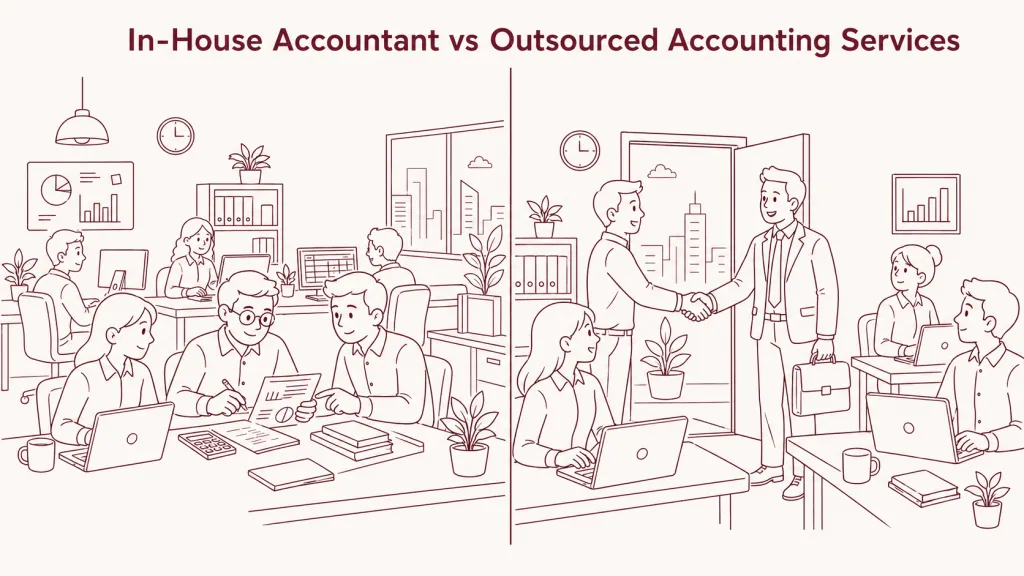
You can address this need in two ways. You can either hire an in-house accountant to manage your books internally or outsource financial accounting services to a professional accounting firm. Both approaches help businesses meet their accounting and tax obligations, but they differ significantly in terms of cost, expertise, and scalability.
Often, business owners compare these two approaches by directly comparing an accountant’s base salary with the monthly fees charged by an accounting firm.
But when you do so, you often miss hidden costs and the key differences in capabilities.
That’s what this article is all about. Here, we break down the true cost of hiring an in-house accountant versus outsourcing your accounting in the United Arab Emirates (UAE). We will compare the direct and indirect costs of both approaches and discuss which option makes the most sense at different stages of business growth.
Many business owners naturally assume that the accounting and recordkeeping function should be managed internally. This is often because growing businesses look to larger organizations as a blueprint or because owners value direct access to financial insights.
However, hiring an in-house accountant is often less cost-efficient when your business is small and transaction volume is low.
A better alternative is to rely on financial accounting outsourcing services. This allows you to access experienced accounting professionals at a fraction of the cost of building an equivalent in-house team. Your books may not have a full-time person dedicated exclusively to them, but the cost reduction can be significant, and choosing the right accounting outsourcing partner can often offset the reduced time commitment through broader technical expertise.
At a larger scale, however, you may need to begin bringing the accounting function in-house.
This trade-off between outsourcing and internalization is something all businesses must navigate as they grow.
If you want to truly compare the cost of in-house accountants with outsourced accounting services, you must not oversimplify by looking only at the salary. Let us break down the true cost of an in-house accountant.
Public salary benchmarks vary by experience, emirate, qualification, and role scope. As a rough reference point, PayScale data for accountants in Dubai shows annual salaries ranging widely, with junior and experienced accountants falling into materially different cost bands. In our own experience, UAE based junior accountants earn AED 5,000-8,000 per month. But you need to bear in mind, that businesses must comply with evolving VAT and Corporate Tax regulations, as well as financial reporting requirements that often demand practical experience rather than theoretical knowledge.
Even seemingly routine tasks, such as preparing and filing VAT returns, involve numerous edge cases that inexperienced accountants may struggle to identify. Our guide on UAE VAT returns discusses several such nuances in more detail.
As a result, businesses looking to maintain a lean finance function often need to hire a more experienced accountant, whose salary typically starts from AED 10,000 per month.
An employee’s salary is just one part of the cost of hiring. The total cost, often referred to as the fully loaded cost, is commonly estimated to range between 1.35x and 1.75x the base salary, depending on the employer’s benefit structure and overhead. The fully loaded cost accounts for visa processing, administrative overheads, mandatory benefits such as end-of-service gratuity, and other employee-related costs.
While we did say that hiring experienced professionals is necessary to keep your accounting team lean, finding a super all-rounder on a budget is often impossible. As accountants progress in their careers, many develop specialist expertise depending on their interests and opportunities. Such people work better in teams where other specialists can cover their gaps effectively. Hence, building a lean accounting team in the early days is extremely challenging from a cost perspective.
Let us break down the cost of outsourcing accounting.
Our monthly package includes accounting and tax services as well as operational support. The accounting services include transaction capture, bank account reconciliation, payroll and gratuity calculation, and monthly financial statements. As part of our tax services, we help you register and file for VAT and Corporate Tax while also offering liaison services and tax advisory. This package also gives you access to the Skrooge app, a Zoho Books account, and a dedicated accounting team.
It is common for outsourced accounting services to be priced as per the transaction volume. The monthly pricing as per transaction volume at Skrooge is as follows:
| Transaction volume | Monthly cost |
|---|---|
| 0 | AED 499 |
| 1-10 | AED 799 |
| 11-30 | AED 999 |
| 31-50 | AED 1,199 |
| 51-75 | AED 1,399 |
| 76-100 | AED 1,599 |
| 101-150 | AED 1,899 |
| 151-200 | AED 2,199 |
| 201-300 | AED 2,699 |
| 301-500 | AED 3,799 |
| 500 and above | Custom |
Often, businesses need pre-onboarding support or support for activities whose responsibilities are shared between finance, HR, and other departments. Such financial accounting services are extended as add-ons. Namely, we offer backlog accounting service at a 25% discount to the monthly package price and Wage Protection System (WPS) file preparation for AED 59 per employee.
If you already have accounting systems and workflows in place and simply need support to cover such gaps, we can also offer the following one-time services:
Skrooge is on a mission to make accounting less complicated for UAE businesses. Here’s what other entrepreneurs have to say about our accounting services.
Looking at salaries or monthly accounting fees in isolation rarely leads to the right decision. Businesses should instead compare the expenses incurred, expertise available, scalability, and operational impact of each approach. The table below summarizes the key differences between outsourced accounting and hiring an in-house accountant.
| Factor | Outsourced Accounting | In-House Accountant |
|---|---|---|
| Annual cost | From AED 9,588 per year (AED 799/month for up to 10 transactions) | AED 100,000+ per year after accounting for fully loaded employment costs |
| Upfront hiring costs | None | Recruitment, onboarding, visa processing, and training |
| Expertise | Access to a team with expertise across bookkeeping, VAT, Corporate Tax, and payroll services | Depends on the experience and specialization of the individual accountant |
| Scalability | Monthly package can usually be upgraded as transaction volume grows | Additional hiring may be required as the business expands |
| Business continuity | Work continues even if one team member is unavailable | Productivity may be affected during annual leave or employee turnover |
| Accounting software | Often included as part of the engagement | Purchased and maintained separately by the business |
| Best suited for | Startups and SMEs seeking cost-efficient finance support | Businesses requiring continuous internal finance operations |
| Data security | Accounting firms typically implement contractual confidentiality obligations and internal controls to protect client data | Depends on internal access controls, employee training, software permissions, and management oversight. |
| Indirect benefits | Allows entrepreneurs to focus more on their core business activities | Having a person intimately familiar with all key financial processes gradually adds a layer of industry knowledge |
Although outsourcing appears considerably cheaper for most small businesses, cost should not be the only deciding factor. Businesses should also consider reporting requirements, transaction complexity, response times, and the level of day-to-day finance support they require.
Another major cost driver is the choice of accounting software. The right platform can automate routine tasks, improve visibility, and maximize your accounting team’s productivity for a relatively modest subscription fee. We compared the leading accounting software solutions available to SMEs in the UAE in a previous article.
The optimal accounting model changes as a business grows. Transaction volume, reporting requirements, and operational complexity all increase over time, gradually shifting a business’s accounting needs. Hence, it is valuable to periodically reassess whether outsourcing or hiring internally offers better value.
Micro businesses and startups usually process relatively few transactions each month. Their accounting requirements are generally centered around bookkeeping, VAT compliance where applicable, Corporate Tax obligations, payroll, and periodic financial reporting. From an operational point of view, entrepreneurs also hope that their accounting processes can support cash flow management.
For businesses at this stage, hiring a full-time accountant is often difficult to justify financially. Even a junior accountant represents a high fixed cost compared to outsourcing, while the available workload may not match the hours they spend working.
Outsourced accounting allows founders to access professional accounting and tax expertise without committing to a full-time employee, making it the more cost-effective option for many early-stage businesses.
As businesses enter a stage of steady growth, financial management becomes more demanding. Higher transaction volumes, additional employees, supplier relationships, inventory management, and more frequent management reporting all increase the accounting workload.
Despite these requirements, many small SMEs still benefit from outsourcing. An accounting outsourcing company simply moves the business to a higher pricing tier when the transaction volume increases, allowing the finance function to scale without the disruption and cost of recruiting additional staff.
When your business takes off, you may need regular cash flow analysis, budgeting support, profitability reporting, stronger financial control, assistance with financing, and faster responses to operational queries. At the same time, transaction volumes may increase to a point where day-to-day accounting activities require continuous attention.
At this stage, many businesses begin hiring internal finance staff. However, this does not necessarily mean outsourcing should end. Instead, businesses often divide work in such a manner that employees handle operational finance while regulatory compliance, financial forecasting, and other complex accounting tasks are handled by external specialists.
Although cost is one of the most important considerations, that’s not the only thing you should be looking at. The accounting function supports compliance and informed business decisions through accurate reporting. That’s why you must also consider the quality and breadth of expertise you receive.
An outsourced accounting firm is typically made up of professional accountants with years of experience. They know how to maintain financial records in a manner consistent with International Financial Reporting Standards (where applicable) and prepare financial statements. Their expertise also comes in handy when filing returns for VAT and Corporate Tax.
On the other hand, an in-house accountant is better positioned to develop industry expertise and, as a result, better assist strategic decision-making.
Continuity is another important consideration. If an in-house accountant resigns or takes extended leave, accounting work may be disrupted until a replacement is found. Professional accounting services firms generally distribute work among multiple team members. So, you do not feel the operational cost of employee absences.
Ultimately, businesses should consider both cost and operational requirements when deciding how to structure their accounting function.
Outsourcing and hiring an in-house accountant are not mutually exclusive decisions. Under a hybrid model, an internal accountant manages day-to-day bookkeeping, coordinates with other departments, and prepares routine management reports. An outsourced accounting firm complements this function by handling areas that require specialist knowledge, such as Corporate Tax and VAT compliance, year-end financial reporting, and audit support.
This way, you can build internal finance capabilities while continuing to benefit from external expertise. It also reduces key-person dependency. Day-to-day accounting tasks are handled in-house, while complex accounting tasks are outsourced.
For many SMEs, this can serve as an effective solution before they transition from fully outsourced accounting to an internal accounting department.
When you are choosing the right accounting solution for your business, consider your size, transaction volume, reporting requirements, and potential growth rate.
Outsourced accounting is generally well suited to startups and SMEs. At this stage, you want sound technical expertise and innovative solutions for reliable accounting and tax compliance without hiring multiple specialists or subscribing to expensive SaaS tools.
Hiring an in-house accountant becomes increasingly attractive as the business grows and requires continuous financial support. Businesses that prepare frequent management reports, manage large accounting teams, or require immediate access to financial information throughout the day may benefit from internalizing part or all of the accounting function.
Many successful businesses begin by outsourcing accounting, gradually build an internal accounting capability as financial operations become more complex, and continue relying on external specialists where additional expertise is required.
For many startups and SMEs, outsourced accounting is often more cost-effective than hiring an in-house accountant. An outsourced accounting services firm essentially spreads the cost of hiring specialists in various areas like bookkeeping, tax compliance, and investor reporting. So, the cost of internalizing the quality of services provided by accounting outsourcing services will typically be higher unless you are operating at a significantly large scale.
The fully loaded annual cost of employing an accountant in UAE starts from approximately AED 100,000 per year.
Outsourced accounting service fees depend on how much of the accounting function is being outsourced and the firm’s pricing policies. Many firms price their services based on transaction volume. Monthly packages typically include accounting tasks like bookkeeping, bank reconciliations, financial reporting, and tax compliance support.
There is no fixed transaction volume or revenue threshold at which every business should hire an in-house accountant. Instead, the decision depends on operational requirements. Businesses often begin considering hiring a full-time accountant when they require frequent management reporting, continuous support for operational teams, faster access to financial insights, or when transaction volumes make a dedicated accountant cost-effective.
Most accounting firms in the UAE provide support for VAT and Corporate Tax compliance in addition to bookkeeping services. Their VAT and Corporate Tax support may include tax registration, return preparation and filing, responding to tax authority queries, and general tax consultancy services.
Thank you!
We've received your request and will get back to you shortly.
Loading...
 Thank you!
We've received your request and will get back to you shortly.




 Contact Us


