

Corporate Tax Return Filing in UAE | Free Guide on Deadlines and Requirements
Understanding Corporate Tax Filing in the UAE Corporate tax regime was implemented in 1 June,…
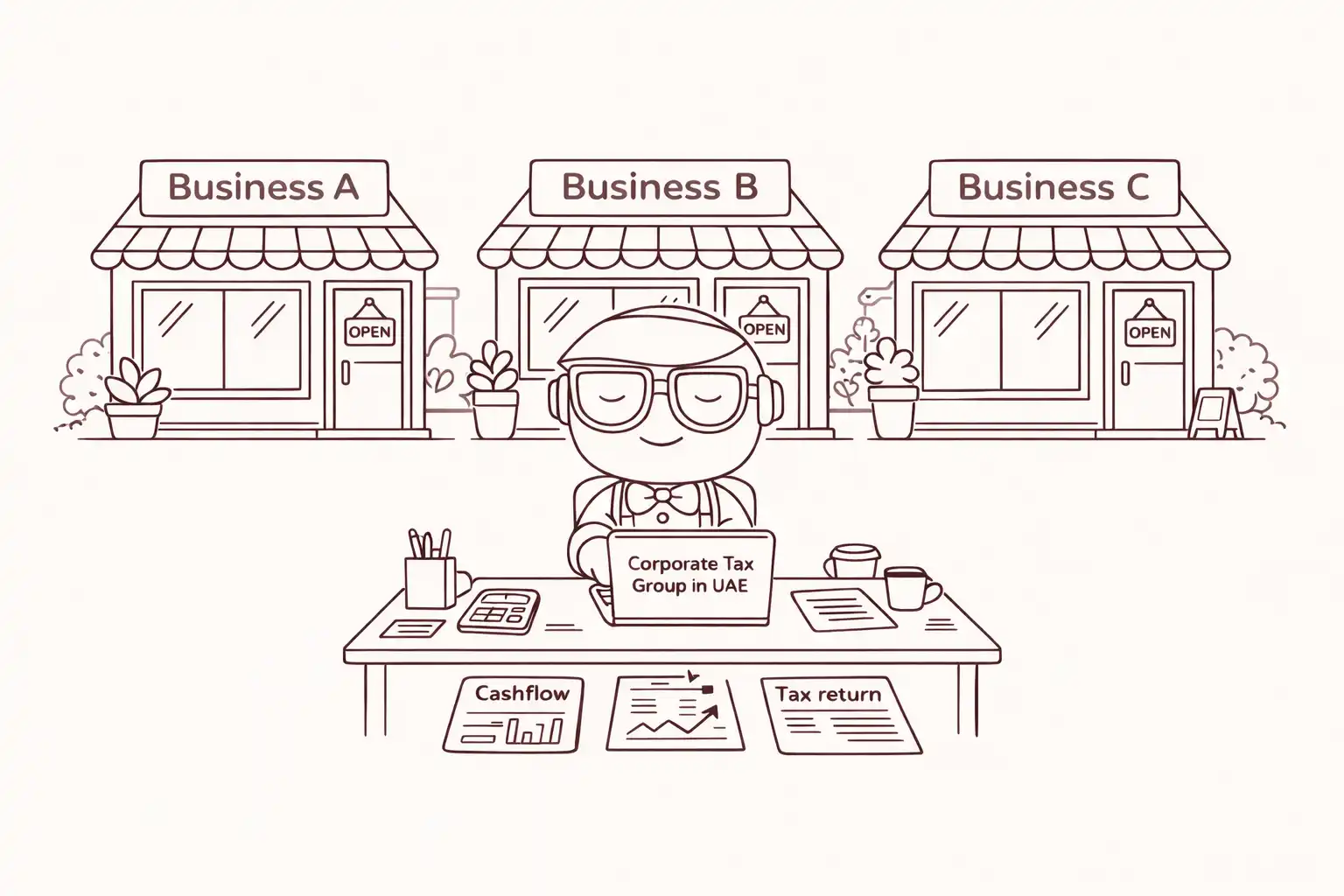
With the introduction of the UAE Corporate Tax Laws under Federal Decree Law No. 47 of 2022 effective 1 June 2023, businesses operating through multiple UAE entities have the option to form a corporate tax group.
The UAE has two main types of tax groups: Value Added Tax (VAT) Groups and Corporate Tax (CT) Groups. For the purpose of this article, we will only cover corporate tax groups.
CT groups require careful planning and structuring of their business activities for compliance efficiency. This framework allows qualifying companies to be treated as one taxable person for corporate taxation purposes, subject to strict ownership, residency and accounting conditions.
In this article, we explain how UAE mandates groups, who is eligible, key benefits and obligations business entities should consider before registering.
A corporate tax group is a tax treatment that allows two or more UAE-resident companies to be treated as a single taxable person for corporate tax purposes, subject to approval by the Federal Tax Authority (FTA).
In practice, this means that:
Typically, a tax group is formed by:
Given members of the group must be juridical resident persons (i.e. legal corporate entities), resident natural persons (i.e. sole proprietors, freelancers, founder personally holding multiple businesses) are excluded even if they are subject to corporate tax individually.
Note
Any wholly owned and controlled subsidiaries by exempted entities may be subject to exemption if conditions are met.
To qualify for group eligibility, all conditions must be met at the same time:
Not all businesses are eligible to form a UAE corporate tax group.
The corporate tax regime is limited to companies that meet residency and other legal requirements. In addition, all members must satisfy the 95% ownership requirement—any shortfall, even 94%, makes the group ineligible. These restrictions ensure that only companies under common control can consolidate for corporate tax purposes, preventing the artificial shifting of profits and losses between independently controlled entities.
To summarize the benefits of forming a tax group:
| Activity | Additional Context |
|---|---|
| Simplifying compliance and reduced administrative burden | One tax return instead of multiple filings in a single tax periodThe group must prepare consolidated financial statements |
| Tax efficiency and loss utilization | Losses of one entity can offset profits for another |
| Cash flow optimization | Reduced immediate tax outflowsInstead of paying for multiple tax payables, the group can optimize the process |
| Reduced transfer pricing documentation and error exposure | Intragroup transactions within the tax group are generally disregarded |
Once each company has registered for Corporate Tax individually and confirmed it meets the eligibility requirements, the parent company can apply to form a Corporate Tax Group through the FTA’s EmaraTax portal.
Verify that all proposed members satisfy the Corporate Tax Group conditions.
The parent company, acting as the representative member, logs into EmaraTax and submits the Corporate Tax Group application. During the process, the representative member identifies the group members, completes the required declarations, and uploads any supporting documents requested by the FTA.
The FTA reviews the application and may request additional information before making a decision. The Corporate Tax Group only becomes effective from the approved tax period and cannot be applied retrospectively to tax periods that have already been filed.
Once approved, the group receives its own Tax Registration Number (TRN). From that point onward, the representative member is responsible for filing a single consolidated Corporate Tax Return and managing the group’s tax obligations.
Looking for the complete process? Read our step-by-step guide to registering a UAE Corporate Tax Group in this EmaraTax walkthrough.
As a single taxable entity, tax groups are required to continuously comply under CT Law.
As such, the following are considered as joint risks for the parent company and other members.
The parent company must prepare consolidated financial statements for the tax group, which can increase compliance costs. As the representative, they are responsible for the administration, including submission of one taxation returns and settlement of the tax liability for the entire group.
A corporate tax group can add new members after it has been formed, provided the new entity meets all eligibility requirements and the change is approved by the FTA. Keep in mind that all conditions must be met before the new entity can be added.
In practice, the representative member must notify the FTA through the EmaraTax portal and submit the updated group details and documentation. The new addition takes effect from the approved tax period and is not considered as retroactive.
A UAE Corporate Tax Group may remove a member if eligibility conditions are no longer met, such as ownership falling below 95%, restructuring, or voluntary application.
A company leaving the group retains any unused pre-group tax losses, while losses generated during the period registered within the group remain with the tax group.
Certain tax adjustments may apply if assets were transferred within the group before departure. If the group no longer qualifies, it is dissolved and each company resumes filing Corporate Tax returns independently, with the FTA requiring timely updates to avoid administrative penalties.
In the event a Corporate Tax Group is dissolved, each company is treated as a separate taxable person from the effective date of dissolution.
Each member becomes responsible for its own Corporate Tax compliance, including filing returns, maintaining records, and meeting future filing deadlines.
If the dissolution results from a company ceasing its business activities, the parent company must apply to the FTA to deregister the group where required.
Businesses should also promptly update their Corporate Tax records, as failing to notify the FTA of relevant changes may result in administrative penalties and future compliance issues.
In practice, each company still prepares its own financial statements. These records are then combined at group level for tax purposes.
The Parent consolidates the members’ results and eliminates intra-group transactions to produce Tax Group consolidated financial statements.
Afterwards you apply Corporate Tax adjustments (e.g., non-deductible expenses, interest limitation rules, exempt income/reliefs) to arrive at Tax Group taxable income.
Tip
A common mistake is to assume that forming a Tax Group means you can simply add up each company’s profits and file once. In practice, each entity’s results still matter, and the Tax Group taxable income is calculated by consolidating members’ results and then applying Corporate Tax adjustments. The Tax Group affects how Corporate Tax is calculated and filed, not how each company operates day to day.
Once group taxable income is determined, the group applies the standard tax rates:
This will produce the group’s tax payable to be reflected when filing. Remember that all members are jointly and severally liable for the full amount.
For most businesses, the 9% tax rate will apply.
However, for large multinational enterprise groups, they may be subject to additional layer of tax under global minimum tax rules.
Multinational enterprises with global consolidated revenue of EUR 750 million or more are subject to the Domestic Minimum Top-up Tax (DMTT). DMTT brings up the effective tax rate up to 15% through this top up tax, meaning it does not replace the 9% tax rate and will only apply to the difference needed to reach 15%.
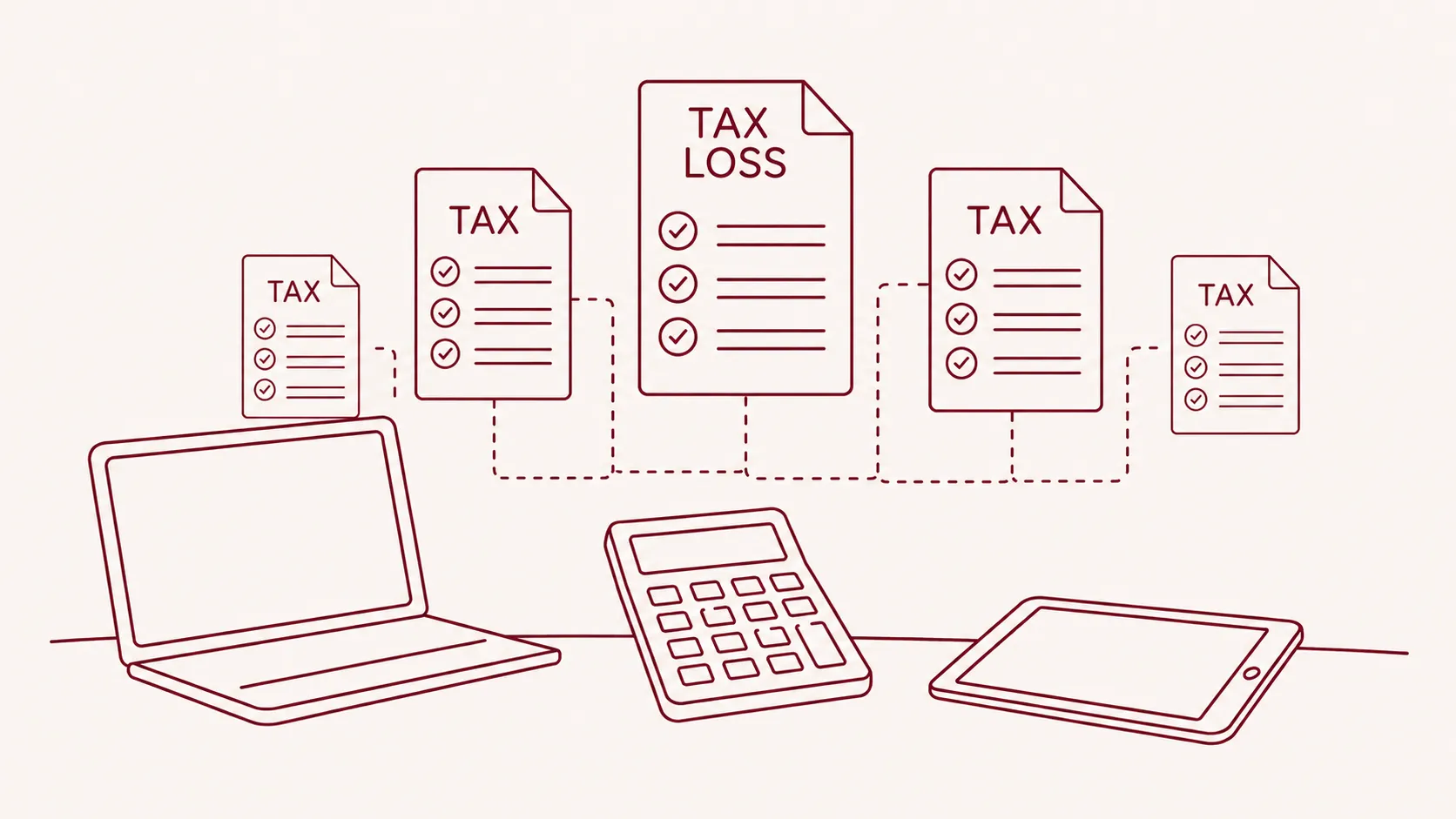
Tax losses in a Corporate Tax Group are treated differently depending on when it happens.
Losses incurred after the group is formed can generally be shared to offset the group’s taxable income, while losses from before joining remain with the original company and cannot be transferred to other members.
The UAE Corporate Tax regime also imposes annual limits on how much taxable income can be offset by losses.
Read our full guide to understand how tax loss relief works for Corporate Tax Groups.
When companies operate as part of a group, the tax law pays close attention to how transactions between related parties are priced. This is where the transfer pricing rules apply.
Intragroup transactions between members of the same corporate tax group are generally ignored for tax purposes, considering that they are treated as one taxable person.
Transactions outside the group however follows a different principle. When a member transacts with:
These transactions must follow transfer pricing rules. Rules state that related parties must price transactions under the arm’s length standard i.e. as if they were dealing with an independent third party.
To understand the difference on how each transaction is treated and how transfer pricing documentation is applied, check out our guide below.
Forming a tax group can unlock real efficiency, but only if it is set up correctly and monitored continuously. While tax group formation can be tricky with its shared risks and benefits, structured support matters more than one-off advice.
These are the errors that most often cause issues with the FTA and where our systems and processes help founders stay ahead.
| Mistake | What to do |
|---|---|
| Trying to register a tax group before individual CT registrations are complete | Skrooge can ensure that each entity is correctly registered and visible on EmaraTax before any group application is initiated |
| Assuming tax group approval is automatic | Approach tax grouping as an approval process, instead of a one-off compliance checkbox. Prepare the financial records with supporting and aligned documents available for review at any time.
At Skrooge, we keep your transactions recorded and ready for viewing at any time using our AI-enabled accounting platform plus experienced finance professionals. |
| Missing or misalignment in financial year or accounting standards | A centralized and well kept bookkeeping and reporting can make inconsistencies visible early, even before filing. |
| Including a free zone company or branch that is already claiming the 0% QFZP status | Our expert accountants can flag inconsistencies and conflicts ahead so founders don’t run the risk of missing important information. |
Skrooge is built to support complex compliance decisions like tax registration and filing, combining automation for accuracy with hands-on accountant review for judgment calls. With our multi-year experience and hundreds of clients served, we help founders make the right election, apply it correctly, and sustain compliance over time.
If you’re interested to learn more, visit our website and use our transparent pricing calculator to get a clear, upfront view of what support you might need.
A tax group refers to a group of resident individual companies treated as one taxable person, while individual company taxation treats each company as a separate taxpayer.
An entire tax group can be taxed as a single entity with one consolidated tax filing and their profits and losses can be used to offset across group members. Intragroup transactions are generally ignored after joint application is completed and approved by the FTA. All tax group members are jointly and severally liable for the group’s tax, while individually taxed companies are only responsible for their own liabilities.
The main benefit of forming a tax group is the ability to calculate corporate tax at a group level instead of per company. The ability to offset profits and losses across members is especially enticing, which can reduce the overall tax payable.
Aside from tax incentives, a tax group is beneficial to simplify administrative burden in a financial year. Tax compliance is easier since the group will only need to file one consolidated return. For groups with uneven performance across entities, this structure can improve cash flow and administrative efficiency.
Under UAE CT Law, the following criteria must be met to form a tax group:
✔️ Members must be UAE resident juridical persons (i.e. companies, not individuals)
✔️ Ownership interest: Parent company must own at least 95% of its subsidiary or subsidiaries covering capital share, voting rights and entitlement to profits and net assets
✔️ All members must be subject to corporate tax as taxable entities
✔️ All members must use the same financial year and accounting framework as reflected in their financial statements
This ownership requirement means the parent company must own the subsidiaries, and the following must be met simultaneously in all categories:
-> Ownership of share capital
-> Voting rights, and
-> Profit entitlement
Ownership must be direct or indirect and maintained throughout the relevant tax period. If ownership falls below 95% in any one of these areas, the tax group does not qualify or may be dissolved. This rule ensures that the group operates as a single economic unit rather than loosely connected companies looking for a tax break.
Only UAE resident juridical persons may be members. Non-resident companies, even if they have UAE-sourced income, cannot be members of a tax group. A foreign company with a UAE Permanent Establishment (PE) is still treated as a non-resident and cannot join a tax group.
Likewise, the following are not eligible to join:
1. Persons exempt from CT cannot join
2. Free zone companies may only join if they do not claim the 0% Free Zone tax regime
3. Natural persons (individuals) are not eligible. Only companies are allowed to apply.
Yes, a free zone company can be part of a corporate tax group only a) if they do not claim the Qualifying Free Zone Person (QFZP) status with 0% regime on qualifying income, and b) they are eligible as per criteria mentioned above.
Once a free zone company joins a group, it becomes taxed under standard taxation brackets and their income is included in the group’s consolidated tax-eligible income. This prevents businesses from combining free zone tax incentives with tax group benefits.
You should upload ownership structure chart. Additionally, compliance for group tax requires documentation on transfer pricing that reflects arm’s length standards, particularly for transactions with related parties outside the group.
The TRN is a unique number issued by the FTA once the group is approved. This identification number applies to the whole group as a single taxable person, and is used for filing returns and making tax payments.
The TRN is linked to the representative member (typically the parent company) within the EmaraTax platform.
Yes, members can leave, but only if the change is properly notified and recognized by the FTA. Only taxable entities can be members, so a member may leave if:
✔️ a company is sold or restructured
✔️ no longer meets the 95% ownership requirement
When a taxable entity leaves the group, it reverts to being taxed separately as its own taxable person. Certain tax treatments that applied only because the group was taxed as one entity may stop at exit, requiring forward looking adjustments so future tax calculations remain accurate.
Changes to group membership must be reported immediately through EmaraTax, and the exit is effective from the approved tax period (not retroactively). Non compliance will create penalties.
Group losses incurred after the group is formed can be shared across members and used to offset gains at the group level.
Pre-group losses (losses incurred wholly before formation) remain ring-fenced to the original company and cannot be shared with other members.
Loss utilization is assessed per tax period and only losses incurred wholly and exclusively for business purposes are eligible for relief.
Thank you!
We've received your request and will get back to you shortly.

Loading...
 Thank you!
We've received your request and will get back to you shortly.








 Contact Us


