


Salary Certificate UAE: What Employers Must Include (+ Free Template)
Let’s say your employee asks for a salary certificate on Sunday. They need it for…
Saying goodbye to a company you worked hard on is already hard without having to navigate the additional compliance requirements involved in liquidation.
This guide is for UAE founders, shareholders, directors and finance managers closing a mainland or free zone company and needing to understand the legal process and tax obligations involved. While the appointed liquidator oversees the formal liquidation proceedings, businesses must also address their accounting, Corporate Tax and VAT obligations before completing the closure process.
The first thing to note is that closing a company under the UAE Commercial Companies Law involves more than allowing your UAE trade license to expire.
When a company’s shareholders decide to dissolve a commercial company, the business generally enters liquidation, with the appointed liquidator handling its remaining financial obligations before final deregistration.
The process can involve the licensing authority, FTA, labor and immigration authorities, banks, landlords, utilities and creditors.
While federal law provides the main framework, free zones may apply their own rules. Understanding the requirements of the relevant authorities helps founders, shareholders and finance managers close a UAE company properly and avoid leaving unresolved legal or tax obligations.
A liquidation report is the liquidator’s final financial or accounting report documenting:
In short, a liquidation report is a formal account prepared by the appointed liquidator, documenting the company’s financial position, how its assets and liabilities were handled, and the outcome of the liquidation process.
It forms part of the documentation required to complete the company’s closure, subject to the applicable authority’s requirements.
A liquidation report is the more commonly used term for the documentation prepared as the final account after liquidation. The appointed liquidator must submit the report and record its completion in the commercial register.
The liquidation report is prepared by the liquidator appointed to oversee the company’s dissolution.
The liquidator may be appointed by the partners, General Assembly or equivalent body, or by the competent court where liquidation follows a court order. The eligibility requirements for liquidators depend on the applicable law and licensing authority. Some free zones, for example, require the appointment of a liquidator from an approved list or require specific licensing documentation.
The liquidator cannot simultaneously be the company’s auditor and cannot have audited its accounts during the five years immediately preceding appointment.
This separation helps maintain independence during the liquidation process.
Businesses can learn more about the different types of audit reports in the UAE and the role they play in financial reporting.
A liquidation report is commonly requested as part of the final company cancellation or deregistration package.
The exact form, supporting documents and timing can differ significantly between authorities.
Note that there is no single UAE-wide administrative liquidation checklist covering every company.
The federal Commercial Companies Law provides the underlying legal framework, while free zones can impose their own requirements where their regulations contain special provisions.
For example, Dubai mainland commercial-company closure currently includes:
There is no single UAE-wide document called a “liquidation certificate.” The term can refer broadly to the documents issued during the company closure process.
Depending on the authority, the process may involve clearance certificates confirming that financial, tax, labor, utility or other obligations have been settled, followed by dissolution or final deregistration documents.
These clearances support the liquidation process, but they do not necessarily mean liquidation is completed.
For example, the final documents may include a dissolution certificate, license cancellation or final deregistration certificate, while the FTA separately issues a tax deregistration certificate.
Company liquidation in the UAE can take different forms depending on why the business is closing and whether it can meet its financial obligations. For founders, one of the most important distinctions is whether the company is solvent or insolvent, as this affects the applicable liquidation or insolvency process.
There are several reasons why a company may need to close, depending on the type of liquidation.
| Type of Liquidation | Reason for liquidation | What needs to happen legally | Specific examples |
|---|---|---|---|
| Solvent / Voluntary Liquidation | The partners agree to dissolve the company, provided the decision complies with the voting requirements under the company’s constitutional documents and applicable law. | The partners’ agreement should specify the method of liquidation and identify the appointed liquidator. The liquidator then manages the company’s affairs, settles its obligations and prepares the final liquidation account. | A company with sufficient assets to settle its liabilities decides to cease operations because its founders are pursuing other ventures or no longer intend to continue the business. |
| Insolvency / Financial Restructuring and Bankruptcy | The company is unable to pay its debts as they fall due or is facing financial circumstances covered by the applicable insolvency framework. | For mainland companies, Federal Decree-Law No. 51 of 2023 provides the framework for preventive settlement and bankruptcy proceedings. Under Article 15, a debtor may apply within 60 days of ceasing payments or becoming aware that it cannot pay its debts when due. The law also provides that an application is not automatically inadmissible solely because this period has passed. Certain free zones have their own insolvency and winding-up procedures. For example, DMCC’s Company Regulations expressly recognise insolvent voluntary winding-up, including creditor involvement and the appointment of a liquidator. | A mainland company has accumulated unpaid supplier liabilities and can no longer meet its financial obligations. Depending on its circumstances, it may seek preventive settlement or enter bankruptcy proceedings under the applicable law. |
| Compulsory / Involuntary Liquidation | Compulsory liquidation is initiated by a court order due to unpaid debts, legal disputes or other grounds recognized by the applicable law. For General Partnerships and Limited Partnerships, a court can dissolve the company where a partner establishes good cause or another partner fails to honor commitments | Where liquidation is based on a court order, the court determines the liquidation method and appoints the liquidator | A company is ordered to be dissolved and liquidated by a competent court following a legal dispute or other statutory ground for court-ordered dissolution. The shareholders are not choosing to wind up the company themselves; the court orders the liquidation. |
| Provisional Liquidation | An interim appointment intended to protect company assets or preserve the company’s affairs while relevant legal or insolvency proceedings are pending. | The appointment and powers of a provisional liquidator depend on the applicable court process and jurisdiction-specific rules. | A company facing a dispute over its assets may require interim protection while the court considers the next steps in the proceedings. |
The federal law requires the liquidator to establish the company’s financial position and document the liquidation.
The statutory foundation of the report would generally cover:
A liquidation report/final account may therefore include:
Note
The Commercial Companies Law does not prescribe one universal liquidation-report template containing every item above.
The exact document required by DET, JAFZA, DMCC, IFZA, Meydan or another authority can differ.
Check the issuing authority’s current validity requirements before commissioning the final report, because documents may need to be issued within a specified period.
Once dissolution takes effect, the liquidator is responsible for identifying and protecting the company’s assets, collecting outstanding receivables, settling liabilities and paying creditors before the remaining assets can be distributed.
The exact liquidation timeline varies depending on the company, authority and circumstances, but the legal framework below sets out the key stages within the liquidation proceedings.
To close a mainland company in the UAE, you must publish a formal liquidation notice in two local daily newspapers (typically one in an Arabic daily and another one in an English daily).
Under the federal Commercial Companies Law, creditors must generally be given at least 30 days from the liquidation notice to submit claims. Dubai mainland procedures currently use a 45-day creditor claim period.
This statutory window gives creditors and other third parties time to submit formal financial claims against the business.
Companies are required to observe the applicable creditor notification period before proceeding with the final liquidation and deregistration stages.
Before publishing the liquidation announcement, the company must appoint a liquidator in accordance with the applicable company law and licensing authority requirements.
The initial dissolution resolution and liquidator appointment must then be submitted to the relevant authority for registration and approval, where required.
The official tear sheets or digital proof of publication from the newspapers must later be submitted alongside the liquidator’s final report to cancel your trade license.
Cancelling a trade license does not automatically deregister a company from the FTA.
Closing a business still requires its tax obligations to be dealt with as part of the formal closure process. Corporate Tax, VAT and other tax registrations have separate deregistration requirements, deadlines and documentation.
Failing to address them can result in administrative penalties.
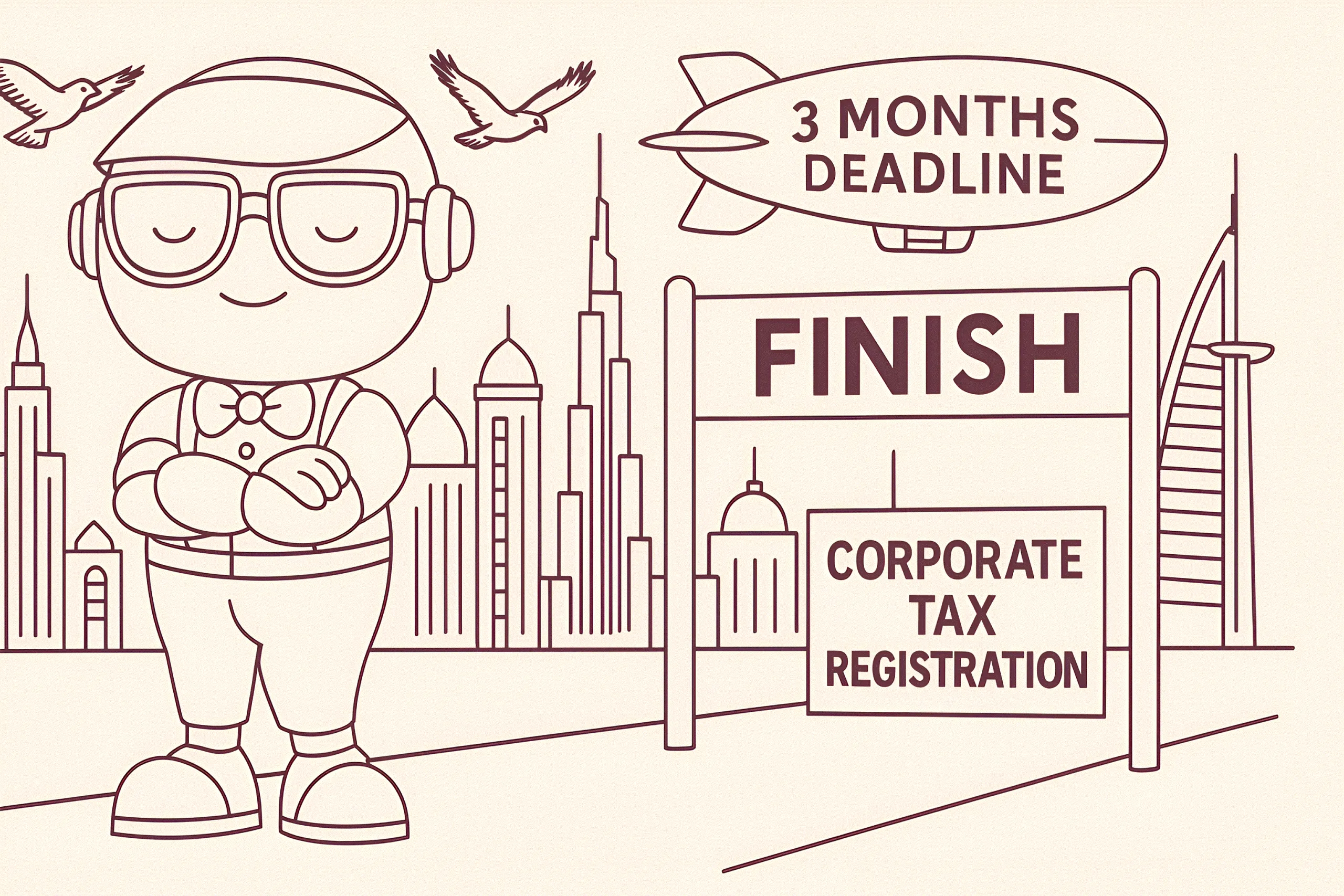
A juridical person that ceases business, dissolves or goes into liquidation must apply for Corporate Tax deregistration through EmaraTax. The application must generally be submitted within 3 months of the cessation, dissolution or liquidation event.
The FTA requires the taxpayer to have dealt with its outstanding tax obligations, including relevant returns, Corporate Tax liabilities and administrative penalties, before deregistration can be approved. For a liquidation or bankruptcy, supporting documents can include the license cancellation document and financial statements up to the cancellation date.
The company must also deal with its final Corporate Tax return covering the applicable shortened final tax period, along with any outstanding payment obligations. Corporate tax returns must be filed, and are generally due within 9 months of the end of the relevant Tax Period.
Late Corporate Tax deregistration can result in an AED 1,000 penalty, followed by AED 1,000 for each month of delay, up to AED 10,000.
VAT deregistration is a separate FTA process with its own deadlines and penalties. The application must be submitted within 30 business days from the date the deregistration obligation arises.
Depending on the reason for deregistration, the FTA may require supporting documents such as a cancelled trade license, liquidation letter or board resolution.
The required documentation depends on the basis for deregistration. Once the application is approved and outstanding tax obligations are settled, the FTA issues a VAT Deregistration Certificate.
The final VAT return and any VAT payable must be dealt with within 28 days from the effective date of deregistration. Late mandatory VAT deregistration can result in an AED 1,000 penalty initially and AED 1,000 monthly thereafter, up to AED 10,000.
For a deeper explanation, see our guide for VAT deregistration.
Note
The key takeaway for founders is simple: trade license cancellation is not the same as FTA deregistration. Corporate Tax and VAT deregistration are separate regulatory clearances, each with its own trigger, deadline and documentation.
An accountant’s perspective can be helpful when navigating the accounting and tax requirements involved. Skrooge offers transparent and end-to-end company liquidation support.
Company deregistration in the UAE does not mean you can immediately dispose of the company’s books and records.
Keeping these records in an orderly way is important because tax and corporate obligations can continue to require supporting documentation after the business has closed.
Under the Commercial Companies Law, companies must retain their accounting records for at least five years from the end of the relevant fiscal year. The Corporate Tax rules separately require relevant tax records and documents to be retained for seven years after the end of the relevant Tax Period. This includes records supporting transactions, assets, liabilities and tax returns.
For Limited Liability Companies (LLCs) and other companies, arrangements for retaining records after liquidation should be documented clearly.
Under the federal Commercial Companies Law, accounting registers must generally be kept at the company’s head office for at least five years from the end of the fiscal year. Free zones may impose additional or different record-keeping requirements.
Closing a UAE company involves both corporate liquidation and tax deregistration. While these processes are connected, they have separate requirements, documentation and responsibilities.
The appointed liquidator oversees the formal liquidation proceedings, including the preparation of the final liquidation report. Separately, the company must address its accounting records, outstanding liabilities, Corporate Tax and VAT deregistration, and applicable final tax returns.
Through its network of vetted liquidation partners, Skrooge can help coordinate with the appointed liquidator while supporting the accounting and tax requirements involved in closing the business. This includes preparing accounting records, supporting final accounts, assisting with Corporate Tax and VAT deregistration, and helping businesses address outstanding filing obligations.
A Liquidation report is a final report/account prepared by the appointed liquidator documenting the liquidation, including the company’s financial position, settlement of liabilities and treatment of remaining assets.
The final liquidation report is prepared by the appointed liquidator, not independently by the company.
The liquidator is appointed by the partners, General Assembly or equivalent body, or by the competent court where liquidation follows a court order.
Additional licensing or approval requirements depend on the applicable jurisdiction and licensing authority.
The time required depends on the company, the licensing authority and the complexity of the winding-up process. Under federal law, the liquidator’s mandate is generally based on the period stated in the appointment document; where no period is specified, a partner may ask the court to determine one.
For Dubai mainland companies, the current process includes a 45-day period for creditors to submit claims. Free zones follow their own procedures and timelines. For example, JAFZA currently lists 21 working days for its company termination service once the required submission is complete.
Outstanding creditor claims, tax obligations, employees, property, banking matters or other clearances can extend the overall liquidation timeline.
Yes. If the company is registered for Corporate Tax and ceases to exist through liquidation or dissolution, it must apply for Corporate Tax deregistration with the FTA.
The application must generally be submitted within three months of the relevant event.
The company must also file its final Corporate Tax return for the applicable final Tax Period and settle outstanding liabilities before deregistration can be completed.
License cancellation does not by itself complete the company’s tax obligations.
Corporate Tax and VAT deregistration are separate FTA processes. Failure to submit required deregistration applications can result in administrative penalties.
Outstanding tax returns, payments and deregistration obligations must also be addressed. Failure to comply with the applicable requirements may result in administrative penalties.
Thank you!
We've received your request and will get back to you shortly.

Loading...
 Thank you!
We've received your request and will get back to you shortly.










 Contact Us


