

Accounting services in DIFC
Accounting in DIFC goes beyond maintaining financial records. Companies operating in the Dubai International Financial…
From time to time, you will incur various costs for the benefit of your client. If your business is a law firm, you may pay for court fees. Trading businesses often send employees to different cities or even countries for client meetings. A consultancy firm may engage the services of specialists. A contract manufacturer may procure special raw materials needed to produce something that meets the client’s unique expectations.
Where these costs are recovered from the client, the VAT treatment depends on whether the recovery is a reimbursement or a disbursement.
In this article, we will discuss the meaning of reimbursements and disbursements, how these two differ from each other, how to prepare invoices for both, their UAE VAT implications, and what businesses often get wrong about such expenses.
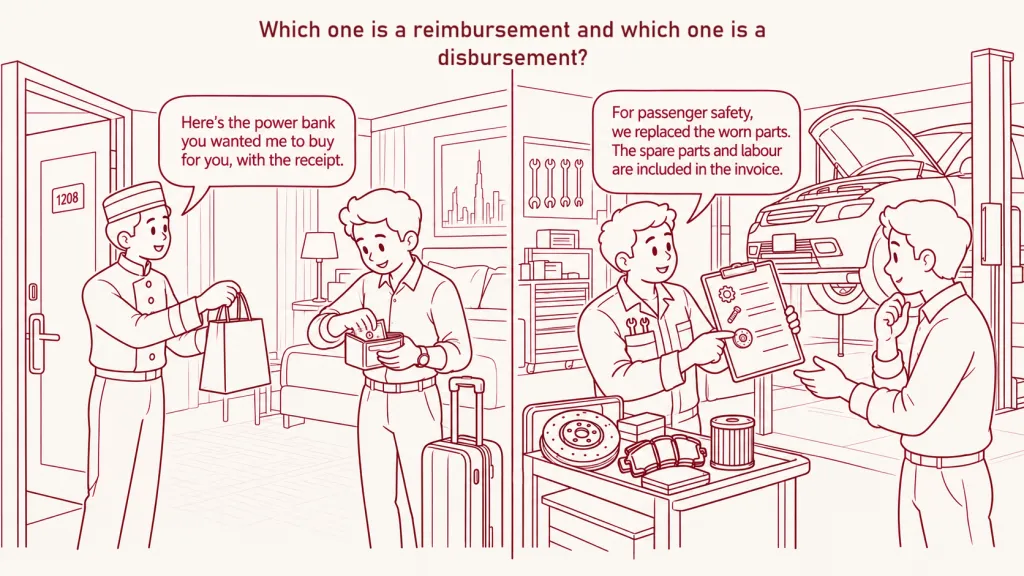
Reimbursements and disbursements have different UAE VAT treatments. Both represent expenses incurred to serve the client and the subsequent recovery.
But, as per the public clarification issued by the Federal Tax Authority (FTA), reimbursements fall within the scope of VAT and generally form part of the payment for the main supply, so they follow the same VAT treatment as that supply. A qualifying disbursement is outside the UAE VAT scope.
So, you may charge output VAT on reimbursements but never on disbursements.
An invoice for reimbursement will have the same VAT treatment as the main supply. If the main supply is standard-rated, the reimbursement will be subject to 5% VAT. If it is zero-rated, the reimbursement will also be zero-rated. If it is VAT exempt, the reimbursement will also be VAT exempt.
In contrast, disbursements are outside the scope of VAT, and hence, you do not need to charge any VAT on these invoices.
For reimbursable expenses, your business may recover eligible input VAT. But for qualifying disbursement expenses, any eligible input VAT paid is generally recoverable by the client, not by the business that merely made the payment for the client.
Mistaking a reimbursement for a disbursement may sometimes mean not charging VAT when you should have. This will shrink your margins. On the other hand, mistaking a disbursement for a reimbursement may mean overcharging your client. If the mistake resulted in VAT being incorrectly charged and requires a reduction in output tax, a tax credit note should be issued. You must also correct the VAT reporting in accordance with the applicable rules.
Want to learn when and how to issue tax credit notes? In a previous article, we covered the correct tax credit note format, the relevant deadlines, and how credit notes impact VAT returns.
A disbursement refers to the recovery of a cost where you essentially just facilitated the transactions. Some of the conditions for a cost to be called a disbursement are:
Where these indicators, considered together with the overall facts and circumstances, show that you acted as the client’s agent, the recovery would generally qualify as a disbursement and no VAT should be charged on the recovery. Some examples of disbursement of expenses would be recovering government fees, court filing fees, and visa and license fees, provided the FTA’s conditions for a disbursement are met.
Reimbursement refers to the recovery of the cost your business incurs to purchase goods or services used to serve the client. The client may not want these goods or services, but your business may need them to produce a different supply desired by the client. Or you may have applied a mark-up to these items. Some of the key indicators of a reimbursement transaction are as follows:
Under the UAE VAT law, the VAT treatment for reimbursements is the same as the primary supply. Some examples of reimbursements would be travel and accommodation expenses, subcontractor fees, logistical costs, and software licenses purchased while serving the client.
As per the UAE VAT reimbursement definition, the application of a mark-up to the costs constitutes reimbursement unless the facts and circumstances of the transaction suggest otherwise.
Let’s look at some useful questions that can help determine whether an expense recovery is a disbursement or a reimbursement. These are indicators rather than a standalone checklist, and the facts and circumstances should also be considered.
Here’s a simplified summary of the differences between reimbursement and disbursement.
| Reimbursement | Disbursement | |
|---|---|---|
| Decision-making power | Business | Client |
| Who is legally responsible to pay? | Business | Client |
| Recipient name on the invoice | Business | Client |
| Consumer | Business | Client |
| Mark-up | Can be applied | Cannot be applied |
| VAT treatment | Same VAT treatment as the main supply | Outside the scope of VAT |
Does your business need to recover some unusual or complex costs that do not cleanly fit into either category? Consider consulting Skrooge’s tax experts. We can help you understand the right accounting treatment of any kind of commercial transaction.
The key difference between invoices raised for disbursements and those raised for reimbursements is the VAT treatment. On reimbursement invoices, you need to apply the same VAT rate as the primary supply.
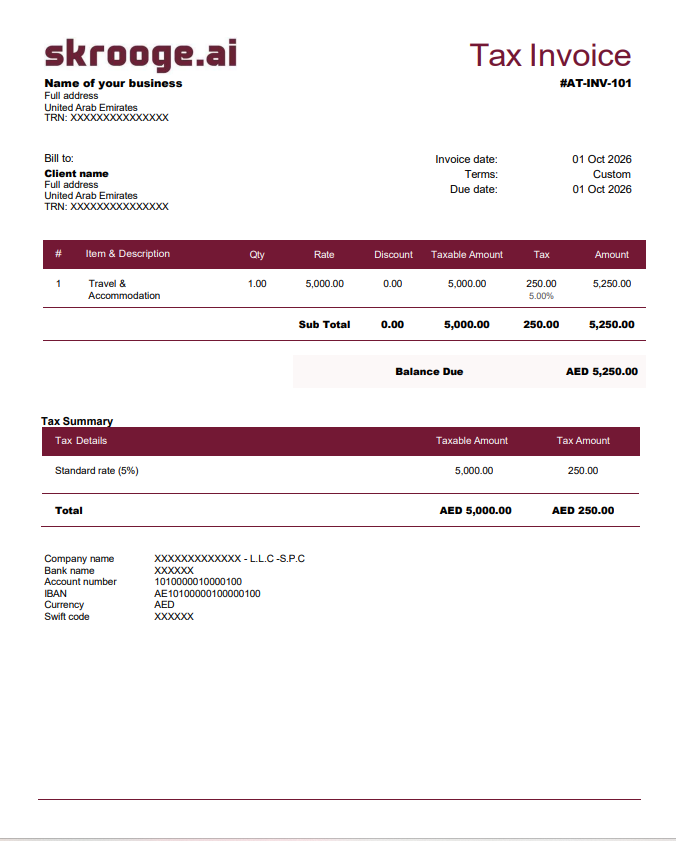
The picture below shows what a reimbursement invoice looks like in our template. Your business incurred AED 5,000 of travel and accommodation costs before VAT. If the reimbursement follows a standard-rated main supply, 5% VAT is applied, resulting in a total charge of AED 5,250.
On the other hand, if your cost recovery is classified as a disbursement under UAE VAT rules, you should not apply any VAT. Suppose your business assists a client in obtaining a trade license from Meydan Free Zone, and the amount paid on the client’s behalf is AED 12,500. Then, the disbursement invoice you raise should look something like this:
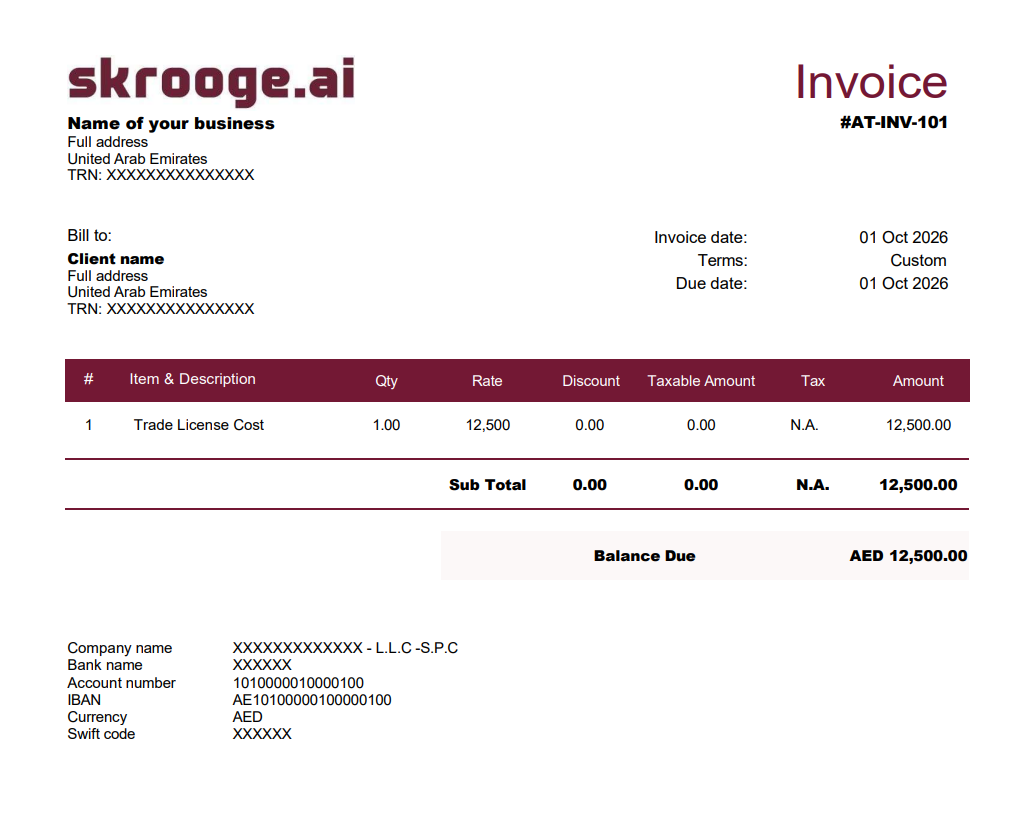
There’s no VAT applied, not even 0%, so the invoice was raised for the exact amount of AED 12,500.
If you are raising a composite invoice for all supplies and cost recoveries, you must include the reimbursable expenses as taxable line items and show qualifying disbursements separately without charging VAT on them. Let’s see how that would look.
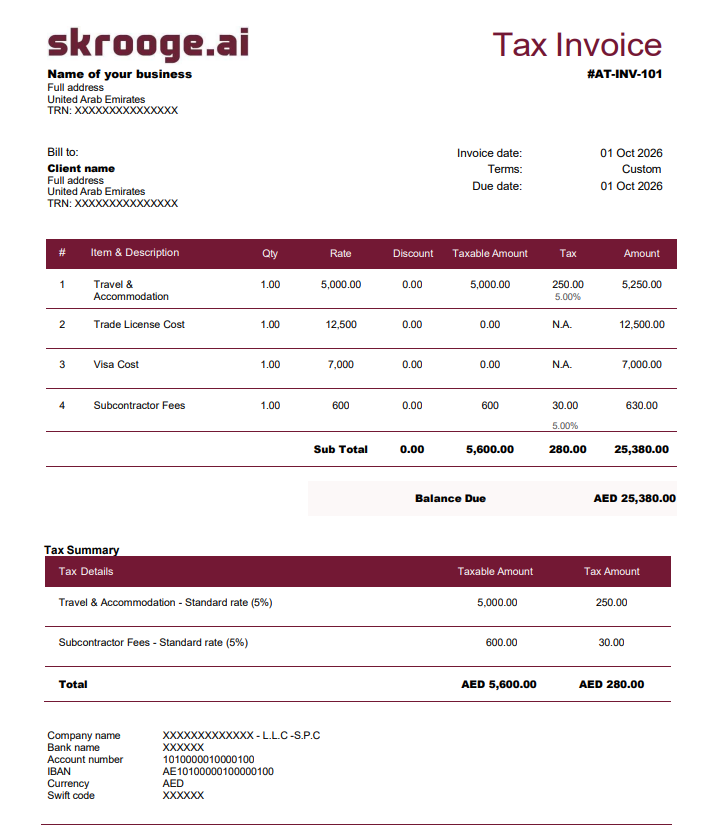
There are 4 costs for which the business is raising the above invoice. Out of the 4, travel & accommodation and subcontractor fees are reimbursements. Visa cost and trade license are disbursements. The 5% VAT is applied only to travel & accommodation and subcontractor fees, and these are the only 2 line items in the tax summary. No VAT is applied to visa costs and trade licenses, and they are not included in the tax summary either.
Note
The above invoices are for illustrative purposes only. As the UAE moves towards e-invoicing, any PDF, Word document, image, scanned copy, or email invoices will not suffice. In certain cases where the buyer hasn’t yet implemented e-invoicing, such traditional digital invoices may be required. However, once your business falls under the scope of e-invoicing, you must issue e-invoices through the prescribed providers. If you would like to learn how your business should adopt e-invoicing, take a look at our previous article that discusses the relevant deadlines, the scope of e-invoicing, how to identify authorized e-invoicing partners, and how to upgrade your accounting processes in preparing for e-invoicing.
Some of the common mistakes businesses make when recovering costs are as follows:
Is your VAT filing deadline approaching fast? Our experts perform a VAT health checkup and prepare and file VAT returns for you for just AED 499. If required, we also perform backlog accounting, which is priced separately. Learn more about Skrooge’s VAT filing service.
If you make a purchase as an agent of the client, you can recover it as a disbursement. However, if you made the purchase as a principal deciding which goods or services to consume to ultimately deliver the supplies requested by the client, you must recover it as a reimbursement. If a mark-up is applied, the recovery does not meet the FTA’s condition for disbursement treatment and would generally be treated as a reimbursement.
Once the correct reimbursement or disbursement treatment has been determined, invoicing software can automate the appropriate VAT treatment and accounting entries. Skrooge’s invoice automation tool is designed to apply configured VAT treatments across invoices generated through connected systems. Our invoice automation tool enables you to generate invoices aligned with your POS systems, accounting software, or payment gateways. The tool is designed to apply the appropriate VAT treatment to invoices and automate the related accounting entries. Learn more about our invoice automation tool.
Reimbursements generally arise where your business incurs the expense as principal and subsequently recovers it as part of the consideration for its supply. They are treated as part of your supply and hence attract the same VAT rate. Disbursements refer to the recovery of costs where you simply facilitated the transaction. If a mark-up is applied to any cost recovery, the transaction is treated as a reimbursement. There are various other technical differences, but the core differentiators remain who authorizes the transaction, whether there is a mark-up, and who consumes the goods or services.
You may need to charge VAT on recharged costs that are classified as reimbursements but not on disbursements. Reimbursements are treated as part of the product you deliver and have the same VAT rate. VAT doesn’t apply to disbursements since these are cases where you simply facilitate the transaction rather than making a supply to the client.
No, if you add a mark-up to a cost recovery, you cannot claim it as a disbursement. Instead, you will have to recover it as a reimbursement and mirror the tax treatment of your primary supply. If your primary supply carried 5% VAT, apply the same to the reimbursement. If it was zero-rated, the reimbursement will also be zero-rated. If it was not a taxable supply, the reimbursement will also not be taxable.
When a disbursement is included on a tax invoice alongside taxable supplies, it should be separately identified, carry no VAT, and be excluded from the VAT calculation.
If the UAE Federal Tax Authority (FTA) reclassifies your disbursement, the applicable VAT must be accounted for based on the VAT treatment of the primary supply, together with any required correction to the relevant VAT return.
Thank you!
We've received your request and will get back to you shortly.

Loading...
 Thank you!
We've received your request and will get back to you shortly.










 Contact Us


