


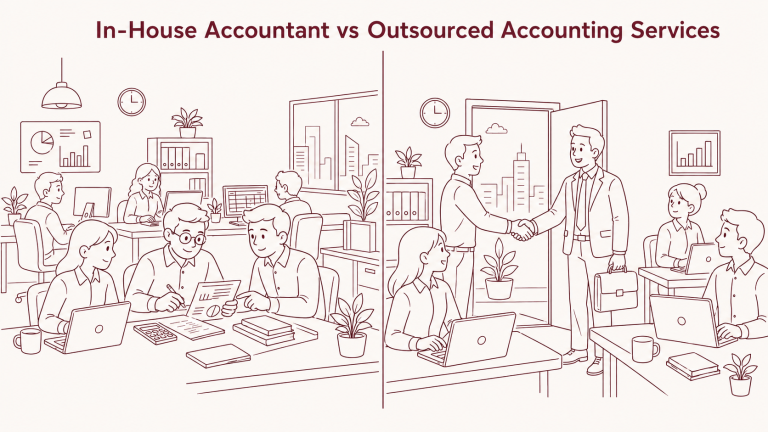
In-House Accountant vs Outsourced Accounting Services in UAE: True Cost Breakdown
Beyond ensuring compliance, accurate bookkeeping helps business owners monitor cash flow, measure profitability, protect the…
Management accounting helps business owners make better decisions using financial and operational information. While most UAE businesses understand the importance of bookkeeping, VAT returns, and Corporate Tax compliance, many overlook the internal reporting systems that explain why the numbers are changing and what to do next.
Financial statements tell you what happened in the past. Management accounting goes one step further by helping you understand where the business is heading, whether you are meeting your targets, and what decisions will improve profitability, cash flow, and long-term growth.
In this guide, we’ll explain what management accounting is, how it differs from financial accounting, how MIS reporting fits into the picture, and why it has become increasingly valuable for businesses operating in the UAE.
Management accounting, sometimes also referred to as managerial accounting, is the process of analyzing financial and non-financial information to support internal business decisions. These decisions may relate to budgeting, pricing, expansion, capital expenditure, cost control, organizational restructuring, or mergers and acquisitions.
In the UAE, management accounting also plays an important role in tax forecasting, tax provisioning, and compliance planning. Management teams monitor taxable income, recoverable VAT, and future tax liabilities throughout the year so they can prepare for VAT and Corporate Tax filings well before the deadlines.
Financial accounting focuses on preparing general-purpose financial statements for external stakeholders in accordance with applicable accounting standards and regulatory requirements. Unlike financial accounting, the purpose of management accounting is to aid the strategic decision-making of the company’s management. It helps management plan future activities, evaluate performance, and allocate resources more effectively.
Here we summarize the key differences between management accounting and financial accounting:
| Financial accounting | Management accounting | |
|---|---|---|
| Core focus | Ensuring that financial records accurately reflect financial performance and that financial statements are prepared in line with applicable accounting standards, such as IFRS or IFRS for SMEs where relevant. | Enabling the management team to make business decisions and maintain oversight over key functions |
| Target audience | External stakeholders | Management team |
| Time focus | Recording past data | Preparing forecasts and modelling scenarios using the company’s financial history and external data |
| Reports prepared | Financial statements such as the statement of financial position, statement of profit or loss, statement of cash flows, and related notes. | Custom reports prepared with the sole objective of enabling informed decisions through data-driven insights |
Here’s what management accounting actually involves:
Management accounting begins where financial accounting ends. As part of management accounting, you must first review your financial position and build forecasts for cost, revenue, and production. Based on these insights, you must prepare a budget, typically for the next financial year or quarter. Often, management teams will also ask for revised budgets in the middle of an accounting period to understand the business’s current cost performance and financing needs.
The management will want to discover any avenues for cost reduction. Businesses typically use cost accounting to record, analyze, and allocate the costs of producing goods or delivering services across different products, services, or revenue streams. This enables management to judge how efficiently each revenue stream generates profits, enabling them to improve operational efficiency.
A company’s future financial performance is often a function of various financial and non-financial factors clubbed under the umbrella of key performance indicators (KPIs). Management teams track KPIs to understand the progress towards key business objectives. The financial forecasts prepared as part of management accounting incorporate most of the observable KPI trends. A good management accountant will capture the variance expected in KPIs and prepare forecasts for different potential scenarios. This informs the management about threats they must be on guard for or opportunities they should prepare for.
Management accounting supports strategic decisions such as pricing, capital expenditure, hiring, and make-versus-buy decisions. This involves leveraging financial analysis and scenario modelling in the following manner:
By modelling different financial scenarios, management can compare costs, estimate future profitability, and evaluate the long-term impact of major business decisions before committing resources.
In the UAE context, risk and compliance support revolves around Corporate Tax, Value Added Tax (VAT), Excise Tax, anti-money laundering regulations, and any Federal Tax Authority (FTA) queries received by the business. Hence, the management team must track the following elements to mitigate non-compliance risks:
These insights will enable the management to stay on top of tax reporting requirements.
Wondering if your business is better served as a free zone entity or a mainland business? In a previous article, we compare the compliance requirements, tax implications, and commercial advantages of both options to help you make an informed decision.
The choice between a management accountant and an outsourced service depends on how frequently you expect MIS reports. Mid-sized companies may manage in a setup where the in-house accountant performs both roles of financial accountant and managerial accountant.
For many SMEs, outsourcing both compliance and management reporting can be a more cost-effective alternative to building an in-house finance function. Skrooge’s Accounting & Tax package, which combines bookkeeping, VAT and Corporate Tax compliance, and monthly management reporting, takes care of both needs at the same time.
Later, at a much larger scale, it might make sense to internalize the management accounting function.
Management Information System (MIS) reports are customizable reports that pull insights from operational as well as financial data to help the management team to make informed decisions. Let us explore MIS reporting and how it connects to management accounting.
Here are the different types of management reports that business leaders use to gain visibility into performance.
| Report name | What does it cover? | Who reads it? |
|---|---|---|
| Financial report | Profitability metrics, cash flow analysis, cost accounting, and revenue forecasts | External stakeholders and senior management |
| Operational report | Inventory, production progress, sourcing, and logistical bottlenecks | Operations managers |
| Sales and marketing report | ROI on marketing campaigns, sales costs, and customer insights | Sales and marketing managers |
| Management control report | Budget versus actual expenditure | Senior executives or the founding team |
| HR report | Employee performance, training progress, competency or headcount gaps, and payroll costs | HR managers |
Note
MIS reports are, by definition, customizable reports meant to help internal managers navigate whichever challenge they are currently facing. So, if need be and if the relevant data is available, you could request your team to prepare an MIS report that doesn’t fit into any of the above categories.
A generic MIS report meant to inform the senior management about the company’s operational and financial health as well as its tax position should include the following elements:
Management accounting reports are not generally a statutory filing requirement under UAE Corporate Tax or VAT rules. Neither the Corporate Tax Law nor the VAT legislation requires businesses to prepare budgets, variance analyses, or monthly management reports. However, businesses that rely only on statutory accounting often discover problems only after they have already affected profitability or cash flow.
The introduction of UAE Corporate Tax has made management accounting even more valuable for businesses. Businesses now need better visibility into taxable income, deductible expenses, and expected tax liabilities. Management accounting provides this visibility by combining financial data with forward-looking analysis, allowing management to prepare for compliance rather than react to it.
If you’re looking for a broader explanation of the Corporate Tax law, our complete UAE Corporate Tax guide explains the rules, filing obligations, and thresholds in detail.
Better internal reporting also makes responding to Federal Tax Authority queries significantly easier because supporting information is already organized.
Free Zone businesses often benefit even more from management accounting. In addition to monitoring commercial performance, many need to keep track of qualifying and non-qualifying income, maintain adequate documentation, and understand how operational decisions may affect their Corporate Tax position.
Free Zone entities must satisfy specific regulatory requirements to maintain eligibility for preferential Corporate Tax treatment. We explain these rules in greater detail in our guide to Corporate Tax for Free Zone entities.
Ultimately, management accounting turns accounting records into information that management can use to make better business decisions. Instead of using accounting records only to satisfy regulators, businesses can use the same information to make faster and more informed decisions.
As businesses grow, maintaining accurate books and producing timely management reports becomes increasingly time-consuming.
At Skrooge, we combine experienced accountants with AI-powered automation to deliver both statutory accounting and the management reporting that business owners rely on to run their companies. Our team maintains your books, prepares IFRS-compliant financial statements, supports your VAT and Corporate Tax compliance, and provides clear monthly reporting covering your Profit & Loss, Balance Sheet, and Cash Flow.
Rather than treating accounting as a once-a-quarter compliance exercise, we help you maintain continuous visibility into your business’s financial performance. That means fewer surprises, better planning, and greater confidence when making operational and financial decisions.
Whether you’re an early-stage startup looking for reliable financial reporting or a growing business that needs more sophisticated management insights without building an in-house finance team, our Accounting & Tax package provides the expertise, systems, and technology to support your growth.
If you’d like reliable bookkeeping, timely financial reporting, and expert VAT and Corporate Tax support in one package, explore Skrooge’s Accounting & Tax package.
Management accounting is the process of analyzing financial and operational information to help managers make better business decisions. Unlike financial accounting, which focuses on reporting historical performance, management accounting supports budgeting, forecasting, cost analysis, performance measurement, and strategic planning.
Financial accounting prepares financial statements for external stakeholders and follows recognized accounting standards such as IFRS. Management accounting prepares custom internal reports that help management evaluate performance, plan future activities, and make operational and strategic decisions.
Management Information System (MIS) reporting involves preparing internal reports that summarize the financial and operational performance of a business. For a UAE SME, an MIS report commonly includes the Profit & Loss statement, cash position, budget variance analysis, debtor ageing, VAT position, and Corporate Tax provision, although the exact contents depend on the management’s reporting needs.
No. UAE Corporate Tax legislation does not require businesses to maintain management accounting reports. However, management accounting helps businesses monitor taxable income, estimate future tax liabilities, plan cash flows, and prepare for Corporate Tax compliance throughout the financial year.
There is no standard format for an MIS report because it is designed around the information management needs to monitor the business. However, most UAE SMEs benefit from monthly reports covering profitability, cash flow, budget versus actual performance, debtor ageing, VAT liabilities, and estimated Corporate Tax provisions.
Yes. Management accounting is not limited to large organizations. Even small businesses can benefit from regular budgeting, cash flow monitoring, profitability analysis, and monthly management reports.
Thank you!
We've received your request and will get back to you shortly.

Loading...
 Thank you!
We've received your request and will get back to you shortly.



 Contact Us


