

Simplifying VAT Return Filing in the UAE (including changes in 2026 and how to prepare)
VAT has been part of doing business in the UAE since January 1, 2018, and…
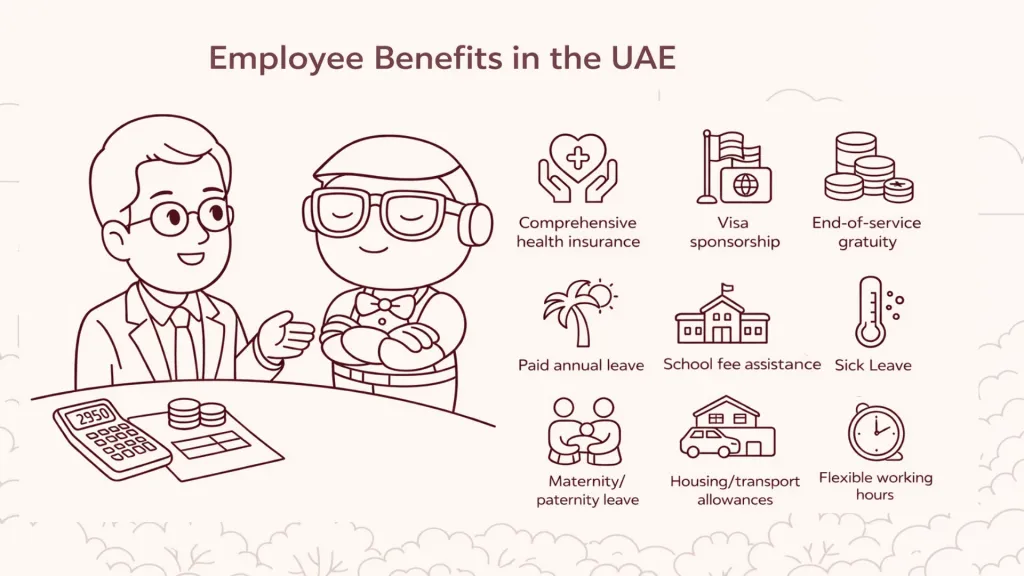
The UAE Labour Law, enforced by MOHRE, outlines optional and mandatory employee benefits for workers. Read about each benefit and how to design a cost effective benefit package to maximize your employees’ wellbeing.
The United Arab Emirates has made progress in making it to a global economic hub. Part of their recent progress includes signing into law guidelines for how employment works in practice.
Federal Decree-Law No. 33 of 2021 on the Regulation of Employment Relationships governs employment in the UAE private sector, including the core mandatory benefits and leave entitlements discussed in this guide.
Companies that align with labour laws while providing additional perks gain a competitive edge in the UAE market.
Understanding employee needs is the foundation of an effective UAE employee benefits strategy.
Note
Typically, UAE Labour Law requires employee contracts to be issued as fixed-term agreements. These contracts may be renewed or extended for UAE’s workforce.
The law also recognizes multiple work arrangements, including full time, part time, temporary and flexible work arrangements.
If you need to learn more about termination of employment, we outline the notice period requirements and how to ensure compliance in this article.
Private-sector workers are generally covered by the UAE Labour Law, including part-time workers. However, some entitlements for part-time workers, such as annual leave, are calculated on a pro-rata basis according to actual working hours and the employment contract
Workers must have a valid work permit issued by Ministry of Human Resources and Emiratisation (MOHRE) to qualify.
The following employees are excluded from employee benefits under Labour Law:
Domestic workers (i.e. housemaids, nannies, drivers, cooks, gardeners, or other employees directly employed by households) are governed separately under Federal Decree-Law No. 9 of 2022 Concerning Domestic Workers and are entitled to:
Likewise, domestic workers are protected from employer withholding passport, forcing work without consent, and being charged recruitment fees by the employer.
The UAE government mandates essential employee benefits to protect workers’ rights and ensure fair treatment.
Employees are entitled to payment of wages agreed on in the employment contract. A wage computation includes basic salary, allowances, and benefits in kind as contractually defined. According to the Wage Protection System, wages must always be paid on time and in AED (unless otherwise agreed upon).
Employers should regularly review employment policies to ensure they comply with updated regulations.
EOSB or End of service benefits is a mandatory statutory benefit under the federal law. It is generally a lump sum payment paid at the end of employment. This calculation mostly applies to expatriate workers or non-UAE nationals completing more than a year of service.
UAE nationals do not receive gratuity but are enrolled in mandatory state pension schemes wherein both employer and employee contribute monthly to the General Pension and Social Security Authority (GPSSA).
To calculate gratuity accurately, make sure to calculate based on basic wage only (excluding allowances). The formula is as follows:
The total gratuity payment may not exceed the equivalent of two years’ salary. The end of service benefits must be pro-rated for partial years after first year. Unpaid leave periods are excluded from calculation.
Employers must ensure that end-of-service gratuity payments are made within 14 days of the end of the employee’s contract.
Note
In 2023, the UAE introduced a voluntary alternative end-of-service benefits savings scheme for private-sector employers.
If an employer elects to participate, it must calculate the monthly subscription amount and transfer the required contributions to the approved investment fund within the prescribed timeline.
Under UAE Labour Law, certain scenarios can trigger employees receiving paid leave benefits. Paid leaves are legally required and all companies must remain compliant.
|
Type of Leave |
Provisions |
|---|---|
|
Annual Leave |
Employees are entitled to 30 days of paid annual leave after completing one year of service.
|
|
Sick Leave |
Under UAE labour law, employees are entitled to 90 days of sick leave per year.
During probationary period, sick leave may be unpaid. |
|
Maternity Leave |
After a child’s birth, mothers are entitled to a paid and time bound leave of absence.
|
|
Parental Leave |
|
|
Compassionate (mourning) leave |
|
|
Study leave |
|
|
National service leave |
For UAE nationals only. Its purpose is to allow employees to perform mandatory national and reserve services. This is also recognized under UAE Labour Law as protected leave category. |
|
Public holidays |
Employees must be paid and allowed to take a day off during official public holidays. |
Note
Unpaid leave outside of these scenarios is still allowed with employer approval.
Under the Labour Law, leaves must be taken in the year it is earned. It is not designed to accumulate indefinitely.
Employers may control the scheduling with at least 1 month notice to the employees. Meaning, if employees don’t use their leaves, employers can require them to take it.
Alternatively, unused annual leaves may be carried forward to next year with employer approval based on company policy.
In certain cases, employees may also agree with the employer to receive a cash allowance instead of taking the carried-forward annual leave, if company policy allows. However, it is mandatory that an employee must be paid for their unused annual leave balance upon termination of employment.
Maternity and sick leave are an exception. If unused, it expires and there is no payout as it is considered a conditional benefit. Parental, compassionate, and study leaves if unused are forfeited and cannot be carried forward as they are event-based entitlements and not accrued benefits.
Most employers are reasonable and compliant, but in the event that any employer removes, reduces or denies statutory leave rights, it becomes a violation of the UAE Labour Law.
Article 47 allows compensation of up to three months’ wage where termination is due to the worker filing a serious complaint with MOHRE or a lawsuit whose validity is proven.
Standard shift schedule in the UAE include 8 hours a day with a total of 48 working hours per week. Maximum allowable overtime is at 2 hours per day (exceptions apply).
Overtime pay is calculated at +25% of normal hourly wage for standard overtime and at least +50% of normal hourly pay if working between 10:00 PM and 4:00 AM. Graveyard shifts may be excluded from night overtime premium.
Rest days are also mandated weekly with employees entitled to minimum 1 paid rest day.
These are typically outlined in the contract signed upon hiring.
Note
Certain Free Zone entities seeking to qualifying for corporate tax benefits (e.g. Qualifying Free Zone Person status) must meet adequate economic substance and activity requirements under UAE Corporate Tax regulations.
Thus, being able to establish documentation for local working hours is crucial. Qualified staff must be seen performing core business activities as stated in their license.
Health insurance requirements in the UAE are regulated at the emirate level. Employers are required to provide health insurance in Abu Dhabi and Dubai, while requirements may differ in other emirates.
In Dubai, employees’ health insurance is governed by Dubai Health Insurance Law and includes minimum basic coverage plan.
In Abu Dhabi, employers must provide for employees and cover employee’s spouse and up to 3 children under specific conditions.
Additionally, employee safety must be prioritized with workplace safety measures and occupational health protections.
In the event of work injuries and occupational related disease, employer must cover treatment costs until recovery and compensate wages of full salary (up to 6 months) and half of salary for the next 6 months if needed.
If an employee dies due to work related causes (i.e. death caused by work injury or occupational disease), employers must pay to the employee’s family an equivalent of 24 months of the employee’s basic wage before death.
Legal limits require minimum AED 18,000 and maximum of AED 200,000. The family is also entitled separately the end of service gratuity, any unpaid wages or other financial dues, to be paid within 10 days of death (or knowledge of death).
The family may also request for the employer to cover costs of preparing and transporting the body to their home country.
Note
Family in this scenario may apply to the spouse and children. If they are unmarried and childless, the payment goes to legal heirs determined by UAE’s succession law.
Employers in the UAE must cover the costs of visa sponsorship, Emirates ID, and repatriation to the employee’s home country.
In the UAE, both part time and full time employees must hold valid visa work permits. Only full time roles typically require employer sponsored residency visas.
Part time employees may work for multiple employers under separate permits, and may already be sponsored under a different visa (i.e. family or student visa).
Before employment, the employer must obtain work permits. Any recruitment cost cannot be charged to the employees. Delays may happen due to incomplete or incorrect documentation especially during approvals from MOHRE and immigration authorities.
The process is as follows:
Any failure in one step can block the entire chain of events.
If an employer fails to settle employee dues, this may result in working visas being indefinitely postponed or cancelled and delay in renewals.
Repatriation (return travel) must be covered by the employer unless the employee joins a different company or termination happens due to employee’s fault.
While these are implied as part of proper business conduct, it bodes well to be mindful of the following as well:
The Federal Labour Law applies broadly to mainland and generally Free Zone private companies. Some categories (such as government employees and domestic workers) may be excluded or governed separately by Cabinet decisions or specific regulations..
Benefits for mainland and most Free Zones are broadly aligned under UAE Labour Law, but specific zones may introduce additional rules or differences in implementation. Certain jurisdictions – Dubai International Finance Centre (DIFC) and Abu Dhabi Global Market (ADGM) – operate under their own employment laws.
Health-insurance requirements are regulated at the emirate level. Employer-sponsored health insurance is mandatory in Dubai and Abu Dhabi, while requirements may differ in other emirates. In Abu Dhabi, employer coverage also extends to eligible dependents under the applicable rules.
Below are the key differences in employee benefits:
| Type of Benefit | Mainland & most free zones | DIFC | ADGM |
|---|---|---|---|
| End of service gratuity | Mandatory gratuity treated as lump sum payment upon termination | Mandatory funded savings scheme where employer contributes monthly into investment fund. Employee accumulates invested end of service benefits, meaning there is no large lump sum payment upon exit. | Allows traditional gratuity or workplace savings scheme as an optional alternative |
| Leave entitlements | Annual: 30 days / year Sick: 90 days with tiering, as explained Maternity: 60 days | Annual: 20 working days Sick: Typically 60 working days Maternity: ~65 working days (varies by structure and more aligned with international HR standards | Annual: 20 working days Sick: 60 working days, structured as: -> First 10 – full pay -> Next 20 – 50% pay -> Remaining 30 – unpaid Requires medical certificate Maternity: 65 days (first 33 days – fully paid; remaining 32 – 50% payment) |
| Contracts | Fixed term required | Flexible | Flexible |
| Dispute resolution | MOHRE + UAE competent courts | DIFC Courts | ADGM Courts |
The UAE’s competitive labour market has led companies to enhance their employee benefits programs.
Employers may provide benefits beyond minimum legal requirements. These other benefits aim to enhance employee satisfaction and better financial wellbeing for part time and full time employees. Employers may implement bonuses, allowances, incentive schemes, wellness programs and more flexible work life balance.
Note
Allowances are not part of EOSB calculation, but are included in total wage for payroll structuring.
The UAE Labour Law recognizes family as both spouse and children. In the event the employee has no spouse or children, family dependent benefits (i.e. health insurance, education benefits, family relocation support) don’t apply.
Wage is defined as basic salary + allowances + benefits in kind. Bonuses are not automatically part of the computation, and only become part of the wage if contractually defined.
Bonuses may become enforceable if clearly defined in employment contracts or formal company policies, subject to stated conditions.
Bonuses may also depend on continuous service and paid on designated payout date after minimum service period is fulfilled.
Bonuses and commissions are excluded from gratuity calculations.
Employers may introduce savings or incentive-linked schemes as part of their broader retention structure. However, any deductions from an employee’s wage to fund such programs must be made with the employee’s prior written consent.
This ensures that participation in benefit or investment programs remains voluntary and compliant with UAE Labour Law.
Contractual vs discretionary bonuses
Contractual bonuses (i.e. sign on, sales commissions) are guaranteed if conditions are met and employer must pay.
However, discretionary bonuses (performance, one-off bonuses and commissions, 13th month pay) are not guaranteed and full discretion is based on the employer.
Employers offer family health insurance coverage, especially for multinationals, finance, law and tech sectors, and senior roles or expat packages.
Wellness programs are customized to cultural preferences and integrate holistic health solutions in the UAE.
Fitness memberships for example could be gym memberships or fitness reimbursements given yearly.
Mental health support (Employee Assistance Programs or EAPs, therapy or counseling access, mental health days as per company policy) may be offered. Mental health days can also fall under sick day if medically certified.
Preventive care programs such as annual health screenings, wellness stipends and vaccination programs are considered as lifestyle and community-focused. These offerings are usually tailored to workforce demographics and reflect a broader shift toward holistic employee wellbeing in UAE.
Companies are increasingly recognizing that work-life balance enhances employee well-being and drives productivity.
The UAE outlines work models as full time, part time, temporary, and flexible work arrangements.
Flexible work policies have shifted from optional perks to essential workplace strategies in the UAE and vary based on business needs.
Remote work (wherein work is performed outside the company premises) is also allowed if agreed with the employer.
Company policy should define core office hours, expected availability and overtime rules, especially if employee is working internationally. Additionally, it helps to be clear on output expectations, KPIs and reporting structure. The law may not explicitly define guidelines, but it is best practice operationally to be on the same page on performance tracking.
HR must also define who shoulders the equipment and expenses to operate (i.e. laptop, internet allowance, office setup allowance may also be defined separately).
Note
Multinational companies are localizing their employees’ benefits to attract talent in the UAE. While jobs continue to be competitive, retaining regional talent gets expensive. It helps to localize the benefits and prioritize what the market really needs.
Employees who feel valued are less likely to seek opportunities elsewhere in the UAE labour market.
A strong benefits package improves retention, enhances employer branding, and ensures compliance with UAE labour laws. HR teams should conduct regular surveys, feedback sessions, and engagement studies to identify preferred benefits.
First step to designing an employee benefits package is to ensure all packages meet minimum statutory entitlements, including:
These are minimum legal rights and cannot be reduced or waived.
Note
Employee termination can be tricky. This article explains the regulations under Labour Law, covering lawful grounds for termination, notice requirements for employees leaving, and risks of unlawful dismissal for employers.
Employers in the UAE are required to pay salaries through the Wage Protection System (WPS), ensuring timely electronic payments. Under UAE Labour Law, wages must be paid in accordance with Ministry of Human Resources & Emiratisation (MOHRE) approved systems. Wages reported through WPS must reflect the full pay structure and be verified on behalf of private sector employees.
The Wage Protection System significantly impacts how employee wellbeing is structured. The system forces full transparency and employees can easily prove underpayment, missing allowances and delayed wages. Benefits become more enforceable in the event of disputes.
We outline in further detail Wage Protection System here.
First time registering? For a step-by-step guide on setting up WPS, see our detailed resource here.
Employee benefits can be divided into:
Employers must budget for both fixed statutory liabilities and variable, market driven benefits. Budgets must also include future “liabilities” based on salary over a length of time, and EOSB that accrues over continuous service.
Note
For startups, we recommend securing at least 6 to 12 months of runway allotted for your employee costs before making a hire.
This helps with payroll stability, reduces financial strain, and gives you sufficient buffer to meet ongoing salary and benefit obligations.
In house management allows for greater control and customization, but it requires dedicated HR with strong compliance knowledge.
Outsourcing can streamline administration, reduce compliance risks and access local expertise. This is particularly useful for private sector employers, global companies entering UAE and free zone companies expanding.
A hybrid approach is to manage the core strategy in house and outsource execution to local providers. This maximizes global consistency with local compliance.
Poor administration can lead to overpayments, missed accruals and penalties. Best practice is to centralize payroll and benefits tracking, and automating calculations and reporting.
Simplify your employee benefits, payroll and compliance in one place with Skrooge’s AI-powered accounting.
Let our dedicated experts do the heavy lifting working behind the scenes. Book a call with us to get started.
UAE Labour Law states rules that apply for mainland private sector employers and most UAE free zones. Employers must ensure compliance by providing mandatory benefits to part time and full-time workers in the UAE.
Some categories may be excluded or governed separately by Cabinet decisions, such as government employees and domestic workers.
Some Free Zone areas operate under independent employment laws, notably for DIFC and ADGM. In these jurisdictions, certain benefits are implemented differently.
Health insurance is a mandatory employee benefit that UAE law enforces.
In Dubai, employers are required to provide health coverage for employees only. However, in Abu Dhabi, employer must cover employee + dependents (spouse and up to 3 children).
The gratuity system in the UAE rewards long-term employees for their service. Employers must calculate gratuity accurately and ensure timely disbursement to departing employees.
1. Accrue EOSB monthly (not just at exit). Employers should recognize EOSB as an ongoing liability after one year of service. Financial statements reflect true cost of employment.
2. Base calculations on basic salary only. Any changes to basic salary must immediately be reflected in EOSB accrual calculations.
3. Apply statutory accrual rates to arrive at lump sum payment. Convert annual entitlement into pro-rated monthly accrual
→ 21 days per year (first 5 years)
→ 30 days per year (after 5 years)
4. Lastly, distinguish EOSB from payroll expenses. It is not a monthly cash outflow, but ared obligation. In management reporting, it is important to reflect this as forecasted future payouts.
For senior hires located in the UAE, they typically do not require full relocation support. Typical benefits include higher cash based packages, performance bonuses, transport or car allowance, health insurance with option to include family, education perks and international travel allowance.
Foreign senior hires require full relocation setup support. Employers must make transition seamless, which typically includes housing, education and relocation allowance. It is mandatory to cover the costs of recruitment and repatriation for foreign hires. Sometimes, employers may sponsor annual home leave and flights to the home country once a year.
Either way, packages are meant to support lifestyle and reduce friction from transitions.
Yes, this may be changed mid contract, but only if the change is mutually agreed upon between employer and employee. There must be explicit and written employee consent.
Changes are allowed when there is a/an:
✔️ Increase in salary or benefits
✔️ Restructuring of compensation (i.e. employee shares may be offered midway)
✔️ Other changes aligned with promotion and role changes
To remain compliant, employers must issue a contract amendment or addendum. After, employers must update internal HR records, reflect changes in WPS filings and payroll systems.
Under the Wage Protection System, employers need to report accurate salary data that reflects the full compensation structure. WPS payroll files must match the employee’s contract.
This distinction is critical as basic salary forms basis for gratuity and overtime calculations. Allowances contribute to total compensation but not EOSB, making proper payroll structuring essential for both compliance and cost management.
1. Not granting minimum statutory leave or failing to track accrued leave properly
2. Incorrect leave balances resulting in disputes during termination
3. Mismanaging public holiday entitlements. If employees work on a public holiday, they must receive a substitute day off or additional compensation.
4. Not paying wages on time and misclassifying wage vs allowances
5. Incorrect gratuity calculations and final settlements linked to leave balances
Other risks may arise from poor data management, all of which can lead to employee disputes and regulatory exposure if not managed properly.
HR and payroll records must be retained up to 2 years after termination of employment. Records include:
✔️ Employee contracts and amendments
✔️ Payroll records including WPS files
✔️ Leave records and balances
✔️ Calculation for end of service gratuity
✔️ Benefits and allowance documentation
Thank you!
We've received your request and will get back to you shortly.

Loading...
 Thank you!
We've received your request and will get back to you shortly.


 Contact Us


