

Accounting services in DIFC
Accounting in DIFC goes beyond maintaining financial records. Companies operating in the Dubai International Financial…
Under UAE VAT Law, two or more businesses can form a single taxable entity. Running multiple businesses often means separate VAT tracking, multiple registrations and repeated filings across related business establishments.
VAT group registration centralizes how businesses are treated for VAT purposes. Additionally, VAT group registration can reduce administration costs and internal cash flow friction.
Although VAT group registration makes it easier to coordinate the affairs of the structured entities, it also increases shared responsibility and joint liability for VAT obligations and liabilities.
This 2026 guide breaks down which entities qualify, what the Federal Tax Authority (FTA) checks for eligibility, and what the process looks like in practice.
If you’re looking for the individual VAT registration process and mandatory vs voluntary registration requirements, check out our other guide here.
VAT group registration is a system that allows related legal entities to register as a single group for tax purposes.
This structure allows for streamlined tax management and consolidated VAT returns by treating several distinct businesses as a single taxable unit. Understanding tax group registration is essential for businesses with multiple subsidiaries or related entities in the UAE.
All members of a group share joint liability to pay VAT dues and any penalties that arise during the time they are part of the group.
Proper planning is essential to ensure that the tax group remains a tool for efficiency rather than a source of complications. Poorly structured arrangements may attract additional FTA scrutiny, including penalties, or tax evasion concerns.
A VAT tax group can only be formed if all members meet the eligibility criteria.
Each member of a VAT tax group must be actively engaged in business activities on a regular and independent basis, carry out taxable supplies or imports, and collectively exceed the mandatory VAT registration threshold.
Only legal persons, such as companies or government entities, can be members of a VAT tax group in the UAE.
All members of a VAT group must be related parties, demonstrating economic, financial, and organizational connections.
Members must be related parties. This can be shown where one person or more has 50% or more voting interest, 50% or more market value interest, or control by other means. The FTA may also consider economic, financial, and regulatory links between the businesses.
For example:
This control requirement ensures genuine business relationships within the group structure. Actual business activities may be linked through:
These conditions may be used to establish a connected business structure required for multiple businesses.
Considering two companies: Rose Trading Ltd and A-One Trading Ltd where Mr. X is a Director of Rose Trading and a partner at A-One Trading.
Mr. X is also a Director of A-One Trading and a partner at Rose Trading.
They both have shared control and involvement across two entities.
Both companies are then linked through common management and shared ownership interests. Rose Trading Ltd and A-One Trading Ltd may be treated as related entities and apply for tax group registration.
Note
Designated Government Bodies can only form or join a VAT group with other Designated Government Bodies.
The FTA may refuse a VAT group where a specified Government Entity or Charity is grouped with a person that does not share that same status.
Each group member must be a legal person with a place of establishment or fixed establishment in the UAE. Every member is required to carry out a business that includes taxable supplies or imports to qualify.
This includes companies, partnerships, and other legally recognized business entities. All members must have legitimate UAE operations and tax compliance responsibilities.
For VAT group registration, the FTA assesses the combined taxable supplies and relevant imports of the proposed group. The combined amount should meet the applicable VAT registration threshold, with the mandatory threshold currently set at AED 375,000.
The assessment is based on combined activity across all members. VAT regulations do not require each company to be assessed separately.
Example
Company A, B, C are all below AED 375,000 annual turnover threshold. Individually, none of them qualify.
But if combined and their total taxable activity may exceed the threshold, the group can qualify based on the combined amount.
All businesses in the group must follow the same VAT accounting period for compliance purposes.
During the application, taxable supplies and expenses must be reported for the representative member, each group entity, and then the group as a whole.
All figures must be reported in UAE Dirhams (AED) and be supported by documentation to avoid FTA rejection.
Tax group members should be able to provide consistent data for the group’s VAT reporting period. In practice, aligning reporting calendars and accounting cut-off dates helps simplify consolidated tax returns.
VAT group members should maintain consistent, reconcilable accounting records that allow the Representative Member to prepare accurate group-level tax returns. Using the same accounting system can help, but the key requirement is reliable data, proper documentation, and clear internal reconciliation across all members.
One company within the tax group must be designated as the Representative Member, while other companies are named as part of the group.
The Representative Member holds administrative responsibility for all VAT dealings, including entering taxable expenses and supplies for itself, each member and the group as a whole. They also uphold executive regulations set by the UAE VAT Law.
Additionally, they are responsible for filing only one VAT return for the whole group per tax period. Any VAT liability is, however, shared jointly among all members, ensuring collective accountability for tax obligations.
After completing group registration in UAE, the tax group is assigned a single Tax Registration Number (TRN) for all its members, which is reflected in the Representative’s EmaraTax dashboard.
The VAT group registration application is submitted through the Representative Member’s tax portal on the FTA website.
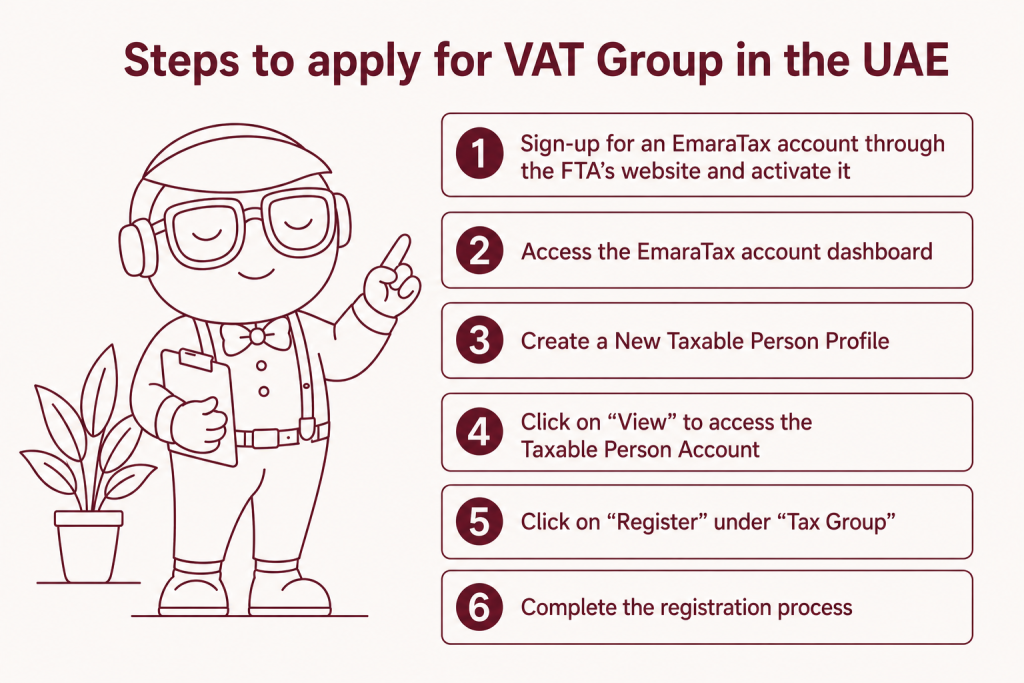
The application must include detailed information about all group members, their ownership structure, financial relationships, and unified accounting systems. Supporting documentation includes corporate registration documents, proof of control relationships, and evidence of synchronized financial years.
It typically takes 45 minutes to complete the application.
The FTA will review and approve applications for VAT group registration only if all eligibility criteria are met. It takes an average of 20 business days from the date the completed application was received for the FTA to review and approve.
If the application is approved, the VAT Group will be assigned a single VAT Group Tax Registration Number (TRN).
In case the member is not registered for VAT, they can review the registration requirements here.
Files must be uploaded in PDF format. Maximum file size for each document is 15 MB.
Note
This application can only be completed in a separate process submitted through the Representative Member’s EmaraTax Account. Upon approval, the FTA will issue a VAT Group Registration Certificate, confirming the group’s status.
By default, each business is treated as a single taxable person and must complete VAT compliance and registration individually.
A single consolidated VAT return is filed by the Representative member on behalf of all the members. Once businesses are grouped, they lose the ability to file individual VAT returns, which may affect their operational independence.
| Comparison between Tax Group vs Individual Registration | VAT Tax Group Registration | Individual Registration (Standard Registration option for a single taxable person) |
|---|---|---|
| What happens after registration? | VAT Tax group receives its own TRN at group level | A new taxable person profile is created and each business has its own VAT TRN |
| Mandatory vs Voluntary Registration | A VAT group generally requires the combined taxable supplies and relevant imports of the members to meet the applicable VAT registration threshold of AED 375,000. | May qualify for voluntary registration |
| Who handles VAT records and submission? | The representative member must ensure that all internal transactions and filings are accurate and prompt to maintain compliance. | Each entity maintains its own VAT records and submission |
| VAT Compliance | Handled at group level | Handled per entity |
| Documentation and Declarations | Details for all members are handled by the Representative | Each business provides its own turnover data and submits their own documentation and declaration |
| Add one or more members in one taxable profile? | Yes | No |
| Pay VAT? | Joint liability | Must calculate and pay individually |
Before applying, businesses should complete a preparation and eligibility check to ensure:
The FTA reviews the request for VAT Group Registration based on the relationship and compliance history of the companies.
Changes to a VAT tax group require formal submission through the EmaraTax system. Adding or removing members requires approval from the FTA.
In order to track submissions and correspondence with the FTA, the system generates a reference number after application. The FTA may contact the applicant to ask for further details or clarification.
The remaining members resume filing their own VAT returns following the de-registration procedure. Additionally, as single taxable persons, they default to their own registered VAT numbers.
For a detailed breakdown of the process, requirements, and timelines, read our full guide on VAT de-registration in the UAE.
Tax group registration in the UAE requires meeting ownership conditions, demonstrating taxable activity across members, and exceeding mandatory threshold.
Prior to VAT tax group registration, not every member needs to register individually for VAT. Unregistered members may be included in the VAT group application and may need to complete requirements as part of the registration process.
The Representative Member manages administrative duties and VAT filing. They also act as the primary point of contact with the FTA.
All members share joint liability for VAT payments regardless of individual contributions. The group must maintain unified financial records and accounting practices. Supplies between VAT group members may be disregarded for VAT purposes, but intra-group transactions should still be properly documented internally so the group can reconcile accounts, support external supplies, and respond to FTA queries.
Tax authorities have authority to dissolve a group if conditions cease to be met.
The process of forming a tax group can be complex and time-consuming due to strict eligibility and control requirements. Skrooge provides expert guidance for VAT group registration in the UAE, helping businesses navigate complex regulations. Our experts help businesses prepare and submit group applications to the FTA in the UAE.
Skrooge’s AI-powered accounting service can streamline the VAT group registration process for small and medium-sized businesses in the UAE. Our in-house team also offers ongoing support for VAT compliance, which is essential for businesses operating under a VAT group in the UAE.
To learn more, simply leave your number and book a call with us.
VAT tax group registration allows two or more related businesses to apply and be treated together as a single taxable person for VAT purposes.
A VAT group requires formal approval from the FTA and the FTA reviews the group as a combined tax structure.
A VAT tax group is formed when multiple businesses meet ownership control, and their combined taxable supplies and imports exceed the mandatory VAT threshold.
Designated Government Bodies can only form or join a VAT group with other Designated Government Bodies.
The FTA will assess the overall structure and relationships of the group as part of its review.
VAT tax group registration centralizes application, reporting and data submission through the Representative member. It also reduces administrative costs on the group.
It allows businesses to reduce duplication in VAT administration and disregard certain intra-group supplies for tax purposes.
Additionally, groups can save on costs as they centralize interaction with the FTA on VAT regulations and compliance.
The VAT tax group must file under a single VAT reporting cycle once VAT registered. As such, it is best practice that all members of the same tax group must use the same accounting system. To ensure uniformity in financial record-keeping, all businesses must use the same accounting techniques and resources.
Before registration is approved, aligning fiscal year-end dates and reporting periods can help simplify VAT reporting and reconciliation for the group
The Representative Member details the following responsibilities on behalf of the group:
✔️ Initiates the application process through their EmaraTax account. Other members are not allowed to initiate or submit the application.
✔️ Files the tax returns for the group, together with all member and group details including supplies and expenses subject to VAT
✔️ Adds and manages the other member companies including members with TRN and members without TRN (and initiates the latter’s VAT registration if required)
✔️ Uploads supporting documents and ensures data is accurate and supported by documentation
Businesses do not need prior individual registration before applying for group registration in UAE. However, unregistered members must complete VAT registration during the process of group application in order to be approved by the FTA.
All members of a VAT tax group are jointly liable for VAT dues and any penalties, which may increase financial risk.
If a member no longer qualifies as related party or stops carrying out taxable activity, the group may need to update its structure (i.e. remove the member), or reassess its group eligibility with the Federal Tax Authority (FTA). They must seek approval from the FTA to remain compliant.
Thank you!
We've received your request and will get back to you shortly.

Loading...
 Thank you!
We've received your request and will get back to you shortly.








 Contact Us


