

Simplifying VAT Return Filing in the UAE (including changes in 2026 and how to prepare)
VAT has been part of doing business in the UAE since January 1, 2018, and…
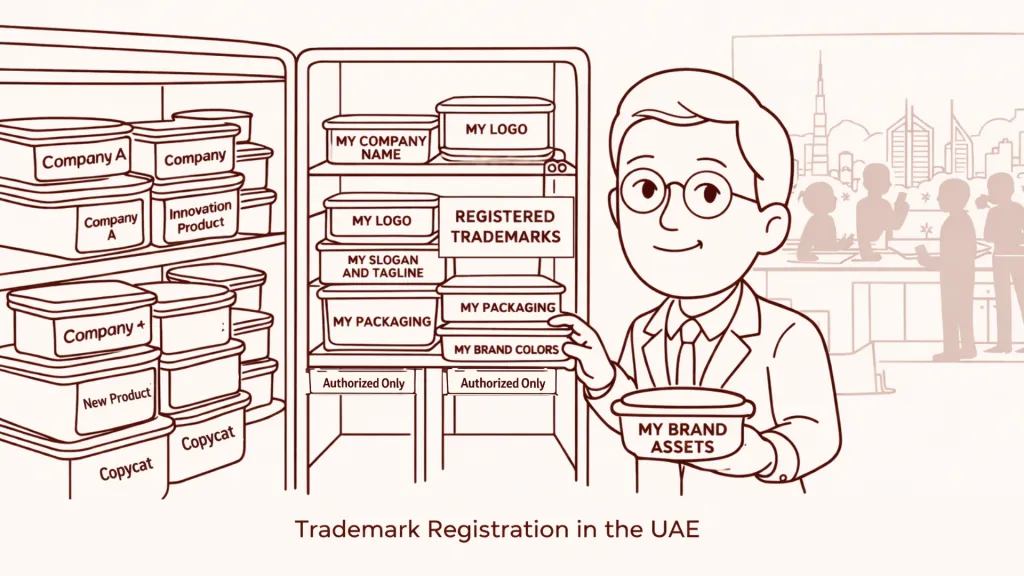
To understand trademarks, you can think of it like labeling your own packed lunch. You want to make sure your lunch boxes are properly labeled, so that no one else can steal it. If they do end up copying your brand assets, being able to establish that it belonged to you first would build your credibility and avoid confusion.
In this guide, we go through the federal law around intellectual property and the trademark registration process in UAE. We also clarify common founder mistakes and the costs associated with filing for trademarks.
A trademark is a distinctive sign that identifies your goods and services as distinctive from other entities in the market. It can include:
Registering a trademark provides exclusive rights to use the brand within the UAE. The trademark registration procedure in the UAE is governed by Federal Decree-Law No. 36 of 2021.
The Ministry of Economy and Tourism (MoET) is the authority responsible for trademark registration in the UAE.
Under the federal law, registering trademarks grants the owner exclusive rights to use their brand assets in the UAE. Additionally, it affords them legal protection against unauthorized usage or infringement.
Note
Your whole brand identity is not necessarily a trademark, as the former is a marketing concept that presents your visuals, tone, positioning, or customer perception. Registered trademarks provide the strongest legal protection for your brand.
A registered trademark can serve as a valuable business asset that can be sold, licensed, franchised, or used as collateral for financing.
The following can register for a trademark in the UAE:
Note
Both free zone and mainland companies can register a trademark in the UAE. Trademark registration is handled at the federal level by the Ministry of Economy & Tourism not limited to your business license jurisdiction.
Registration under a company is usually better if you plan to raise funding; may want to license or franchise the brand later; or need clean ownership for investors.
For brand owners to qualify for trademark registration in UAE, your mark must:
|
Types of Trademark |
Definition |
Additional Mandatory Documents for Specific Type of Trademark |
|---|---|---|
|
Goods and Services Trademark |
Most common type of trademarks and ties directly to Nice Classification system |
Core documents, including copy of trade license |
|
Control & Inspection (Quality Mark) |
A quality mark indicates that product or service meets specific standards and certified by an authorized body. |
A copy of the applicant entity’s Articles of Association, including any amendments.
Make sure the following is included:
|
|
Temporary Protection of a Trademark at Exhibitions |
If you showcase your brand at a recognized exhibition, you may receive temporary rights before formal registration. |
|
|
Collective Mark |
Used by members of an association, group or organization
This mark is not for individual businesses and relevant if you run or belong to an organized group using a shared brand.
|
A copy of the Articles of Association, including amendments that includes:
|
|
Other marks |
Depending on jurisdiction and how the mark is presented, this may include:
|
UAE primarily recognizes words, logos, shapes and colors. |
Trademarks must be registered under specific classes of goods and services. These classes define what your brand covers and where your legal protection applies.
Rule is that registration is not for your brand “in general”. Trademark registration is for specific business activities only.
Certain marks are not eligible, even if they are part of your brand.
The trademark class system is a standardized way of organizing trademarks based on the type of goods and services they cover, set up by the World Intellectual Property Office (WIPO).
The Nice Classification is an international system used to classify trademarks. It is widely adopted globally, including in the UAE. Generally, business activities are divided into 45 trademark classes:
Your trademark protection will apply to the classes you fall under.
For example, if you are a pop up clothing store that sells food and beverage, your brand can be under Class 25 (clothing); class 35 (advertising / business services); and Class 43 (restaurants) as long as there is no consumer confusion. It is best practice to select the relevant classes based on current operations and future plans.
Common founder mistake
Choosing classes that are too narrow may limit protection. Incorrect classification can also lead to rejection or weak enforcement.
Classification issues are a common way to trigger corrections or delays.
Filing a multi-class application can end up being cheaper, but there is a risk that the entire application is affected if one of the classes receive objection or opposition. Trademark certificates are issued per application (and not per class).
For those interested to learn more, you can check out this website and search the Nice Class that applies to your product or service.
A trademark search can help prevent rejection of a trademark application due to similarity with existing trademarks. It is essential to determine if a proposed trademark is already in use by another party in the UAE.
The UAE follows a first-to-file approach. If someone else has a similar registered trademark, your registration can be rejected or opposed later.
You can check if a trademark is registered by searching your brand name and variations (spelling, spacing, similar words). You can also check relevant trademark classes.
The primary official route is the Ministry’s Trademark Inquiry service, which allows applicants to check whether a proposed mark is identical or similar to a submitted or registered trademark. This is the official trademark registry where published marks are listed.
Look for:
Important note
Many founders may pass the search stage, but still face opposition after publication. This can delay official trademark registration.
Before filing, make sure your internal disclosure is aligned with standard trademark disclosure requirements.
Here is a checklist for applicants:
The following are the documents required for trademark registration:
Trademark registration in UAE is done via online application. Average duration for service delivery is 20 working days for the authorities to study and issue a decision on the application.
You can start the process by clicking on this link. For any concerns, you can phone or email them via info@moet.gov.ae.
The trademark must be distinctive and not conflict with existing registered marks or public morals.
Choosing a distinctive trademark design secures your brand’s reputation and reduces the risk of rejection.
It is recommended to perform a trademark search before filing a formal application to avoid potential conflicts.
Trademark searches are conducted via the trademark registry in the UAE Ministry of Economy & Tourism online services platform.
Search for existing trademarks by name or application details. Make sure to review your proposed trademark against existing marks and marks under publication.
Following the Nice Classification system, make sure to apply the relevant classes based on current operations and future plans.
Make sure to attach the required documents. Complete the online application through the service portal.
Typical service delivery is 20 business days after submission of completed application form.
Pay the trademark registration fees or in this case, the examination fee of AED 750. The Ministry of Economy & Tourism will review the application.
If the application is approved, the applicant will be notified and is required to pay AED 750 as publishing fee in the official trademark bulletin.
Additional fees may apply depending on the application and process (i.e. administrative fees, logistic costs, etc).
After the Ministry of Economy & Tourism approves a trademark application, it must be published in a trademark journal under the official gazette that lists newly accepted trademark registrations. The official trademark bulletin is issued twice a month. The current official publication fee is AED 750.
Key details of the published trademark typically include:
Trademark applications can be challenged by third parties during the publication stage if they claim prior rights to the trademark.
If no opposition is filed during the 30-day opposition period, the trademark proceeds to registration. The final registration fee of AED 5,000 must be paid.
Otherwise, a legal review process starts and your registration may be rejected if found in conflict. The owner has 30 days from the date of notification to file an appeal with the Appeals Committee.
After the objection period ends, the trademark registration certificate will be issued within 30 days from the end of the objection period. Your certificate issued by the Ministry of Economy & Tourism will serve as proof of legal ownership.
Make sure the trademark certificate is secured properly, since this may become basis for any future disputes.
It will also be required for enforcement and licensing down the line.
As of the date of publishing, total government fees for registering typically starts at AED 6,500 per class , depending on publication costs and official updates.
A trademark registration fee does not include any legal and translation fees that may be necessary during the application process.
Additional costs may arise during the trademark registration process due to opposition, responding to official actions, attestation, and translation services.
The breakdown of trademark registration required fees is as follows:
AED 750 (Regular Examination)
AED 2,250 (Expedited Examination within one business day)
AED 750 for official trademark journal paid to Ministry of Economy & Tourism
AED 5,000 for Trademark Registration
AED 7,500 for Quality Mark Registration
Trademark protection in the UAE lasts for 10 years starting from the date of filing the registration application. Afterwards, the trademark registration in UAE can be renewed for successive periods of 10 years. Trademarks are not necessarily permanent, and must be actively maintained to retain legal protection.
Trademark renewal in the UAE should be completed before the expiry date. A grace period of up to 6 months after expiry is allowed, subject to penalties.
To renew a trademark registration in the UAE, a copy of the old registration certificate must be submitted along with the renewal application to the Ministry of Economy & Tourism platform.
The current official MoET renewal fees are AED 750 publication fee, AED 5,750 final renewal fee during the tenth year, and AED 6,500 final renewal fee within the 6-month grace period after expiry.
A trademark registration in UAE may be cancelled or lapse if:
Once cancelled, your trademark automatically loses protection and may become available for others to register.
Trademark applications can be refused during examination or challenged later through trademark opposition.
The process may be heavy on the details.
Most issues arise from how the application is prepared vs. the number of documents submitted.
| Main reason for rejection | Description | How to avoid it |
|---|---|---|
| Similar or conflicting trademarks | The mark is identical or confusingly similar to an existing mark | 1. Perform a proper trademark search before filing. 2. Check for similar spellings, pronunciation, or similar or related classes |
| Lack of distinctiveness | Mark is too generic or descriptive. It does not clearly distinguish your brand (i.e. plain cup of coffee logo with “Cafe” below it) | Avoid generic product names and common industry terms |
| Poor description of goods and services | Vague or unclear description of business activities | 1. Clearly define your offerings 2. Use proper classification of goods and services |
| Incorrect trademark classification | Filing under the wrong class | Select classes based on current operations and planned expansion. Double check before submission |
| Incomplete or incorrect applicant details | Missing or inaccurate information given | Triple check spelling, etc and make sure your information is consistent across documents |
Trademark owners in the UAE are responsible for monitoring their trademarks to prevent unauthorized use. Owners can file a complaint with the UAE Ministry of Economy & Tourism if their trademark is infringed.
Legal actions for trademark infringement can include civil or criminal proceedings in the UAE.
Founders can look into this by regularly monitoring:
The UAE is a member of the Madrid Protocol, allowing for international trademark protection after local registration. Businesses can protect their brand in multiple countries beyond the UAE. However, trademark rights are territorial, meaning protection is granted per country and not automatically worldwide.
The UAE is a member of the Madrid Protocol, an international system for trademark registration. The system is administered by international organizations such as the World Intellectual Property Organization (WIPO).
A basic trademark registration in the UAE can serve as basis for an international application under the Madrid Protocol. After your application is reviewed by the UAE as “office of origin”, your trademark gets transmitted to WIPO for processing.
You do not get to register “globally” in one step. Instead, you file once through the Madrid protocol and then designate multiple countries for protection. Each country will then examine your trademark, and choose to accept or refuse protection.
This aims to simplify international expansion, reducing the need to file separate applications in each country.
The Madrid Protocol centralizes part of the process across multiple jurisdictions through one system.
Trademark registration may be done directly by brand owners. However, many businesses choose to work with a trademark agent to manage the process.
For one, an agent will help reduce unnecessary costs by getting the application right the first time. They can prepare accurate filings and handle follow ups with the Ministry. Weak filings can limit how effectively you can enforce your rights later.
As your business expands, proper registration ensures trademark protection across all seven emirates and fewer risks when scaling operations.
Lastly, working with a trademark consultant can give you a competitive edge by navigating local nuance and risk management for stronger trademark rights.
Trademark registration is a critical step to protect your brand and build long term business value. From selecting a distinctive mark to navigating UAE laws around IP protection, each step in a lengthy process is meant to align with your business goals.
A trademark certificate provides clear legal ownership and strengthens your infringement rights. This gives brands greater confidence as they operate across the UAE market. With proper registration, ongoing monitoring and timely renewal, your trademark becomes a long term asset that supports credibility and competitive positioning.
The trademark registration process in the UAE is completed in several stages. The examination review may take around 20 working days to issue a decision, followed by a 30-day opposition period.
If no opposition is filed and all fees are paid, the trademark certificate is issued within ~30 days after the opposition period ends.
UAE does offer an expedited process wherein examination is prioritized and done in one (1) business day.
As of the date of publishing, total government fees typically starts at AED 6,500 per class, depending on publication costs and official updates.
Typical service fees include:
Trademark Examination Fees:
AED 750 (Regular Examination)
AED 2,250 (Expedited Examination within one business day)
Publication Fees:
AED 750 for official trademark bulletin
Registration Fees:
AED 5,000 for Trademark Registration
Professional fees for trademark agents widely vary and must be consulted prior to undergoing the process.
You can undergo the process mandated by the trademark office yourself or choose the benefit of having professional help.
However, trademark owners located outside the country typically submit with a registration agent and provide a notarized and legally translated Power of Attorney.
Yes, UAE nationals and foreign applicants can apply for trademarks. Applicants living outside the UAE must apply with a local agent and a notarized and translated Power of Attorney.
Log on using the online services platform, which acts as the official trademark registry, and search your brand name and variations (i.e. different spellings or spacing). You can review for exact matches, similar sounding or visually similar marks, and other related classes.
A registered trademark is protected for 10 years starting from the date of filing the registration application, and it may be renewed for successive 10-year periods.
Renewal should be completed before the expiry date. A grace period of up to 6 months after expiry is allowed, subject to penalties.
To renew, simply:
1. Submit within the same period a renewal application to the MoET
2. Provide a copy of the existing certificate
3. Pay the applicable renewal fees
Yes, you can include multiple classes in a single trademark application in the UAE.
When filing, you can select more than one trademark class under the Nice Classification, which allows you to protect your brand across different business activities in one application.
Multi class applications are useful if you operate across different categories and have plans to expand into new areas.
Choosing too many unrelated classes, however, can increase costs and complicate the application. It may weaken your position during a dispute, particularly if the trademark is not clearly connected to those goods or services.
After filing your trademark in the UAE, you can apply for international trademark protection through the Madrid Protocol. This centralized system is administered by the World Intellectual Property Organization.
Your UAE trademark acts as the base or home application, and then submit an international application through the UAE MoET (“your office of origin).
The renewal application is reviewed by the UAE authority, then forwarded to WIPO for processing.
Note that approval in one country does not guarantee approval in another. The Madrid system only simplifies and reduces filing across multiple jurisdictions.
It is best practice to check on documents required when submitting the application form and present clear evidence to avoid any unnecessary issues.
However, trademark applications can still face issues in 2 main stages:
1. During examination -> rejection by the trademark office
2. After publication -> opposition by third parties
If an application is rejected during examination, you are notified of the decision and have the option to respond to the objections and correct the issues. You can submit an appeal to the Appeals Committee within 30 days.
Thank you!
We've received your request and will get back to you shortly.

Loading...
 Thank you!
We've received your request and will get back to you shortly.










 Contact Us


