

Accounting services in DIFC
Accounting in DIFC goes beyond maintaining financial records. Companies operating in the Dubai International Financial…
Businesses often rely on petty cash for everyday expenses, from office supplies and transportation costs to emergency operational expenses. While these transactions may seem too small to matter, poor receipt management can lead to unaccounted expenses and increase the risk of fraud, as custodians may struggle to track all transactions accurately.
A structured petty cash management system helps businesses maintain control over small expenses. In larger organizations, monitoring petty cash usage across multiple departments can be difficult, increasing the risk of financial mismanagement due to inconsistent oversight.
Proper management of petty cash will include the procedure of managing, accounting, securing, and replenishing the cash balance.
Regardless of whether you use a physical cash box or an online expense management tool, knowing how a good petty cash system operates is important when it comes to developing financial accountability in the UAE.
Petty cash refers to the small reserve of cash readily available for incidental expenses. A designated petty cash custodian is responsible for handling the fund, disbursing cash for approved expenses, and maintaining detailed records.
The imprest system maintains a fixed cash fund that is replenished to its original amount after each period, ensuring that petty cash is always available for small expenses.
In this section, we cover the basics of petty cash management, including its definition and other control requirements.
Petty cash management is overseeing a small, secure fund of cash for minor business expenditures where cheques are impractical.
This exists due to some purchases that become cumbersome via normal purchasing or banking procedures. Companies will be able to pay their miscellaneous transactions without undergoing long approval periods.
Generally speaking, proper management of the petty cash implies accounting for it. Under financial statements (i.e. balance sheet), petty cash is treated as a current asset.
For accounting teams, this means:
When dealing with emergencies, it is best to practice discernment specific to the limits of the petty cash fund. One purchase should not significantly deplete the fund before it is scheduled to be replenished.
Common petty cash expenses include office supplies, postage, transportation costs, and minor repairs, which are often too small to warrant issuing a check or processing through the main accounting system.
|
Common Expense Types |
Examples |
Spending Limits per month |
|---|---|---|
|
Employee Reimbursements |
|
Up to AED 300 per claim |
|
Office Supplies |
|
Up to AED 500 |
|
Miscellaneous Expenses |
|
Up to AED 150 per expense |
|
Minor Repairs |
|
Up to AED 1,000 |
Employee reimbursements may balloon quickly, so it is best to set a standard rule of thumb on what can be considered under petty cash management.
Also, employees may sometimes confuse using petty cash vs spending their allowance (for example, cafe expenses for working outside the office). It is best to align early to avoid unauthorized expenses.
Regular reconciliation of the petty cash fund is essential to ensure that the total of the cash remaining and the receipts equals the original imprest amount, helping to prevent misuse or potential fraud risks.
Similarly, regular audits of petty cash usage help identify different patterns in expenses, including where overspending occurs, and ensure accountability among employees.
Note
Petty cash is not the same as cash on hand.
Petty cash is reserved for routine, low-value, incidental expenses that is exposed to limited risk.
Cash on hand refers to other cash available to the business that is held outside the petty cash fund and may be reserved for broader operational or other contingencies.
Under UAE regulations, managing petty cash requires strict compliance with IFRS standards, Federal Tax Authority, and Central Bank of the UAE (CBUAE) anti-money laundering (AML) guidelines.
To stay audit ready and compliant, businesses must maintain well documented transaction records for every fund disbursement.
Petty cash management includes keeping compliance under UAE’s Federal Tax Authority rules. For VAT purposes, supporting records are generally retained for at least 5 years, while Corporate Tax records should generally be retained for at least 7 years after the end of the relevant Tax Period. Every transaction must clearly document the expense’s business purpose and support any input VAT recovery claims.
For mandatory documentation:
To support FTA audit readiness, your petty cash policy must feature:
Note
Small businesses, especially one person or small teams, should separate petty cash with personal funds.
It is best practice to strictly prohibit personal borrowing or salary advances from the cash box.
Normal VAT rules still apply to petty cash expenses. Businesses still need valid supporting documentation, valid tax invoice or qualifying receipt and a business purpose for the expense to recover input VAT.
For example:
Input VAT can be recovered if:
To avoid any issues on recovering input VAT, we wrote more details on what a proper tax invoice should look like in this guide here
A card slip, payment confirmation, or informal receipt is not always enough for input VAT recovery. The business should retain a valid tax invoice or simplified tax invoice containing the required VAT details, including the supplier TRN where applicable.
Note
Don’t ignore small expenses. Individual petty cash purchases may seem insignificant, but recurring expenses such as office supplies, transportation, and staff reimbursements can add up over time.
A structured process for collecting and validating receipts helps businesses maximize legitimate VAT recovery while maintaining audit-ready records.
When employees are reimbursed through petty cash, businesses should determine whether the payment is a disbursement or a reimbursement, as the VAT treatment differs.
The expense would form part of the business operations if the employee makes the payment on behalf of the business and the goods/services received are indeed for the benefit of the company. The VAT treatment will therefore vary and businesses should maintain supporting documentation.
When a payment qualifies as a disbursement, the employee is acting solely as a paying agent for the business, and different VAT treatment may apply.
Petty cash management is effective when there are clear accountabilities and proper reconciliations are done regularly. Whatever system is chosen, assigning a petty cash custodian will make managing the fund much easier.
A petty cash custodian processes and disburses the cash to cover any expenses approved, and recording all transactions in detail.
The petty cash reserve should always be equal to the sum of cash on hand and supporting receipts under the imprest system. Regular reconciliation helps with early detection of any discrepancies.
Traditional petty cash management relies on physical cash, manual approvals and paper-based record keeping.
While this approach remains common among small businesses, the reliance on physical cash in petty cash systems makes it an easier target for theft, as unauthorized personnel can access cash boxes.
|
Traditional Petty Cash Systems |
Description |
|---|---|
|
Advantages |
|
|
Disadvantages |
|
|
Examples |
Businesses using traditional systems often rely on spreadsheets or accounting software such as QuickBooks to track transactions and reconcile balances. |
As small businesses grow and shift toward cashless operations, digital payment methods are becoming more popular as they are traceable and less vulnerable to fraud risks.
Many businesses are replacing traditional petty cash systems with expense tracking software to enhance security and convenience. Automated systems can reduce manual processing time, improving accuracy and transparency in expense management.
A potential downside is the cost of upkeep, since most software charge monthly. Freemium services are available, but limited in scope usually.
Common features within petty cash management software include real-time tracking, capturing receipts, automated approvals, spending controls, digital audit trail, and accounting integrations.
Petty cash custodians also prefer software when managing petty cash as it makes for faster reconciliations and easier reporting. Additionally, it helps with maintaining good employee welfare.
Without clear policies and oversight, employees may exceed approved limits or make purchases outside authorized categories. Avoid the misuse of petty cash by following these steps.
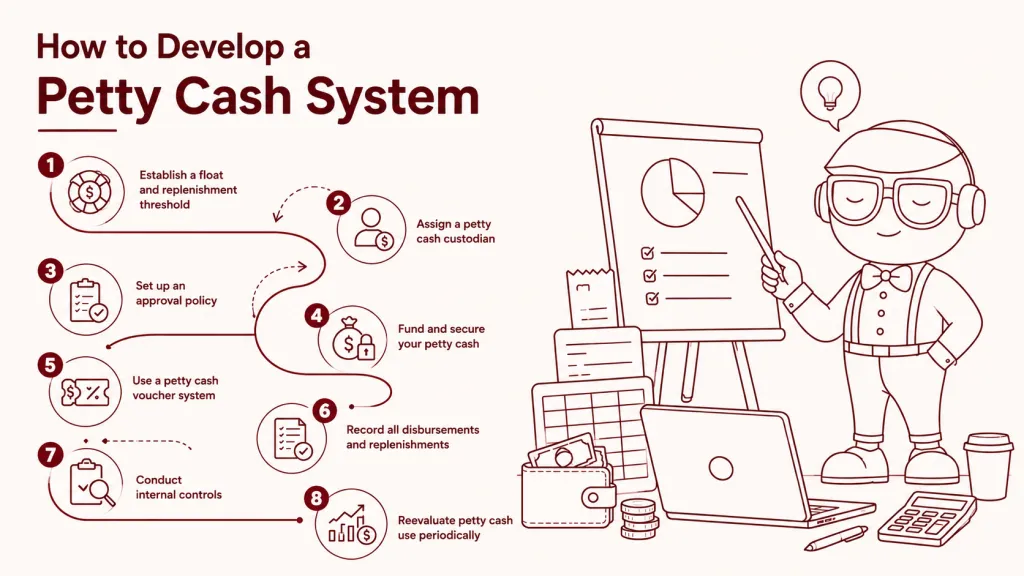
To set up a petty cash management system, it is essential to have clear policies and workflows when maintaining petty cash in each branch or department.
A standardized procedure of replenishing petty cash will ensure that there is always enough petty cash available without shortage.
Here’s an example of how to set up a petty cash management process for your own organization.
Fund management requires meticulous planning and maintenance, especially for larger organizations or SMEs. Establishing your operations around these steps ahead of time helps remove headaches down the line.
Effective petty cash management depends on regular reconciliation and strong internal controls. Whether a business uses a traditional petty cash box, an imprest petty cash book, an analytical petty cash book, or digital petty cash book systems, every transaction must have proper documentation.
Employees must provide proof of expense, such as receipts, whenever money is drawn from the petty cash fund. Without proper documentation, employees may use petty cash for personal expenses instead of business needs, increasing the risk of fraud.
Petty cash should be stored securely, typically in a locked box or safe, to prevent unauthorized access and ensure accountability.
For proper petty cash management, businesses need to establish:
If you’re still worried about potential audit risks or need help with record keeping, come and have a chat with our expert team.
Skrooge combines experienced UAE accountants with AI-powered automation to handle the heavy lifting—from document collection and transaction processing to identifying missing records and compliance gaps.
Our senior accountants review the details, helping you maintain accurate books, stronger controls, and clearer financial visibility while staying focused on running your business. We make sure this works for small businesses too, with our transparent, all-in monthly fees and clear review on your specific needs.
Leave your details and our team will be in touch to discuss your accounting and tax requirements.
To maintain strong controls and support FTA compliance, businesses should follow:
1. A single custodian is assigned to handle petty cash
2. Disbursements must be accompanied by a receipt
3. Internal transaction limits: many SMEs set petty cash limits such as AED 500 to AED 1,000 per transaction, but the right limit depends on the business size, risk profile, approval process, and expense type.
4. Strict separation with other personal funds (especially for solopreneurs) and specifying spending limits
5. For VAT purposes, supporting records are generally retained for at least 5 years. For Corporate Tax purposes, relevant records should generally be retained for at least 7 years after the end of the relevant Tax Period
Normal VAT rules still apply to expenses paid by the petty cash. Businesses still need valid supporting documentation, valid tax invoice or qualifying receipt and a business purpose for the expense to recover input VAT.
Traditional petty cash systems cover minor expenses using physical cash, manual approvals or paper-based record keeping.
While the approach is popular for early stage businesses because it’s simpler to manage, this system is vulnerable to theft and can be time consuming (especially as transaction volumes grow).
Using petty cash management software like digital expense tracking platforms or record-keeping software can improve security with its real time tracking feature, and potentially reduce manual processing time.
Regardless of the system used to manage petty cash, a custodian should aim to reconcile regularly.
Regular reconciliation of petty cash accounts is essential to ensure that the cash balance matches the recorded expenses.
The rule of thumb is to do it monthly, or as soon as the fund depletes to 20% or less of the total.
✔️ Detailed physical or digital receipts for these small transactions
✔️ For VAT-registered suppliers, the receipt must include the Tax Registration Number to reclaim VAT on the expense
✔️ Petty cash vouchers signed by requestor and approved by management
Petty cash refers to incidental expenses incurred for business purposes.
In general, petty cash should not be used to reimburse employees for personal expenses. However, employees may be reimbursed through petty cash for approved business-related expenses that they paid using their own funds, provided they submit the required supporting documentation, such as receipts or invoices.
This helps ensure petty cash is used only for legitimate business purposes and maintains an accurate record for financial control.
Thank you!
We've received your request and will get back to you shortly.

Loading...
 Thank you!
We've received your request and will get back to you shortly.








 Contact Us


