

Simplifying VAT Return Filing in the UAE (including changes in 2026 and how to prepare)
VAT has been part of doing business in the UAE since January 1, 2018, and…
Good financial health is more than compliance. Businesses need to understand that each part of their operations affects their financial performance. A working accounting system can paint an accurate picture of their cash flow visibility, profitability tracking, investment readiness, and overall financial planning.
In short, the right accounting method should support how you operate today and where you plan to grow.
The accounting method that a small business owner vs a publicly traded company widely differ. Choosing cash or accrual accounting will affect:
In this guide, we walk through the basics of cash or accrual accounting, and how you can use each method to your advantage.
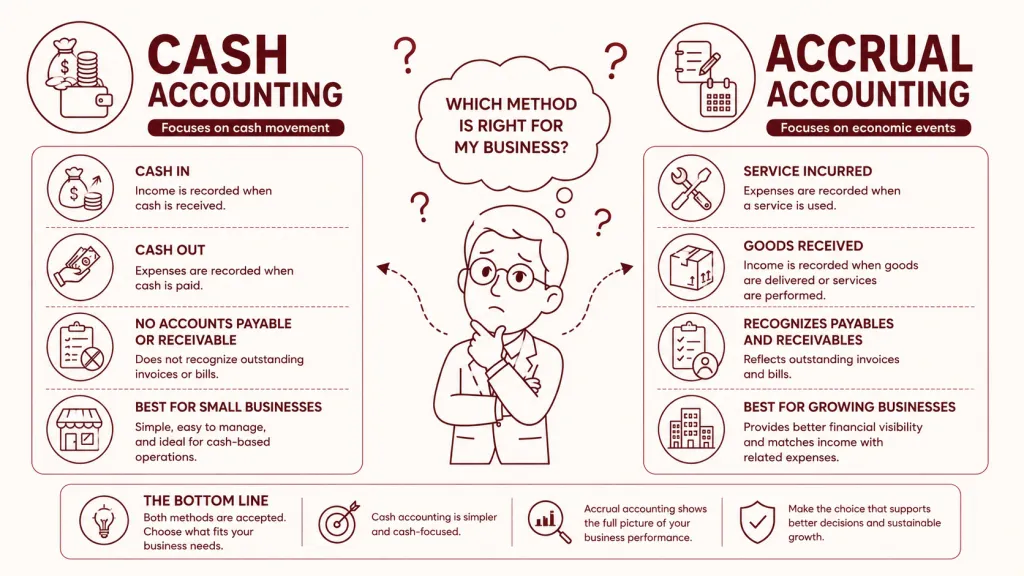
Cash and accrual accounting are different accounting systems wherein the main difference lies in the timing of when revenue and expenses are recognized.
Under cash accounting, your books reflect only cash that has actually moved, ignoring accounts receivable and accounts payable.
For example, a business records revenue when payment is received. Likewise, an expense is recorded when payment is made. Cash basis accounting allows for an accurate picture of actual cash in the bank account.
Under accrual accounting, businesses recognize income when it is earned, even if payment has not yet been received. This can mean taxable income includes revenue before the related cash has been collected, which may create cash-flow pressure if receivables are slow.
Expenses are also recognized when incurred, regardless of when cash leaves the bank account. For UAE Corporate Tax purposes, financial statements are generally prepared using IFRS, while IFRS for SMEs may be used by taxable persons with revenue not exceeding AED 50 million. Accrual accounting generally aligns with IFRS-based reporting because it recognises income and expenses in the period to which they relate.
While accrual accounting is favored by expanding companies and those looking for investors or debt funding, cash basis accounting is frequently utilized by smaller companies with more straightforward cash flow requirements.
While cash accounting can distort profitability based on payment timing, accrual accounting provides a more realistic long-term picture by matching revenue with the expenses that generated it.
The differences between accrual and cash accounting are summarized here.
| Area for Adjustment | Cash Accounting | Accrual Accounting |
|---|---|---|
| Revenue recognition | When cash is received | When income is earned |
| Expense recognition | When payment is made | When obligation occurs |
| Accounts receivable/payable | Usually excluded | Included |
| Record keeping requirements | Fewer timing adjustments | Requires tracking receivables, payables, prepaid and accrued expenses |
| Financial visibility | Short-term | More complete |
| Financial records | Focuses on completed cash transactions | Reflects earned revenue and incurred expenses regardless of payment timing |
| Ideal for | Smaller/simple businesses | Growing/scaling businesses |
Note
Accrual accounting does not necessarily mean more cash in the bank or higher profitability. A business can appear profitable while facing cash flow pressure.
Cash accounting is best suited for small, service-based businesses with minimal inventory and more straightforward bookkeeping system.
Accrual accounting improves reporting accuracy and reconciliation, leading to a more reliable profit analysis.
| Area for Adjustment | Cash Accounting | Accrual Accounting |
|---|---|---|
| Accounts Receivable | Unpaid customer invoices not reflected until payment is received. | Customer invoices are recorded when revenue is earned, even if payment is pending. |
| Accounts Payable | Supplier obligations must be paid to be recorded | Supplier obligations are recorded when incurred, even if payment has not yet been made. |
| Balance Sheet Visibility | Provides a view of cash on hand Does not reflect outstanding obligations or future collections. | Provides visibility into assets and liabilities |
| Income Statement Accuracy | Profitability can fluctuate based on payment timing. | Revenue and related expenses are matched within the same reporting period, providing a more complete view of performance. |
| Annual Revenue Reporting | Revenue may vary significantly depending on when customers pay invoices. | Revenue reflects business activity during the reporting period, regardless of payment timing. |
The UAE Corporate Tax regime requires businesses to maintain accurate reporting of their financial performance.
Under Article 20 of the UAE Corporate Tax Law, taxable income is generally determined based on financial reports prepared using accepted accounting standards.
A taxable person may prepare statements using the cash basis of accounting when:
The AED 3 million threshold is frequently discussed in relation to UAE Corporate Tax because it is also relevant to eligibility for Small Business Relief under the UAE Corporate Tax framework.
The UAE’s Small Business Relief (SBR) allows eligible resident businesses with yearly revenues not exceeding AED 3 million to be treated as having no taxable income, effectively exempting them from Corporate Tax.
The UAE continues to align its business environment with internationally recognized reporting practices.
Many businesses preparing their financial documents rely on IFRS-based reporting frameworks. Accrual accounting generally aligns more closely with these reporting standards because it captures economic activity regardless of when cash is received or paid.
| IFRS | GAAP |
|---|---|
| International framework | Primarily US framework |
| Commonly used across many countries | Mainly used in the United States |
| Relevant to UAE’s compliance and financial disclosure | Usually only relevant if dealing with US stakeholders |
| Based on accounting standards issued internationally | Based on US accounting standards |
For practical purposes, both frameworks generally favor accrual accounting records.
Note
Most UAE businesses prepare financial records using internationally recognized reporting frameworks such as IFRS. However, businesses operating within Islamic finance sectors may also be subject to standards issued by AAOIFI.
While IFRS is generally the primary reporting framework used across the UAE business environment, Accounting and Auditing Organization for Islamic Financial Institutions (AAOIFI) standards may be relevant for Islamic banks, takaful providers, and other Islamic financial institutions.
For VAT purposes, the timing of output tax and input tax recovery is driven by UAE VAT rules, including the date of supply, tax invoice requirements, and supporting documentation. Cash or accrual accounting may affect internal reporting, but VAT treatment must be assessed under the VAT law and FTA guidance.
A business may need to switch between cash based accounting and accrual basis accounting as its reporting requirements evolve. Businesses may evaluate switching accounting systems when:
Businesses that exceed the AED 3 million threshold should assess whether they are still eligible to use the cash basis of accounting and whether a transition to accrual accounting is required under the applicable UAE Corporate Tax rules.
During the transition, businesses should review:
Strong documentation can support future VAT reporting, corporate tax compliance, reconciliations, and audits.
There is no universally “better” accounting method. The right choice depends on transaction volume, payment cycles, inventory requirements and growth plans.
Understanding Timing Differences between business activity and cash movement
For example:
Under accrual accounting, these events can be reflected in the reporting period to which they relate. This can improve financial management, forecasting, and decision-making.
Note
Profitability does not always equal cash flow. For example:
As a result, the business may report a profit while still needing to manage working capital, payroll, supplier payments, and operating expenses.
This is why accrual accounting often works best when combined with active cash flow management.
Whether a business uses cash accounting or accrual accounting, having the right systems and processes in place becomes increasingly important as transaction volumes grow.
Modern accounting solutions can substantially simplify reconciliations, document management, and financial reporting.
Skrooge supports UAE businesses with a combination of technology and experienced accountants, helping founders stay on top of bookkeeping, VAT, Corporate Tax obligations, and cash flow visibility without losing sight of the bigger picture.
To learn more on how we can help you, simply leave us your number and our expert team will get back to you.
Due to its simplicity and convenience of use, cash basis accounting is favored by sole proprietors and small firms.
Cash basis accounting can be simpler for eligible smaller businesses because income and expenses are generally recognized when cash is received or paid. However, businesses should not choose an accounting method purely to tax; the method must be permitted under the UAE Corporate Tax rules and applied consistently.
Businesses usually need to use accrual accounting in order to report to outside investors or comply with IFRS for tax purposes.
The AED 3 million threshold is relevant because the UAE Corporate Tax framework generally permits eligible businesses with revenue not exceeding AED 3 million to use the cash basis of accounting.
Once a business exceeds this threshold, it will generally need to use the accrual basis of accounting unless the Federal Tax Authority (FTA) approves an exception in specific circumstances.
Not directly. VAT compliance is based on UAE VAT rules, including date of supply, tax invoices, input tax recovery conditions, and supporting documents.
The accounting method used for financial reporting does not override VAT law. Accrual accounting may make VAT reconciliation easier, but VAT returns must still follow the applicable VAT rules.
Yes, businesses can switch between accounting methods when their reporting requirements, operational complexity, or regulatory obligations change.
Many small business owners initially prefer cash accounting because of its cash basis accounting simplicity and its focus on actual cash received and paid.
No. Under the UAE Corporate Tax framework, businesses with revenue not exceeding AED 3 million may generally be eligible to use the cash basis of accounting.
If a business exceeds this threshold, it will generally need to transition to accrual accounting unless an exception is approved by the Federal Tax Authority (FTA).
If your business deals with inventory, a high volume of transactions, or accounts payable and receivable, the accrual method offers a clearer view of your finances.
International accounting standards help ensure that financial statements are prepared consistently and can be understood by investors, lenders, auditors, and regulators across different jurisdictions.
As far as the UAE is concerned, most companies use the IFRS to prepare their financial statements.
One of the reasons why accrual accounting is common is because it adheres to the principles of IFRS through the matching principle, which means that revenue is recognized when it is realized and expenses when incurred.
For growing businesses, IFRS-aligned reporting can support:
→ financing applications
→ investor due diligence
→ audit requirements
→ financial transparency
→ long-term business planning
Certain Islamic financial institutions may also apply standards issued by AAOIFI, depending on their activities and regulatory requirements.
Businesses should generally retain:
✔️ tax invoices and supplier invoices
✔️ receipts and proof of payment
✔️ bank statements
✔️ contracts and agreements
✔️ payroll records
✔️ inventory records, where applicable
✔️ credit notes and debit notes
✔️ VAT returns and supporting schedules
✔️ Corporate Tax records and supporting calculations
Under accrual accounting, businesses may also need documentation supporting:
✔️ accounts receivable (unpaid customer invoices)
✔️ accounts payable (outstanding supplier obligations)
✔️ prepaid expenses such as rent, insurance, or software subscriptions
✔️ accrued expenses such as salaries, utilities, or professional fees
✔️ revenue recognized before payment is received
✔️ expenses incurred before payment is made
Because accrual accounting records revenue and expenses in the period they relate to, businesses often require more detailed supporting documentation to demonstrate how transactions were recognized.
Thank you!
We've received your request and will get back to you shortly.

Loading...
 Thank you!
We've received your request and will get back to you shortly.




 Contact Us


