

Simplifying VAT Return Filing in the UAE (including changes in 2026 and how to prepare)
VAT has been part of doing business in the UAE since January 1, 2018, and…
Founders have a lot on their plates, especially with regard to the various legal requirements they must adhere to.
Companies should be aware that, in addition to the financial consequences, firing an employee could lead to a volatile workplace if it is not handled properly. Any mistake in terminating someone could result in issues with employment, postponed visa clearances, etc.
Since the employment contract is primarily governed by labor laws, it is imperative that founders understand when it is possible to terminate the employment contract and what they should do after.
The purpose of this article is to inform business owners about the various forms of termination, when it is feasible, and the regulations they must follow when terminating employees in the United Arab Emirates.
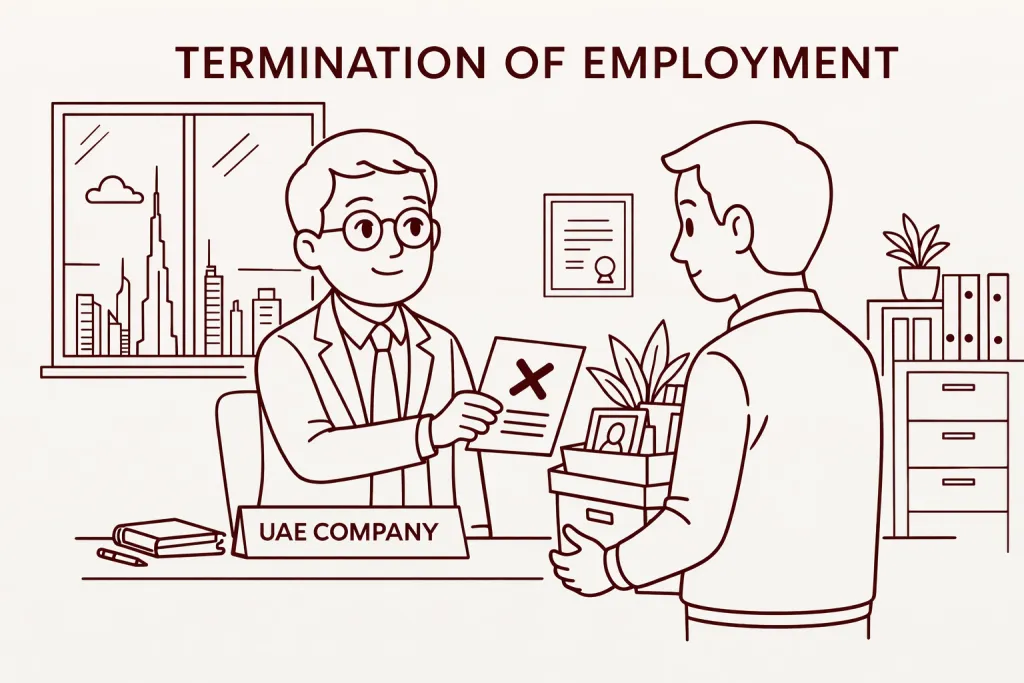
Termination of employment in UAE means the ending of the contractual relationship between two parties, i.e., the employee and the employer, as per a legitimate employment contract. This could be through resignation or the expiry of the contract, among other reasons.
The UAE Labour Law under Federal Decree-Law No. 33 of 2021 is a much-needed update of the UAE’s labour regulations. Amendments such as Cabinet Resolution No. (1) of 2022 have been implemented since then.
The UAE’s Labor Law states that employment is covered by a contract wherein the employee works under supervision in exchange for compensation.
Under UAE private-sector labor law, either party may terminate the employment contract for a legitimate reason, provided written notice is given and the agreed notice period complies with the law.
When employment ends, employer must handle the notice period, final settlement and end of service gratuity, depending on the circumstances.
Employers must pay unpaid wages and other contractual or statutory entitlements within 14 days from the end date of the contract term.
During the hiring process, employees are made aware of the terms of their contract, including stipulations for when their employment ends. This should be the employee’s test of legitimacy, as it protects them under the UAE Labour Law.
There are several types of termination processes. Each affects the employee’s rights differently.
|
Type of Termination |
Definition |
Example |
|---|---|---|
|
Contract Expiry |
Fixed term contract ends and the employment is not renewed |
An employee signs a two-year contract and the employer decides not to renew it (can be because of visa issues, job redundancy or project end, among others) |
|
Resignation |
Employee initiates the end of their employment and completes the required notice period |
An employee submits their written resignation |
|
Employer initiated termination |
Occurs when the boss terminates employment due to economic or exceptional reasons |
|
|
Immediate termination without notice |
Termination without notice in situations permitted by labour law |
|
Note
Employers and employees may mutually agree to waive or shorten the notice period, provided that neither party’s rights are compromised.
Events such as worker’s death, employer death or permanent inability fall under legally recognized reasons for automatic termination of employment contract.
Given its sensitive nature, the UAE has laid down a legal framework that key stakeholders need to follow. Generally, everyone is given the right to fair and documented procedures before ending their employment.
When either the employer or employee decides to end their contract, advance notice is required in UAE. This period must be observed based on what’s agreed in the contract.
Its purpose is to give both parties time to prepare for the transition, complete handovers, and prevent any damage to operations.
The minimum notice timeline is 30 days under UAE labour law. However, if the employee is still within the probation period, the employer may terminate employment by giving at least 14 days’ written notice. During the contractual notice period, the employee is entitled to their full remuneration according to the last salary they were receiving.
If either party fails to honor the notice period agreed, they are required to compensate the other party with an allowance equivalent to the full salary for the unobserved portion of the notice period.
Immediate termination without notice is permitted under specific conditions, which require a formal written investigation and justification for the dismissal.
Employees who believe they have been unlawfully terminated can file a complaint with the Ministry of Human Resources and Emiratisation (MoHRE).
If an employee is dismissed unlawfully, they may be entitled to compensation of up to three months’ salary.
Longer notice obligations are primarily governed by the employee’s contract. A longer notice period may apply if it is validly agreed in the contract, provided it remains within the statutory range of 30 to 90 days.
For senior roles or business- critical positions, human resources may ask to serve a longer period given:
Immediate termination of employment UAE refers to ending the employment relationship without a notice when legally justified.
Under UAE labour regulations, certain serious violations may allow termination without notice. These provisions are commonly referenced under Article 44 of the labour law.
Immediate termination usually involves:
Because this type of termination bypasses the notice period, employers must ensure the legal grounds are clearly documented.
Termination is unlawful if the employee is dismissed for filing a serious complaint with MOHRE or a lawsuit against the employer and its validity is proven. In that case, the court may award compensation of up to 3 months’ wage, in addition to other entitlements such as notice pay and end-of-service benefits where applicable.
Employees may also raise claims with issues related to unpaid dues, including repatriation costs and the cancellation of their UAE residency visa.
Note
This article focuses on the UAE private-sector labour regime under Federal Decree-Law No. 33 of 2021.
Employment in financial free zones such as DIFC and ADGM is governed by separate employment laws and regulations and should be assessed separately.
If the employer terminates the employment contract without notice, the decision must rely on legally valid grounds under UAE labour law.
Immediate termination is generally associated with serious misconduct, actions that harm the employer’s business or major breaches of workplace rules. Employers should document the reason for termination and keep supporting evidence to ensure compliance with contractual obligations.
A worker may leave without notice only in the cases specified by Article 45, such as serious employer breach, violence or harassment, grave danger at the workplace that is not remedied, or instruction to perform fundamentally different work without written consent. This allows the employee to leave the job immediately rather than complete the notice period based on agreement.
Important procedural note
Because termination without notice is an exception, the legal basis and supporting evidence should be documented carefully.
Employees who have completed at least one year of service are entitled to severance pay in the UAE.
Compensation for termination of employment UAE depends on the reason for termination and the employee’s length of service.
Employees terminated must ensure the final settlement reflects these obligations.
After termination of employment, the employee may receive end of service gratuity if they meet the eligibility requirements.
Under UAE law:
The end-of-service gratuity is calculated based on the employee’s length of service and final basic salary.
Calculations would include:
Typical final settlement items include:
Gratuity payment is capped at two years’ wages for foreign employees in the UAE.
In practice, employers should document the end of employment clearly in writing. For termination with notice, written notice is required. For dismissal without notice under Article 44, the dismissal decision must be written and justified. Separately, an employee may request an experience certificate at the end of employment.
A typical letter of termination of employment should include:
Clearer documentation helps avoid misunderstandings or legal disputes.
Employees dismissed unlawfully may be entitled to compensation of up to three months’ salary, depending on the severity of the breach.
Employers must conduct a formal written investigation before terminating an employee without notice for severe breaches.
Employment termination disputes can occur when an employer fails to:
Employers must provide a notice for termination, which must include the reason for dismissal.
Key practices for employee termination include thorough documentation of performance issues, conducting in-person or live video meetings with an HR witness, providing written note and severance, and managing a smooth offboarding process.
Documentation of performance reviews, written warnings, and investigation reports is essential to prove that the termination is legitimate and non-discriminatory.
When handling termination of employment in UAE, both employers and employees should ensure the following steps are completed:
Whether you’re terminating a contract as an employer or employee, it pays to protect yourself and ensure legitimate reasons are properly documented by the other party.
This will help you avoid compliance issues with the Ministry of Human Resources in the future.
The notice period must be stated in the contract and must be at least 30 days and no more than 90 days.
However, if the employee is still within the probation period, the employer may terminate employment by giving at least 14 days’ written notice. The parties may agree to reduce or waive active service during the notice period, but the worker’s rights for the agreed notice period must still be preserved.
If there is a default from either side, then they have to pay the salary for the notice period.
Gross misconduct or violation of the labour law provisions may lead to immediate termination.
Under federal law, it is a serious breach of the basic duties or acts that cause harm to the employer and the rest of the company. Other acts may involve the disclosure of confidential information and intellectual property.
Before proceeding, the employer needs to conduct a thorough investigation and establish a legitimate reason.
Employees are entitled to receive their wages and all other end-of-service entitlements within 14 days from the end date of the contract term.
Final salary is determined by the amount earned but not paid until the last day of work, including any pending allowances or benefits.
Any leave that has been accrued but is still pending must be converted to cash and paid as part of the settlement. This is done on the basis of the last drawn salary by the employee.
End of service gratuity is paid to the employee if he/she has served for at least a year of continuous service. It is calculated on the basic wage (excluding allowances).
Minimum calculation is defined by:
1. 21 days’ basic salary per year for the first 5 years
2. 30 days’ basic salary per year for each additional year
The formula for final compensation =
Outstanding salary + unused leave + gratuity + (notice pay if applicable) + other contractual benefits
Not automatically. It is important to note that summary dismissal does not necessarily mean losing out on the end-of-service gratuity.
Gratuity is still applicable for foreign employees whose period of service is more than one year.
Some exceptions apply depending on the grounds for termination. For those whose dismissal is based on serious violations, it is dependent on whether it was lawfully done or not.
It is the employer’s responsibility to prove the grounds for summary dismissal. If the employer fails, it is considered unlawful termination and the gratuity is still due.
The employees should keep a record and seek clarification from the labour authorities. In case there is a dispute, the employee may lodge a complaint to the Ministry of Human Resources and Emiratisation (MoHRE).
A competent court may finally decide whether the gratuity has to be paid, and they may also have a say on the unfair cancellation of work permits.
Employers must document and communicate valid reasons for termination to protect against potential legal claims.
Common documents to ensure compliance include
✓ final settlement statement
✓ termination letter
✓ handover confirmation
✓ employment records
✓ work permit cancellation documents
The UAE Labour Law mandates that terminations be documented with a written notice or termination letter.
Thank you!
We've received your request and will get back to you shortly.

Loading...
 Thank you!
We've received your request and will get back to you shortly.




 Contact Us


