

Simplifying VAT Return Filing in the UAE (including changes in 2026 and how to prepare)
VAT has been part of doing business in the UAE since January 1, 2018, and…
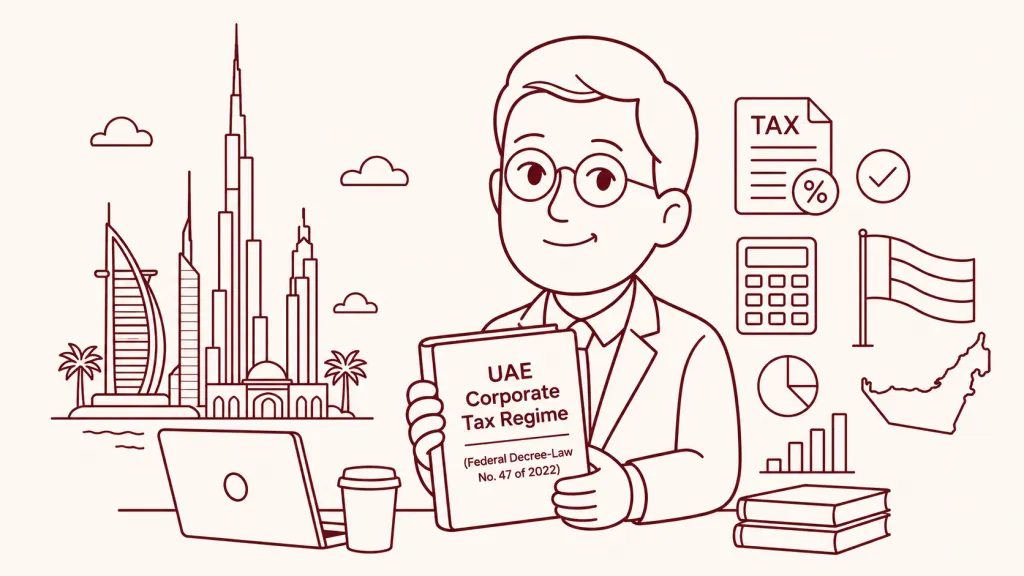
Federal Decree-Law No. 47/2022 is the main law governing UAE corporate tax effective June 1, 2023. Corporate Tax in the UAE is imposed at a rate of 0% on taxable income up to AED 375,000, and 9% on taxable income exceeding AED 375,000.
|
Terminology |
Definition |
|---|---|
|
Resident Person |
|
|
Non-resident person |
A non-resident may become subject to UAE Corporate Tax if it has:
|
|
Taxable income |
Starts with accounting profit before adjustments. This income is subject to tax (instead of revenue). |
|
Permanent Establishment |
Permanent establishment is when a foreign company has sufficient business presence in the UAE to become subject to Corporate Tax, in coordination with international tax treaties. |
|
Tax Groups |
The law allows eligible UAE companies to form a Tax Group and be treated as a single taxable person.
Potential benefits include:
|
The Corporate Tax Law applies to the following businesses and persons, including:
The UAE has also introduced a Domestic Minimum Top-up Tax (DMTT) for financial years starting on or after 1 January 2025.
The DMTT applies to qualifying multinational enterprise groups with consolidated annual revenues of €750 million or more. The DMTT is intended to support a minimum effective tax rate of 15% under the OECD Pillar Two rules.
Exempt Income refers to income that is specifically excluded when calculating taxable income:
The Corporate Tax Law provides exemptions for specific categories of persons and entities.
Exemption is not automatic in all circumstances. Entities must meet the conditions prescribed by the Corporate Tax Law and related decisions.
To support businesses navigating growth, the Corporate Tax Law includes several reliefs and special tax regimes for eligible businesses.
The law allows businesses to carry forward qualifying tax losses and offset them against future taxable income, subject to applicable conditions.
This relief reduces future corporate tax liabilities and manage losses incurred during startup or expansion phases.
The law provides relief for certain transfers of assets and liabilities between members of a qualifying group.
The objective is to facilitate internal business reorganizations without being taxed when there is no actual change in ownership.
This may be relevant when businesses:
A Qualifying Free Zone Person (QFZP) is a Free Zone entity that:
Qualifying Free Zone Persons are eligible for a 0% corporate tax rate on qualifying income and non-qualifying income is taxed at 9%.
To maintain its status as a Qualifying Free Zone Person, the entity must ensure that its non-qualifying income does not exceed the lower of AED 5 million or 5% of its total revenue, which is called the de minimis rule.
If a Qualifying Free Zone Person fails to meet the required conditions at any time during a tax period, it will lose its status as a QFZP from the beginning of that tax period and four subsequent taxation periods.
Businesses that fall within the scope of the CT Law are generally required to complete corporate tax registration with the FTA. Upon successful registration, a CT Tax Registration Number (CT TRN) is issued and used for administration and correspondence with the FTA.
Registration and ongoing compliance are managed through the EmaraTax platform.
Corporate Tax operates on a self-assessment basis. Taxable persons are responsible for calculating their own tax liability and ensuring that their CT Return is submitted accurately.
A Corporate Tax Return is generally filed for each relevant tax period and includes information relating to:
Returns must be submitted within the deadlines prescribed by the Corporate Tax Law and related regulations.
Businesses operating in the UAE are generally required to maintain accounting records and supporting documentation for at least 7 years following the end of the Tax Period to which they relate.
These records may include financial statements, invoices and receipts, contracts and supporting agreements, and other documentation supporting deductions, exemptions, and relief claims.
Companies engaged in related party transactions or connected persons may be subject to transfer pricing requirements.
These rules are designed to ensure that transactions are conducted on an arm’s-length basis and help prevent profit shifting between related entities for tax purposes.
Businesses may be required to maintain supporting documentation to demonstrate compliance with the UAE’s transfer pricing framework.
Recently, the government has released a number of official documents that provide further details about how corporate tax is applied to companies who operate in the United Arab Emirates.
Many of these provisions are applicable to financial years that begin on or after the dates specified in the applicable legislation. The legal and administrative framework is established for registration, filing, assessments, audits, and penalties in the UAE.
| Legislation | Purpose |
|---|---|
| Federal Decree-Law No. 47 of 2022 | UAE Corporate Tax Law |
| Federal Decree-Law No. 28 of 2022 | UAE Tax Procedures Law |
| Cabinet Decision No. 100 of 2023 | Qualifying Income for QFZPs |
| Ministerial Decision No. 73 of 2023 | Small Business Relief |
| Ministerial Decision No. 97 of 2023 | Transfer Pricing Documentation |
| Ministerial Decision No. 125 of 2023 | Establishing rules for Tax Groups |
| Ministerial Decision No. 126 of 2023 | Introduces interest deduction limitation rules |
| Ministerial Decision No. 229 of 2025 | Defining Qualifying and Excluded Activities for Free Zone businesses |
While Federal Decree-Law No. 47 writes the core of the Corporate Tax Law, firms frequently need to consult local legislation and FTA guidelines to understand how the rules apply in practice.
Companies that need to navigate more complex transactions (including Free Zone activities, group structures, or cross border operations) may need expert accounting and bookkeeping, tax advisory or legal services to assess how their strategy impacts their tax obligations.
Thank you!
We've received your request and will get back to you shortly.

Loading...
 Thank you!
We've received your request and will get back to you shortly.




 Contact Us


