

Accounting services in DIFC
Accounting in DIFC goes beyond maintaining financial records. Companies operating in the Dubai International Financial…
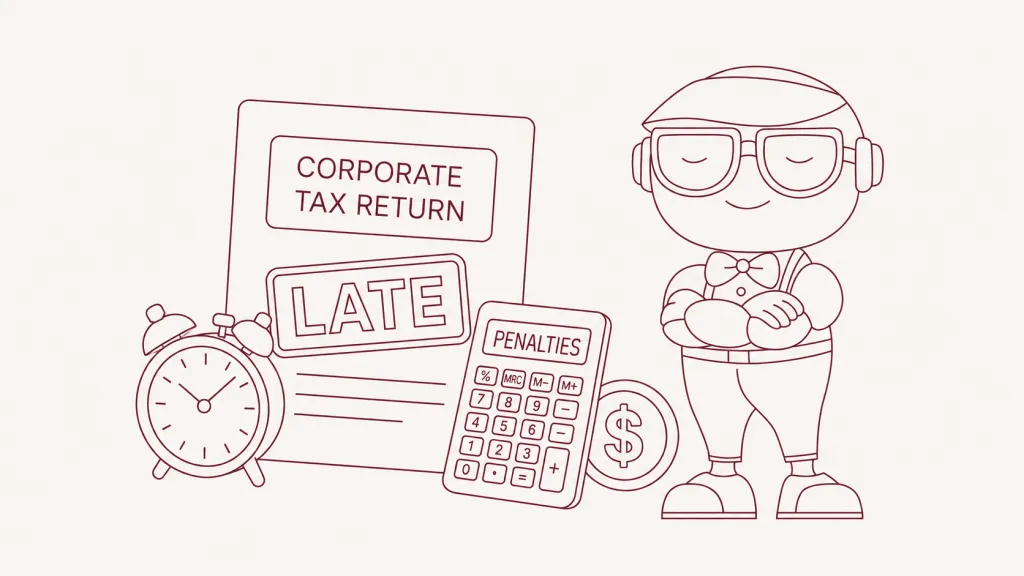
If your UAE business owes Corporate Tax, paying the tax by the deadline matters just as much as filing the return. Late payment can trigger a 14% per annum penalty, calculated monthly on the outstanding tax amount.
This article is intended for UAE businesses, founders and finance teams responsible for Corporate Tax compliance under Federal Decree-Law No. 47 of 2022. The regime also includes free zone companies under CT Law.
Understanding these rules can help businesses plan for their tax liabilities, avoid unnecessary penalties and know what to do if tax remains unpaid or an error is discovered after filing.
Businesses face a late payment fine of 14% per annum, imposed for each month or part of a month on the unsettled payable tax.
The administrative penalty starts from the day after the Corporate Tax payment due date and continues on the same date each month while the tax remains unpaid.
The FTA has clarified that Corporate Tax payable is due no later than nine months from the end of the relevant Tax Period.
For example, where a company’s Tax Period ends on 31 December, the general deadline for filing the return and paying Corporate Tax is 30 September of the following year. If the tax is not settled by 30 September, the late-payment penalty begins from 1 October.
Note:
The 14% is not a one-time 14% fine imposed after a year. It is an annualized rate applied monthly under the administrative penalty rules.
Businesses registered with CT need to file tax returns within 9 months of financial year-end.
Filing and payment generally fall on the same deadline, but they are different obligations.
In the same example where a company closes its Tax Period on 31 December 2025, its general deadline for filing its return is on 30 September 2026.
Late filing of corporate tax returns incurs an extra fine of AED 500 per month for the first year. The late filing fine increases to AED 1,000 per month from the 13th month onward.
Submitting an incorrect Corporate Tax Return can result in an AED 500 administrative penalty, unless the person corrects the return before the expiry of the filing deadline.
The late payment penalty is calculated monthly on the unpaid tax amount starting from the day after the payment and filing deadline.
The annual penalty rate is 14%. For a simple monthly estimate, this is approximately 1.1667% of the unpaid tax per month.
Example of penalty on unpaid tax:
Because the penalty applies for a month or part of a month, businesses should not assume that being only a few days late automatically avoids the monthly charge.
The longer a tax liability is unsettled, the greater the administrative penalty becomes. This is why tax calculations, timely filing and timely payment should be completed before the statutory deadline where possible.
To register for corporate tax in the UAE, submit an application online through the EmaraTax portal managed by the Federal Tax Authority (FTA).
Registration is mandatory for juridical persons subject to Corporate Tax, including Free Zone businesses. Natural persons are required to register where they conduct a Business or Business Activity in the UAE and their total turnover from such activity exceeds AED 1 million within a calendar year.
Late corporate tax registration incurs AED 10,000 in administrative penalties.
Under the published FTA conditions, the penalty can be waived where the taxpayer meets the requirements, including submitting its first Tax Return within seven months from the end of its first Tax Period.
Taxable Persons generally must keep the records and documents required for UAE Corporate Tax purposes for seven years following the end of the relevant Tax Period.
Failure to keep proper records and information carries an AED 10,000 administrative penalty for each violation.
If the same violation is repeated within 24 months from the date of the last violation, the penalty increases to AED 20,000.
The FTA’s Corporate Tax late-registration penalty waiver initiative took effect in April 2025. Eligible businesses can have penalties waived if they meet specific conditions.
The FTA has introduced a specific waiver for the AED 10,000 penalty, provided the business completes its Corporate Tax registration and submits its first Tax Return within seven months from the end of its first Tax Period.
This seven-month requirement is different from the usual nine-month deadline for filing and paying Corporate Tax, and it applies only to the business’s first Tax Period.
If the AED 10,000 penalty has already been paid, the amount is automatically credited to the taxpayer’s EmaraTax account once the waiver conditions are met, subject to the applicable rules.
Note
If your registration was late, do not assume the penalty is unavoidable. This initiative is not necessarily a general waiver of Corporate Tax penalties or the separate 14% late-payment penalty.
If a business discovers an error in its Corporate Tax Return that results in additional Corporate Tax becoming payable, it should correct the error through Voluntary Disclosure where required and settle the resulting tax liability within the relevant deadline.
From 14 April 2026, the applicable Voluntary Disclosure penalty is generally calculated at 1% of the Tax Difference for each month or part of a month, subject to the applicable rules.
A Voluntary Disclosure (VD) is the formal procedure a taxpayer uses to tell the FTA that a previously submitted Tax Return or Tax Assessment was incorrect and that the resulting Corporate Tax liability was understated.
In short, it is relevant when a taxpayer discovers an error or omission that affects its tax position.
Under the Tax Procedures Executive Regulation, if the error causes the Payable Tax to be understated by more than AED 10,000, the Taxable Person must make a Voluntary Disclosure within 20 Business Days from the date it became aware of the error.
If the understatement is AED 10,000 or less, the taxpayer generally corrects the error through the relevant Tax Return for the period in which the error is discovered, where such a return is available.
If there is no Tax Return through which the error can be corrected, a Voluntary Disclosure must be submitted within 20 Business Days of becoming aware of the error.
There is also a Voluntary Disclosure requirement where a taxpayer discovers that a previously submitted tax refund application was incorrect and claimed a refund greater than the amount actually due.
For example:
Because the understatement is more than AED 10,000, the company needs to make a Voluntary Disclosure within 20 Business Days of becoming aware of the error.
Taxable Persons should maintain records that support the figures reported in their Corporate Tax returns.
Required documents can include:
Accounting software can help organize transactions and supporting documents, but software does not remove the need for appropriate accounting and tax review.
Free Zone companies are within the UAE Corporate Tax regime and may have Corporate Tax compliance obligations, even where they qualify for a preferential Corporate Tax treatment.
A Free Zone company’s eligibility for the Qualifying Free Zone Person regime does not by itself remove its obligations to register on time and observe timely tax filing.
For a Qualifying Free Zone Person, audited Financial Statements are required as part of the conditions for maintaining QFZP status, alongside sufficient documentation supporting the calculation of Qualifying Income.
During a tax audit, a business may need to provide records and supporting documents that substantiate its Corporate Tax position. Keeping these records organized also makes it easier for a tax auditor or the FTA to understand how the company’s tax position was calculated.
Late payment is not the same as tax evasion.
If a business fails to pay its Corporate Tax by the deadline, it may incur an administrative penalty, but late payment alone does not mean the business has evaded tax.
Tax evasion involves deliberate conduct to avoid paying tax. For founders, the important thing is to understand the applicable tax deadlines and act quickly when a payment is missed.
Tax advisors can help businesses navigate the UAE government’s requirements and understand how the UAE tax system applies to their business.
They can help identify important tax deadlines, review accounting records before tax filing, and check whether supporting documents properly substantiate the Corporate Tax calculation.
A tax agent can also assist with communication and filings with the FTA, while a legal representative may be involved where formal representation is required.
When an error is identified, tax professionals can help assess the resulting tax difference and determine whether a Voluntary Disclosure or another corrective procedure is appropriate.
Getting this review done early can help businesses plan for timely payment and avoid unnecessary compliance costs that could affect the company’s financial health.
At Skrooge, our work combines AI-assisted accounting with human accountant review: automation handles repetitive tasks such as collecting documents, processing transactions and flagging missing information, while accountants review the tax treatment and complex cases before a return is submitted.
The client then approves the filing, keeping professional judgment and accountability with people rather than relying on automatic tax decisions.
Thank you!
We've received your request and will get back to you shortly.

Loading...
 Thank you!
We've received your request and will get back to you shortly.










 Contact Us


