
Filing for Corporate Tax in UAE under Free Zone Explained: Comprehensive Guide for Qualifying Businesses
Businesses looking to start in the United Arab Emirates (UAE) have the option to get…
Corporate tax regime was implemented in 1 June, 2023 under the Federal Decree Law No. 47. This law aims to create a globally competitive landscape for UAE based businesses while maintaining easier compliance for businesses looking to establish their activities within the mainland and/or free zone areas.
Filing for corporate tax is the process of submitting your company’s tax returns to the Federal Tax Authority. After registering for corporate tax and getting your tax registration number (CT TRN), registered “taxable persons” are obligated to file tax returns and pay their liabilities to the government.
The tax return reports the taxable income for the relevant tax period; the applicable adjustments under the Corporate Tax Laws; any corporate tax payables.
Note
Filing is a separate obligation from paying taxes. Filing every end of tax period is mandatory for all Taxable Persons, even if:
You can refer to this table for the appropriate federal corporate tax rate to follow:
| Category | Threshold / Rate | Who can avail of this? |
|---|---|---|
| Taxable persons other than QFZPs | 0% on the portion of Taxable Income up to AED 375,000 and 9% on the portion of Taxable Income above AED 375,000 | Applies to most Taxable Persons that are not treated as a Qualifying Free Zone Person (QFZP), including mainland companies and Free Zone companies |
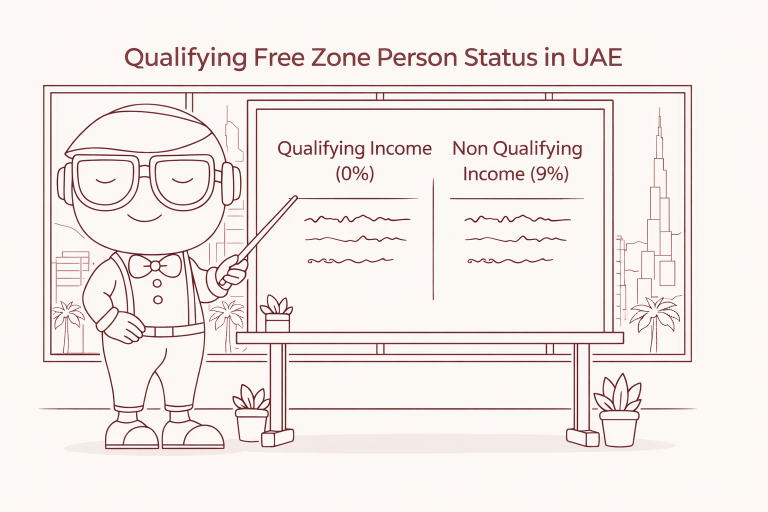
| Qualifying Free zone Persons | 0% on qualifying income and 9% on non-qualifying income | The 0% rate is generally linked to Qualifying Free Zone Person (QFZP) status and applies only to Qualifying Income, provided the Free Zone entity meets the relevant conditions.
Qualifying Income (0%) includes: 1. Transactions with other FZ Persons (subject to exclusions) Non-Qualifying Income (9%) includes: |
| Eligible small businesses with revenue up to AED 3 million in a tax period (also referred to as the “small business relief “) |
0% until the end of 2026 and 9% thereafter | (as of publishing) This incentive will be applicable until the end of 2026.
Note that this incentive is designed for eligible resident taxable persons only. If in any previous year, revenue exceeds 3 million, you cannot avail this anymore. |
| Multinational enterprises (MNEs) with global revenue > €750 million in at least 2 of the last 4 fiscal years | 15% (Domestic Minimum Top-up Tax (DMTT)) | Applicable from 2025, it ensures the overall minimum effective direct tax reaches 15% under OECD Pillar Two rules, without changing the standard rate for most businesses. |
Any individual or organization conducting business and registered for corporate tax must file their corporate tax returns. Corporate Tax in the UAE applies to all license types so long as the licensed activity constitutes a business under the Corporate Tax Law.
Taxable persons include:
NOTE:
VAT vs CT – Filing for VAT returns and corporate tax returns should be treated separately. However, EmaraTax handles the process for both.
Under UAE VAT regulations, some of the revenue may be out of scope but for corporate tax, this will be taxable. An example of this would be :
Certain exempt persons are entities that are outside the scope of the federal corporate income tax.
Here are examples of businesses that are not required to register for corporate tax:
NOTE:
What’s a juridical person? It is defined as a legal entity that the law treats as a separate “person,” with its own rights and obligations, independent from the individuals who own or manage it. A juridical person is capable of owning property, entering contracts and being taxed.
Under UAE’s corporate tax law, tax returns must be submitted and filed within 9 months from the end of the specific Tax Period. Tax liabilities (if any) must also be paid by the same deadline.
After submission, proper records and other supporting documents must be retained for 7 years, just in case the FTA requests a tax audit or further information for specific compliance issues.
To avoid penalties and headaches, it is best practice for businesses to notify the FTA of any key changes to ownership structure, license details, business activities or authorized signatories. You can make the updates on the portal within 20 business days.
This rule applies equally to Qualifying Free Zone persons.
After undergoing corporate tax registration, businesses must file for their tax returns every year within nine months of applicable reporting period, even if no tax is payable or a 0% rate applies.
Before submitting, it helps to know your financial records, what is your gross taxable income, the allowable deductions and tax benefits under your registered tier.
Taxable income refers to the income that is applicable to be taxed and is part of the business’ operations. It is often reflected in financial records within the accounting year, adjusted for exemptions, reliefs, deductions and losses covered under Federal Decree Law No. 47.
Financial statements must follow accounting standards accepted in the UAE. Ministerial rules dictate using cash or accrual basis system of accounting.
Samples of income applicable include:
| Type of Income | Description | Sample transactions |
|---|---|---|
| Operating Income (most common) | Core business earnings and generally taxable | 1. Sales of goods by a trading company
2. Service fees earned by consultants, agencies, or professionals within the business 3. Subscription or licensing revenue (e.g. SaaS, memberships) 4. Project-based income or retainers 5. Commission income from agency or brokerage activities |
| Income from business assets | Note that this is different from income from personal investments or savings | 1. Rental income from business-owned property
2. Income from leasing equipment or machinery 3. Royalties from intellectual property owned by the business 4. Income from exploitation of trademarks, software, or patents |
| Financing and investment-related business income | Where these arise in the course of business, they are generally taxable.
Note: Some dividends and capital gains may be exempt if participation exemption conditions are met or if they are received from UAE resident juridical persons, but otherwise they form part. |
1. Interest income earned by a company (e.g. treasury or financing activity)
2. Foreign exchange gains related to business transactions 3. Gains from disposal of business assets 4. Dividends or capital gains that do not qualify for exemption |
| Other business related income | Some of these can be overlooked, but these are still important to be included | 1. Management fees charged to related entities (under transfer pricing documentation)
2. Cost recharges and mark-upsInsurance recoveries related to business assets 3. Grants or incentives linked to business operations(unless specifically exempt) |
| Qualifying Free Zone Persons (QFZP) | Overall rule: qualifying income is at 0%; non qualifying income is taxed at 9%
De Minimis Threshold Under the de minimis rule, a QFZP can remain eligible for the 0% rate if its non-qualifying revenue does not exceed the lower of 5% of total Revenue or AED 5,000,000 for the relevant Tax Period (subject to the detailed rules). |
Taxable at 0% (if QFZP conditions are met): 1. Income from qualifying activities with other FZ entities 2. Income from approved qualifying activities 3. Qualifying intellectual property income Taxable at 9%: 2. Income from excluded activities 3. Income breaching the de minimis threshold |
Note
Cash basis when you manage your accounting records based on when cash is actually received or paid. Timing would follow bank movements (i.e. if you invoice a client in December and they pay you in February, income will be recorded in February.)
Accrual basis is when you record income when it is earned and expenses when they are incurred, even if paid later. Record keeping follows the business transaction, not cashflow. In the previous example, the income is recorded in December, regardless of when payment arrives.
These are expenses that are generally deductible when calculating income subject to tax. These expenses are incurred wholly and exclusively for business purposes.
Since these reduce net profits, they effectively reduce income liable to corporate tax.
Filing is done through EmaraTax Portal, the official portal by Federal Tax Authority designed as a better experience for UAE businesses managing their tax obligations. Returns must be completed in the form prescribed by the Federal Tax Authority, using figures from the business’ official financial transactions.
The filing process applies uniformly to mainland entities, Free Zone persons, and individuals subject to corporate tax.
Check that your license details are up to date; your financial year end is correct; and authorized signatories are up to date.
Make sure to update any changes before starting the return.
Pre-Filing Checklist:
For corporate tax purposes, prepare the following documents to support your statements.
Remember again that at any point in time, records must be retained for 7 years. Records must be sufficient to explain both how income was calculated and how adjustments were applied.
Statutory deadlines apply within UAE tax laws, wherein it is a legally fixed deadline set by legislation. Therefore, missing the deadline for corporate tax filing will incur penalties and other consequences. Authorities generally have limited discretion to ignore or extend it unless the circumstances allow.
The first tax period is considered as the initial financial or fiscal year for which a business is required to file a UAE Corporate Tax return. The clock starts from when the tax applies to the business and ending on the business’ tax year.
Example:
| Type of Activity | Deadline | Penalty |
|---|---|---|
| Deadline for Timely Filing | Tax Returns must be filed within 9 months after the end of the tax year in question. Any corporate tax due must be paid by the same deadline | Late filing fines – AED 500 per month for first 12 months; then AED 1,000 per month |
| Failure to register for corporate tax | Registration deadlines vary by taxpayer type and status.
For juridical persons, the deadline depends on whether the entity is resident or non-resident, and on its incorporation/license dates, as set out in FTA Decision No. 3 of 2024. For natural persons, registration is required only if turnover from business activity exceeds AED 1,000,000 in a calendar year, in which case the registration deadline is 31 March of the following year. |
A fixed AED 10,000 penalty applies if you fail to register by the deadline set |
| Deadline for Payment of Corporate Tax | Paid by the same 9-month filing deadline | Payment interest at 14% per annum, calculated monthly on unpaid tax |
| Declaration submission for Qualifying Income or Non-taxable person registration | Submitting any declaration to qualify for tax incentives | AED 500 per month in first 12 months
AED 1,000 per month after, total accumulates monthly |
| Maintaining Records | Ongoing obligation; breach occurs when records are missing or not provided upon request | AED 10,000 per violation, and AED 20,000 for repeat offenses within 24 months |
| Updating Registration Details | When changes occur (e.g. authorized signatory, business address change, etc.) | AED 1,000 per violation; AED 5,000 if repeated within 24 months. |
| Incorrect Corporate Tax Return | Error not corrected before the statutory filing deadline | AED 500 fixed amount |
| Failure to provide tax records/documents in Arabic when requested | Immediately when requested | AED 5,000 |
Corporate Tax penalties may be updated from time to time. Always verify the latest penalty amounts and rules through official FTA guidance and the EmaraTax portal.
NOTE
In certain cases, where a Legal Representative is appointed under the UAE tax procedures, penalties for specific violations may apply to the Legal Representative. Businesses should agree responsibilities and timelines clearly with any appointed representative or service provider.
To ensure a smooth, worry-free tax cycle, here are some common mistakes businesses make and how to easily circumvent it using wits and professional services like Skrooge.
Making payments at the time of filing has solved so many issues. Prevention is the best way to avoid interest charges. (think of taxes as your company’s credit card)
At Skrooge, we help simplify things for you with the help of human insights and AI resource expert. Throughout the tax calendar, we keep you up-to-speed on your annual corporate tax compliance and treat is as more than a one-time task.
If managing spreadsheets is overwhelming, let skrooge.ai handle it and keep you safe from penalties.
The deadline for corporate tax filing is within 9 months from the end of the specific taxable period. Businesses are required to file their tax returns and pay any existing tax payables if any.
Any individual or organization that falls under “taxable persons” is required to submit. Specifically:
1. UAE juridical persons (e.g., mainland and free zone companies) that are not treated as exempt under the Corporate Tax Law
2. Natural persons conducting a business activity in the UAE where turnover exceeds AED 1 million in a calendar year (subject to the detailed rules and exclusions)
3. Non-resident persons that have a Permanent Establishment (PE) in the UAE, to the extent they earn taxable income attributable to that PE
4. Corporate Tax Groups approved by the tax authority (filed through the parent/representative member)
You will need to prepare the following records and retain them for 7 years. Statements and documentation must be sufficient to explain how income was calculated and how adjustments were applied.
Common records include: financial statements, trial balance/general ledger, bank statements, invoices and contracts, schedules supporting tax adjustments, and audited financial statements and transfer pricing documentation (mainly for QFZP)
Free zone entities, including those applying the 0% rate on qualifying income, are generally required to file an annual Corporate Tax Return.
Failure to file and pay the direct tax levied on time will constitute a penalty of AED 500 per month for the first 12 months; then subsequently, AED 1,000 per month. Late payment can also trigger a monthly penalty calculated at 14% per annum on unpaid Corporate Tax due.
Related party transactions are transactions between a business and another person or entity that has a relationship of control, ownership, or significant influence over it. Under UAE corporate tax laws, these transactions must follow the arm’s length principle. This means that pricing should be determined as if the parties where independent.
This affects CT returns as the tax authorities can adjust the calculated taxable income if pricing is determined as not “arm’s length”, deny deductions and risk flagging transactions for non-compliance. Similarly, Free zone entities will risk QFZP status if their transactions get flagged.
Thank you!
We've received your request and will get back to you shortly.
Loading...