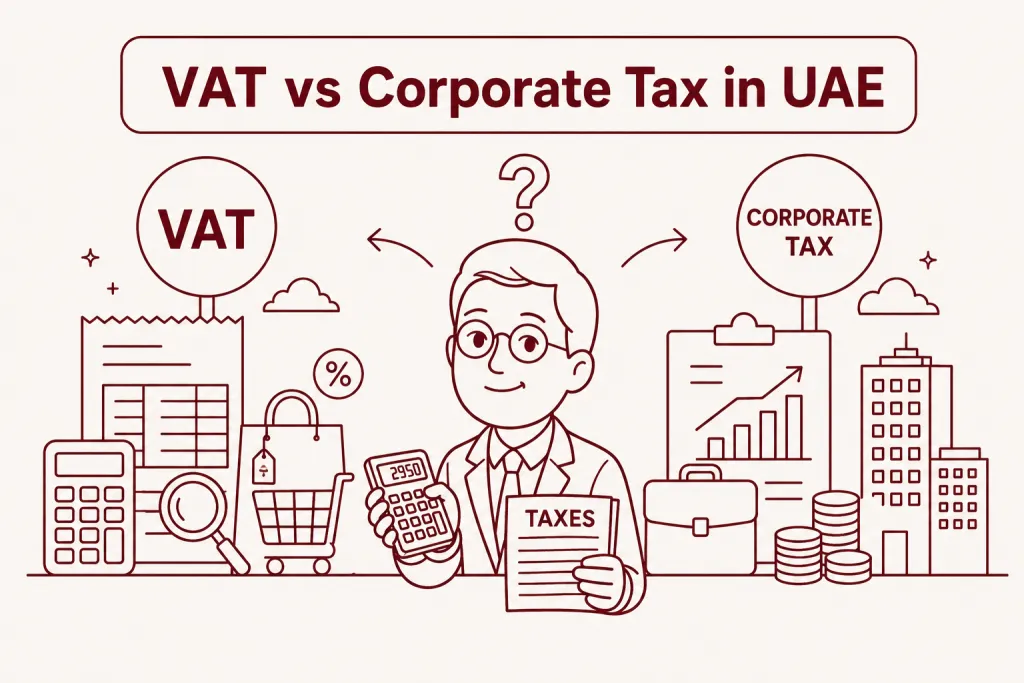
VAT was introduced in 2018 under Federal Decree-Law No. 8 of 2017. Corporate Tax is governed by Federal Decree-Law No. 47 of 2022 and became effective for financial years starting on or after 1 June 2023.
Both taxes are administered by the Federal Tax Authority (FTA) and managed through EmaraTax portal. The UAE government operates a transparent, tiered Corporate Tax (CT) and a broad-based Value Added Tax (VAT) system.
The standard corporate tax rate in the UAE is 9%, whereas the VAT rate is set at 5%.
Details
VAT
Corporate Tax
What it is
An indirect tax imposed on the sale of goods and services.
Direct tax levied on the net profits or income of a corporation or legal entity
Who is a taxable person
VAT applies to any person or business entity registered for VAT to conduct business activities
Juridical persons: Mainland companies, Free Zone entities, and foreign legal entities incorporated or effectively managed in the UAE.
Natural Persons: Subject to CT only if they conduct business or business activities in the UAE and their total turnover exceeds AED 1 million within a calendar year.
Wage, salary, and personal investment income are generally excluded
Registration
Mandatory Registration: Businesses with taxable supplies and imports exceeding AED 375,000 annually.
Voluntary Registration: Businesses can opt in if their taxable supplies and imports are between AED 187,500 and AED 375,000 annually
Taxable persons must register within deadlines prescribed by the FTA.
Businesses within scope of CT are generally required to register, even if they qualify for a 0% rate or Small Business Relief.
Filing Frequency
Commonly:
Quarterly filing periods
Monthly filing periods for certain taxpayers
Frequency is assigned by the FTA
Filed once per tax period. For most businesses, this is either:
one annual corporate tax return
based on the relevant financial year
Tax Accounting Requirements
The focus is primarily on:
Transaction accuracy
Invoice compliance
VAT treatment of supplies
A bookkeeping error can directly affect VAT reporting.
The focus extends beyond bookkeeping.
Businesses may need to evaluate:
Deductible expenses
Exempt income
Tax losses
Small Business Relief
Free Zone incentives
Transfer pricing rules
Related-party transactions
Corporate Tax often requires more judgment and tax analysis than VAT.
Tax Audits and Reviews
FTA reviews often focus on:
VAT invoices
Input VAT recovery
Output VAT declarations
Import documentation
Zero-rated and exempt supplies
FTA reviews may focus on:
Financial statements
Taxable income calculations
Deduction claims
Transfer pricing documentation
Related-party arrangements
Relief claims
Free Zone eligibility
Because Corporate Tax is based on profit calculations, supporting documentation is often broader than VAT compliance.
Corrections and Errors
Errors may require:
VAT return corrections
Voluntary disclosures
Additional tax payments
Refund adjustments
The FTA provides procedures for correcting VAT reporting errors.
Errors may require:
Amended tax filings
Updated taxable income calculations
Reassessment of relief claims
Adjustments to supporting schedules
Penalties
Common compliance risks include:
Late registration
Late filing
Late payment
Incorrect VAT treatment
Insufficient supporting records
Common compliance risks include:
Failure to register
Failure to file returns
Inaccurate taxable income calculations
Inadequate documentation
Transfer pricing non-compliance
Incorrect application of reliefs
Compliance burden on businesses
VAT typically requires:
More frequent reporting
Continuous transaction monitoring
Invoice-level compliance on taxable sales
On the other hand, corporate tax applies:
More technical analysis
Greater reliance on accounting standards
Annual tax computations
Strategic tax planning considerations
About Value Added Tax
VAT is a consumption tax that applies to the supply of goods or services.Businesses collect VAT paid on transactions on behalf of the government and remit it to the FTA.
Taxable supplies are categorized into standard-rated (5%), zero-rated (0%), and exempt transactions
Registration is mandatory if annual taxable supplies/imports exceed AED 375,000, and voluntary if they exceed AED 187,500.
VAT registered businesses can make large sales, charge VAT, and have little or no business profit and still have VAT obligations. The tax is generally charged to end customers, and the business acts as a collector and remitter of VAT.
What is input VAT and output VAT? How VAT works across the supply chain
A business typically:
Pays VAT on purchases (input VAT)
Charges VAT on sales (output VAT)
Pays the difference to the FTA
For example:
Manufacturer sells goods Sale value: AED 10,000 VAT charged: AED 500 For the manufacturer, this is output VAT. For the wholesaler, this becomes input VAT.
Wholesaler sells goods Sale value: AED 15,000 VAT charged: AED 750 The net VAT payable to FTA = AED 750 output VAT- AED 500 input VAT = AED 250
The wholesaler remits the net VAT attributable to the value added at its stage of the supply chain.
Reclaiming input VAT (or input VAT recovery) means taking back eligible VAT paid on business expenses through the tax returns. In general, VAT regulations dictate that this tax should not “cascade” through the supply chain.
Businesses may recover eligible input VAT incurred on business expenses, subject to UAE VAT recovery rules and documentation requirements.
Inventory purchases
Professional services
Office rent (where VAT applies)
Software subscriptions
Business equipment
A business generally needs the following before claiming input VAT recovery.
A valid tax invoice
Proper records
The expense to relate to taxable business activities
Recoverable VAT should not be left unattended indefinitely. In some cases, VAT recovery rights are subject to statutory deadlines, making timely record-keeping and claim preparation essential.
What happens if input VAT exceeds output VAT?
Sometimes a business pays more VAT on purchases than it collects on sales.
This can occur when:
A startup is still making significant early-stage investments in its product or market
A business makes significant capital purchases
A company exports mainly zero-rated supplies
A VAT refund claim happens when a taxpayer requests repayment of excess recoverable VAT from the FTA. Alternatively, businesses can carry the excess forward to future VAT periods instead of requesting a refund.
Strict refund windows for VAT require that all excess input VAT recovery claims are subject to a five-year deadline; unsubmitted balances are permanently forfeited.
Understanding Corporate Taxation
Corporate Tax Rates under UAE Tax Laws
Corporate tax is a direct tax imposed on taxable income, calculated from accounting profits. CT tax liability is calculated by looking at the taxable profit (revenue less allowable expenses), subject to:
0% on taxable profits up to AED 375,000
9% on taxable profits above AED 375,000
Note that revenue is not profit.
For example, company A can have:
Revenue: AED 2 million
Expenses: AED 1.9 million
Profit: AED 100,000
For VAT, this likely exceeds mandatory registration threshold and the company must manage VAT compliance.
For corporate tax, profit remains below AED 375,000 so there is no CT payable. A business can then owe VAT and yet not pay corporate tax.
Corporate Tax Compliance
Under corporate tax regulations, a company can have no tax liabilities, yet still be required to register, maintain records and file a CT return. A business may need to register for CT even if it is loss-making or qualifies for available reliefs.
VAT Returns vs Corporation Tax Returns for Business Owners
Businesses need to file periodic VAT returns on a quarterly or monthly basis.
A corporate tax return is based on the financial records for a specific tax period. The return is generally used to calculate their taxable income and any corporate tax due.
Key components typically include:
Financial records Accounting records and financial statements that support the business’s income and expenses.
Tax period The financial year or reporting period for which the Corporate Tax return is filed.
Net income The accounting profit generated by the business during the tax period.
Allowable business expenses Eligible business costs incurred in generating income.
Allowable deductions and tax adjustments Deductions, exemptions, reliefs, and other adjustments permitted under the Corporate Tax Law when determining taxable income.
Special Considerations for Tax Groups, Foreign companies operating in UAE, Multinational Enterprises, Natural Persons, Free Zone Businesses
For businesses operating as:
Natural persons (including sole proprietors, freelancers and self-employed individuals). Corporate Tax obligations for an individual depend on: Whether they are conducting a business activityThe nature of that activityThe level of revenue generatedWhether applicable thresholds and registration requirements are met. These considerations are separate from VAT registration requirements.
Free Zone Entities
Free Zone businesses are generally within the scope of the UAE Corporate Tax regime.
Certain Free Zone entities may qualify for a 0% Corporate Tax rate on Qualifying Income if they meet the conditions for Qualifying Free Zone Person (QFZP) status.
Qualifying and non-qualifying income may be subject to different tax treatment.
Free Zone businesses must still comply with Corporate Tax registration, filing, and record-keeping obligations.
Tax Groups Although both taxes allow group structures, Corporate Tax Groups and VAT Tax Groups are separate regimes with different eligibility requirements and compliance rules.
Foreign Companies operating in the UAE Foreign businesses should assess both Corporate Tax and VAT exposure separately, as registration and compliance obligations under one tax do not automatically determine obligations under the other.
Multinational Enterprises Multinational groups often face two parallel compliance frameworks: Corporate Tax rules focused on profits and transfer pricing, and VAT rules focused on transactions and supplies.
In summary:
Business Type
Corporate Tax Focus
VAT Focus
Tax Groups
Consolidated taxable profits
Consolidated taxable supplies
Foreign Companies
Permanent Establishment and taxable presence
Taxable supplies made in the UAE
MNEs
Transfer pricing, DMTT, global tax rules
Cross-border VAT treatment
Natural Persons
Business income and revenue thresholds
Taxable turnover thresholds
Free Zone Businesses
QFZP eligibility and Qualifying Income
Designated Zone and VAT supply rules
Common Misconceptions on VAT and Corporate Tax Laws (Businesses Need to Know)
VAT and Corporate Tax are the same thing
VAT and CT are separate tax systems with different laws, calculations, and reporting requirements.
Businesses registered in the UAE may have VAT obligations, Corporate tax obligations, or both depending on its activities, revenue, and profitability.
No profit or cash flow means no tax obligations.
VAT obligations may still exist.
Corporate Tax registration and filing obligations may still apply.
Compliance obligations and tax liability are not the same thing.
VAT is calculated on profit from financial statements
VAT is generally calculated on taxable supplies and transactions.
Corporate Tax is calculated on taxable profit.
If I am not VAT registered, I do not need corporate tax
VAT registration status does not determine Corporate Tax registration requirements.
A business may not meet the VAT registration threshold but may still fall within the scope of UAE Corporate Tax.
Filing a tax return means tax is payable
VAT is done on monthly or quarterly basis; Annual tax returns are required for corporate tax
Businesses may be required to submit VAT or CT returns even when the final tax payable is zero.
Accounting firm for UAE companies
To maintain compliance, companies must upgrade accounting systems, implement thorough transfer pricing documentation for related-party transactions, and secure tax registration numbers with the Federal Tax Authority.
Understanding whether your business is subject to VAT, Corporate Tax, or both is only the first step.
Skrooge combines AI-powered bookkeeping and compliance workflows with dedicated accountant support to help founders stay compliant, organized, and prepared for tax filing deadlines.
Thank you!
We've received your request and will get back to you shortly.
We've received your request and will get back to you shortly.
Back to site
Thank you!
We've received your request and will get back to you shortly.
Back to site
We use cookies for analytics (Microsoft Clarity) to improve your experience on our website. By accepting cookies, you help us enhance our services. Learn more



 Thank you!



 Contact Us


