E-invoicing software UAE
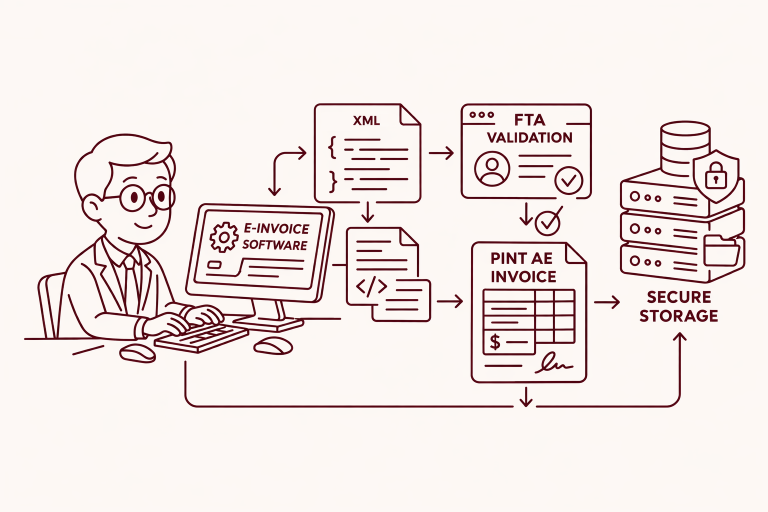
What is e-invoicing software? Electronic invoicing (e-invoicing) software is a digital solution that enables businesses…
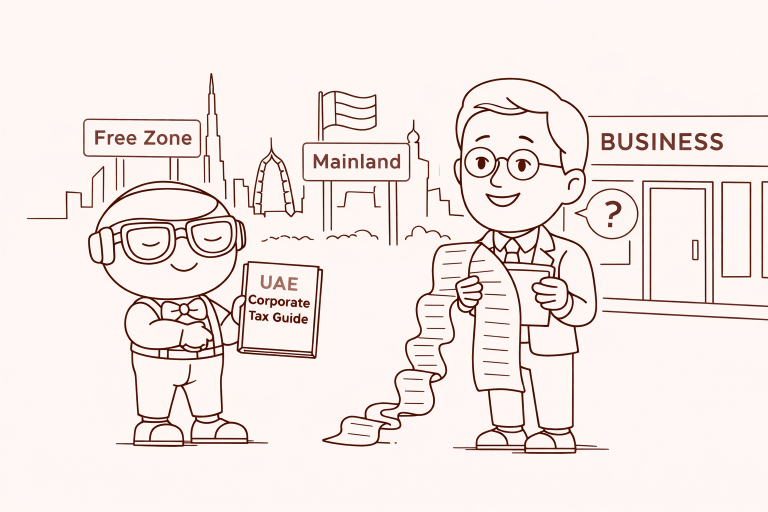
Free zones in UAE provide advantageous benefits through tax advantages and economic benefits. These designated areas provide economic centers specifically built for the purpose of expanding the activities of businesses inside the free zones.
By having an economic center, the business can benefit from streamlined incorporation times, virtual business centers, a fully integrated suite of services, and streamlined immigration and visa processing.
The Corporate Tax Law became effective for financial years starting on or after June 1, 2023. Under Federal Decree Law. No 47 of 2022, the UAE Corporate Tax Law provides a temporary tax relief for small businesses with revenue not exceeding AED 3 million.
In line with this, the UAE has designated that not all free zone persons are automatically exempt. Designating a Qualifying Free Zone Person status legally protects the traditional tax advantages offered, but only if strict conditions are met.
In this article, we talk about the requirements to become a Qualifying Free Zone Person, and separate treatments required for compliance across the UAE.
Businesses can choose to incorporate either in mainland UAE or in Free Zone regulated areas that allows 100% foreign ownership.
Free Zone persons can also elect to register under a dual license in order to trade with the mainland without local agents. To comply with standard corporate tax rules, the QFZP status was created to protect the traditional advantage allowed for Free Zone companies if strict conditions are met.
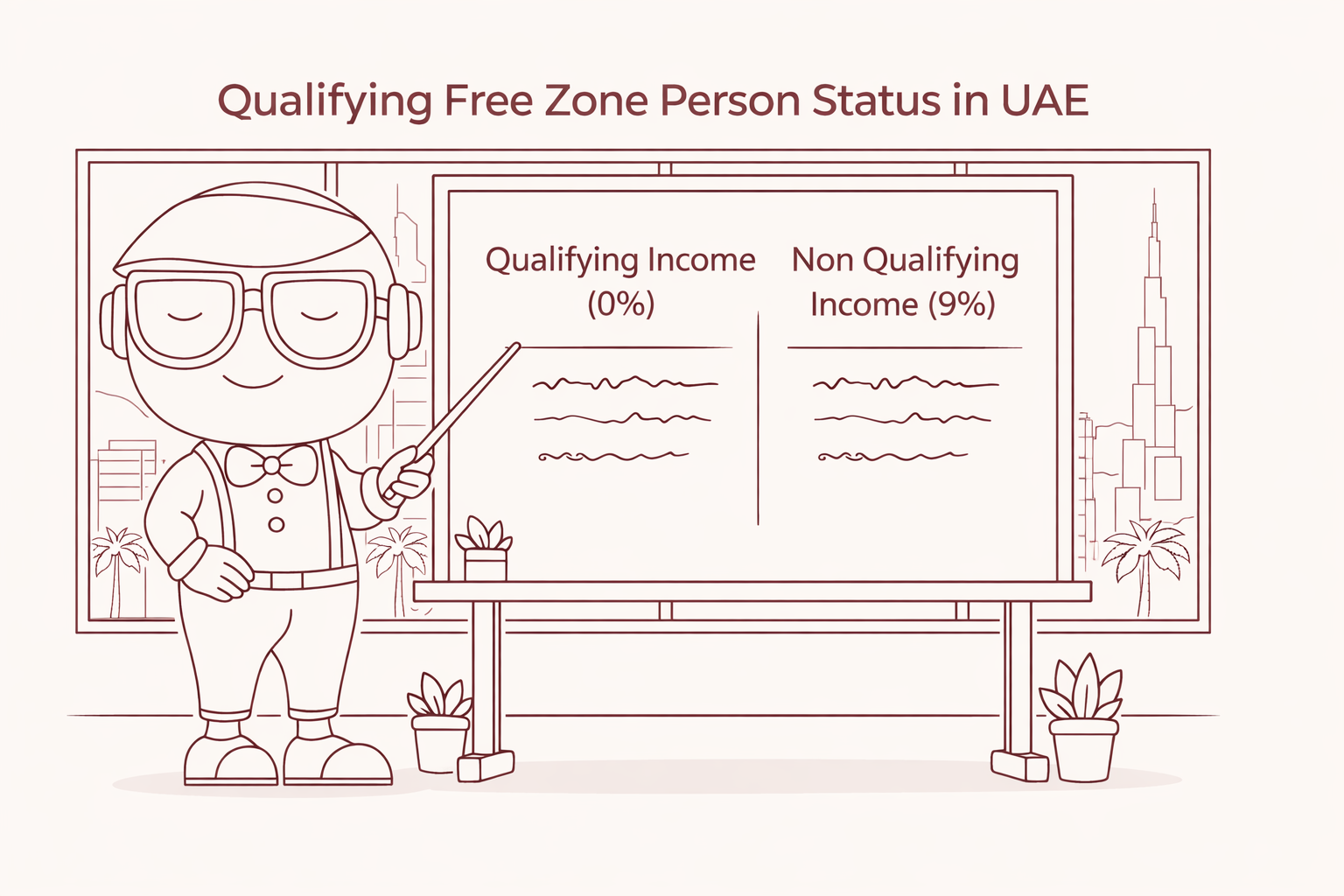
A Qualifying Free Zone Person (QFZP) is a Free Zone Person that meets the conditions in Article 18 of the UAE Corporate Tax Law. A QFZP remains within the Corporate Tax regime, but is taxed at 0% on Qualifying Income and 9% on Taxable Income that is not Qualifying Income (subject to conditions).
FZ companies must now establish and prove their operation’s existence (not just registration status) in order to elect for QFZP. For Corporate Tax purposes, QFZPs must prepare and maintain audited financial statements annually. Separate audit requirements may also apply under the relevant Free Zone authority’s rules.
| Key Aspect | Qualifying Free Zone Persons | Mainland Business & Other Free Zone persons |
|---|---|---|
| Corporate Tax Rate | 0% on earned qualifying income 9% on nonqualifying income | 0% below AED 375k 9% above and in excess of AED 375k |
| De minimis rule | Yes | No |
| Adequate substance test | Mandatory | Not QFZP-based |
| Audit requirement | Mandatory annually | Depends on structure |
| Risk of 5-year penalty window | Yes (if de minimis breached) | No |
| Corporate Tax Groups | QFZP are specifically excluded from forming or joining corporate tax groups because they already benefit from special tax treatment | Yes if conditions are met |
| Can they elect for small business relief? | SBR election is not available to QFZPs | Yes if they meet conditions set by Small Business Relief |
A QFZP benefits from a 0% corporate tax rate on its qualifying income generated from activities conducted within the designated Free Zone.
Companies are able to maximize their tax savings under the framework and structure set by CT Regime.
Additionally, QFZP regime is attractive to foreign-owned companies that establish entities in Free Zones to serve regional or international markets. Companies that maintain status can continue benefiting from other advantages such as:
By clearly defining which income derived qualifies for 0% tax rate, the QFZP framework provides greater transparency for businesses managing cross-border operations.
If a QFZP opts into the standard corporate tax regime, it will lose the benefits of the 0% tax rate on qualifying income and be subject to the standard corporate tax framework.
The framework applies across all recognized Free Zone areas, each with their respective Free Zone Authority. The list includes those located in Dubai and other Emirates.
Common examples include:
Free Zone Area |
Core Expertise |
Key Sectors |
|---|---|---|
Dubai Multi Commodities Centre (DMCC) |
Commodities trading and global trade |
|
Dubai International Financial Centre (DIFC) |
Financial services and fintech |
|
Jebel Ali Free Zone (JAFZA) |
Manufacturing, logistics, and global supply chains |
|
International Free Zone Authority (IFZA) |
Flexible business setups & SME formation |
|
Abu Dhabi Global Market (ADGM) |
Financial services and global investment structures |
|
Sharjah Airport International Free Zone (SAIF Zone) |
Aviation-linked logistics and light manufacturing |
|
Each Free Zone center has its core expertise and advantages related to those industries, including specialized exchanges and services. They would also have their own Approved Auditors List that would sign on audit reports if required by relevant authorities.
The following conditions must all be met to qualify. Failure to meet one requirement and the company becomes subject to the standard tax regime.
As a rule qualifying income (0%) generally includes:
Nonqualifying income (9%) generally includes:
Note
Revenue attributable to a Domestic/Foreign Permanent Establishment, and certain revenue from immovable property or non-qualifying IP, is excluded from the de minimis calculation but is still treated as Taxable Income taxed at 9%.
A QFZP must prepare and maintain audited financial records annually to verify eligibility for the 0% tax rate.
If a Free Zone entity fails to meet any qualifying conditions, it will be treated as a taxable person subject to a 9% corporate tax rate on its full income for the current year and the subsequent four years.
During this time, business will be treated as a regular taxable person and the 0% rate on qualifying income cannot be applied.
After five tax periods have passed, QFZP status may be claimed again if the business meets all requirements for eligibility, and is not part of any tax groups.
The introduction of corporate taxation in the UAE changed the tax environment from 0% to 9% for many businesses. Without a doubt, it significantly changed the country’s tax landscape.
To support the implementation of the new system, the UAE government issued several cabinet and Ministerial Decisions between 2023 that clarified and eased the standard corporate tax rules on Free Zone companies.
A number of Cabinet Decisions were introduced including detailed guidance on the implementation of the Law and key information on:
Incentives remain available while still aligning the UAE tax system with international standards.
These implementing decisions provide further technical guidance on how the rules apply in practice, including:
Together, Ministerial and Cabinet Decisions help businesses maintain cost efficiency while complying with the new tax framework.
All Free Zone entities, including Qualifying Free Zone Persons, must register for corporate tax with the Federal Tax Authority in the UAE.
QFZPs do not have a separate or special registration process. They can register for CT the same way as all taxable persons via the EmaraTax portal. Verifying their status comes later, in how income is treated in the tax returns.
You can find more information on how to register for corporation tax in the UAE in this full guide.
For first-time founders, it helps to have an expert professional guide you through the process. You can reach out to us anytime at skrooge.ai.
QFZP is a status granted to Free Zone persons meeting specific conditions and is eligible for preferential tax treatment. This and the UAE Corporate Tax Law became effective for financial years starting on or after June 1, 2023.
QFZPs (i.e. Qualifying Free Zone Persons) benefit from a 0% rate on qualifying income, allowing them tax savings as long as income is derived from certain approved activities conducted within or through the free zone area.
Corporate tax registration is mandatory for all Free Zone entities, including QFZPs, via the FTA’s EmaraTax portal. The FTA is responsible for overseeing tax compliance, including registration, filing and monitoring of requirements under the CT law.
Businesses still need to self assess their QFZP eligibility and FTA does not need to formally “assign” the status. Instead, businesses can declare it during tax filings.
To maintain this status, the company must meet requirements such as:
✔ Maintain adequate substance requirements in the Free Zone
✔ Registered in the free zone as a juridical person
✔ Earn qualifying income and not elect into standard tax regime
✔ Comply with arm’s length principle and transfer pricing rules
✔ Maintain audited financial records signed by the Approved Auditors List
✔ Meet the de minimis requirements for non qualifying revenue
The United Arab Emirates derives qualifying income from:
→ Income from transactions with other FZ entitie
→ Income from certain qualifying activities even with non free zone persons
→ Income from qualifying intellectual property
Some income is treated as non qualifying revenue if:
→ Income attributable to domestic or foreign permanent establishments
→ certain real estate income
→ Income from excluded activities such as banking or insurance (with limited exceptions).
For income from transactions with other Free Zone entities to qualify for the 0% rate, the other Free Zone company must be the beneficial recipient of the transaction.
If a Free Zone business fails to meet any of the conditions to qualify as a QFZP, it may lose its 0% tax benefit for the current year and the subsequent four tax periods.
They will be treated as a regular taxable entity in the meantime. If eligibility after 5 years still applies, then they may re-elect for QFZP status.
Free Zone businesses must ensure that their non-qualifying income does not exceed the lesser of AED 5 million or 5% of total revenue to maintain their tax-exempt status.
No, only juridical persons (i.e. United Arab Emirates entities created by registration and by the law) are allowed to qualify for QFZP status. Natural persons (or individuals) do not qualify.
Yes. For Corporate Tax purposes, QFZPs must prepare and maintain audited financial statements annually. In addition, some Free Zone authorities may impose their own separate audit requirements, including the use of approved auditors in certain zones.
Certain activities are classified as excluded. Income generated from these activities does not qualify for the 0% rate, even if the company otherwise meets the requirements for Qualifying Free Zone Person (QFZP) status.
Key excluded activities include:
1. Transactions with natural persons except in cases such as regulated fund management, wealth management services, aircraft leasing or ship operations
2. Banking and insurance activities
3. Finance and leasing arrangements unless they fall under specific permitted categories such as treasury or financing services provided to related entities
4. Ownership or exploitation of immovable property
5. Activities closely related (i.e. ancillary or supporting) related to any of the following
Free Zone businesses must comply with transfer pricing rules, ensuring that all related-party transactions follow the arm’s length principle.
This requires companies to maintain strong documentation and governance.
They must also keep the conditions set and track it religiously. It helps to build a compliance dashboard that allows you to track everything throughout the year.
Small Business Relief (SBR) does not apply to QFZPs as it is designed with a separate tax relief system for those with revenue not exceeding AED 3 million in both the current and past tax periods.
Likewise, since a QFZP cannot be part of a tax group, many restructurings involving QFZPs may not qualify for Business Restructuring Relief, given eligibility conditions require transfer of assets between resident taxable persons.
Similarly, BSR requires that none of the persons are regarded as an exempt person or a QFZP to qualify.
Thank you!
We've received your request and will get back to you shortly.

Loading...