

Simplifying VAT Return Filing in the UAE (including changes in 2026 and how to prepare)
VAT has been part of doing business in the UAE since January 1, 2018, and…
Businesses operating in the UAE need to understand the difference between treating VAT in designated zones, non-designated free zones, and mainland UAE. Incorrect zone classification can lead to VAT errors involving goods transactions, imports, and taxable supplies.
In this blog, we outline the qualifications of a designated zone in UAE and the differences in VAT treatment vs. mainland and other free zone areas.
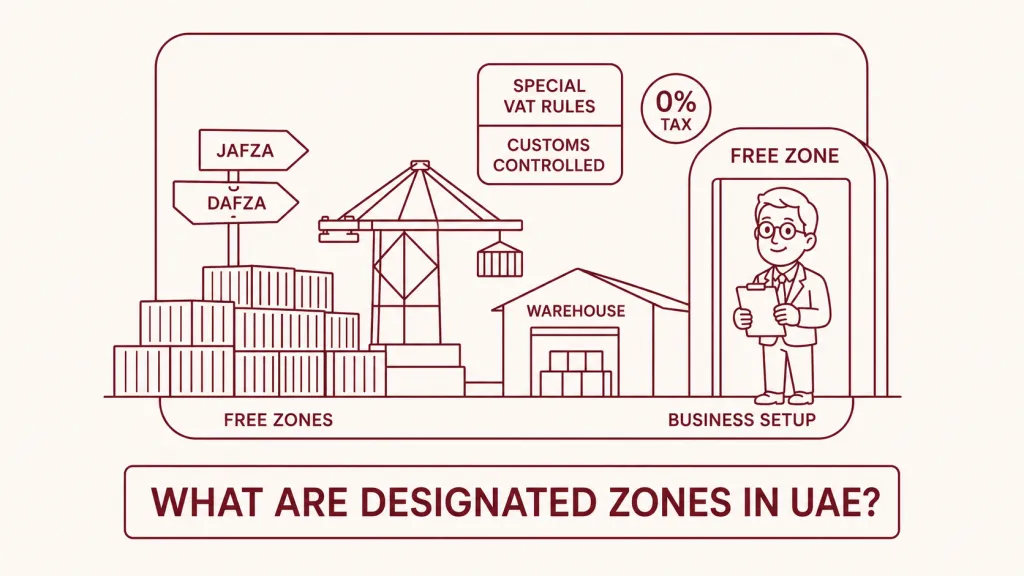
A designated zone in UAE is a certain free zone approved for special VAT treatment under Cabinet Decision No. 59 of 2017.
In general, not all free zones qualify as a designated free zone for VAT purposes. The classification for UAE designated zones must be clearly defined geographic areas with security and customs controls, based on FTA’s regulatory requirements.
For example, qualifying designated free zones may be treated as outside the UAE for certain supplies of goods. Most services supplied inside a designated free zone remain subject to standard UAE VAT rules, wherein businesses must still comply with VAT registration, filing and documentation requirements.
The FTA has published an official list of Designated Zones under Cabinet Decision No. 59 of 2017 and subsequent amendments. The list has included 27 zones, but businesses should check the latest FTA-published version and effective dates before applying the VAT treatment.
Common designated zones include JAFZA, Dubai Airport Free Zone, Hamriyah Free Zone and Khalifa Industrial Zone (KIZAD).
Only certain free zones are called designated zones, which must meet strict qualifying criteria set by the UAE Cabinet Decision No. 59 of 2017.
The criteria for a designated zone include secure geographic boundaries and customs controls that monitor the movement of goods.
The official list of designated zones is set out under the UAE VAT Executive Regulations and related Cabinet Decisions. A designated zone must comply with all rules and regulations set forth by the Federal Tax Authority (FTA) guidelines to maintain its status.
Note
Documentation requirements are typically stricter for designated free zone transactions, especially with tracking customs and cross-border transactions.
These requirements are particularly relevant for businesses involved in logistics, warehousing, manufacturing, and export operations.
Designated zones may receive special VAT treatment for certain goods transactions, while ordinary free zones are generally treated similarly to mainland UAE for VAT purposes.
Certain supplies of goods within designated zones may be treated as outside the scope of VAT if the relevant conditions under UAE VAT regulations are met.
In particular:
| Key Differences | In Mainland UAE | Non-Designated Free Zone Areas | Designated Zones |
|---|---|---|---|
| Type of Setup | “Normal” UAE business jurisdiction | Still considered part of the UAE for VAT purposes | Special type of free zone Created mainly for logistics, warehousing, manufacturing and international goods trade |
| VAT Rules | Standard UAE VAT rules apply | Follow mostly the same VAT rules as mainland UAE | Special VAT treatment applies |
| Goods & Services | Goods and services usually subject to 5% VAT where applicable | No special VAT treatment for movement of goods | Certain goods transactions may be treated as outside the scope of UAE VAT |
| In practice | Selling goods locally -> usually VAT applies | Similar treatment to mainland UAE | Certain supplies or movements of goods may be outside the scope of UAE VAT where the Designated Zone conditions are met. |
Some goods transactions may avoid immediate UAE VAT if:
Note
Qualifying transactions are outside the scope of VAT, which is different from being zero-rated (where VAT rate is 0%) and VAT exempt (where no VAT is charged). VAT can still apply where the goods are moved into the mainland.
Additionally, only qualified goods transactions fall outside the scope of VAT. Services remain subject to normal UAE VAT setup.
Businesses often choose designated free zones for logistics infrastructure, warehousing access, and international trade connectivity.
Office space conditions are important to consider when selecting a designated zone for your business. Setup and licensing costs should be evaluated when choosing a designated zone for your business.
Other considerations may also apply before deciding on specific zones in the UAE.
Businesses in designated zones may still be required to register for VAT if they meet the applicable UAE VAT registration thresholds, and may be eligible to join a VAT group where the legal conditions are satisfied.
In this section, we explain further the difference in terms of applying VAT, taxable supplies within designated free zones, and the customs duty and suspension procedures.
Certain transactions on goods inside a designated free zone may be treated as outside the scope of VAT treatment if conditions are met.
This treatment commonly applies where goods are:
VAT may still apply where goods are considered “consumed” inside the designated zone. The FTA generally treats operational or business use of goods inside the zone as consumption.
Examples of goods treated as consumed include:
Trading stock intended for resale is generally not treated as consumed and is outside the scope of VAT. The same goes for raw materials used to manufacture goods that are later exported or not consumed within the zone.
If goods are supplied within a designated zone to a person who intends to utilize them for private or operational purposes, the supply is subject to normal VAT.
Supplies between qualifying designated zones may remain outside the scope of VAT if customs suspension and movement conditions are met.
A designated zone must maintain customs controls and monitoring procedures similar to those applied at UAE border points under the Executive Regulations.
A qualifying designated free zone must have monitored entry and exit points, fenced geographic boundaries, and systems for tracking movement of goods.
Customs suspension procedures allow certain transfers between designated zones without triggering immediate VAT taxation, provided required conditions are met:
Transfers must follow GCC Common Customs Law procedures to qualify for suspension treatment. Customs authorities may require financial guarantees for certain transfers where customs suspension conditions apply.
Customs documentation, transport records, and proof of goods movement are important for supporting designated zone VAT treatment.
Location is often a key factor when selecting a designated zone for your business. Many designated zones are located near ports, logistics corridors, or international airport free zone infrastructure that can support import, export, warehousing, and manufacturing activity.
Zone operators typically look at the area’s logistics efficiency, customs handling, and supply chain access. Most UAE free zones continue to allow high levels of foreign ownership, but VAT and corporate tax obligations depend on the specific regulatory classification of the zone.
Note
Designated zone status mainly affects VAT and executive regulations for goods transactions. This should not be confused with broader corporate tax or licensing benefits.
The official list of designated zones includes the following free zones:
|
Emirates |
Free Zone Areas that qualify |
|---|---|
|
Abu Dhabi |
|
|
Dubai |
|
|
Sharjah |
|
|
Ajman |
|
|
Umm Al Quwain |
|
|
Ras Al Khaimah |
|
|
Fujairah |
|
Note
Dubai Textile City and Free Zone Area in Al Quoz have been removed from the official designated zones in UAE since 2021.
Businesses should always check the latest FTA-published list and effective dates before relying on designated zone status.
While the UAE VAT framework is standard, each zone offers different advantages relating to infrastructure, industry focus, logistics access, licensing, and operational use cases
|
List of Designated Zones |
Key Business Advantages |
Key Industry Focus |
|---|---|---|
|
Jebel Ali Free Zone |
|
Strong logistics and re-export hub |
|
Dubai Airport Free Zone |
Businesses dealing with high value goods and rapid customs clearance |
Air cargo, aviation, electronics, fast moving imports |
|
Dubai Aviation City |
|
|
|
Khalifa Industrial Zone Abu Dhabi (KIZAD) |
Closely connected to Khalifa Port (or Port Abu Dhabi) operations |
Industrial manufacturing and port-linked logistics |
|
Sharjah Airport International Free Zone |
|
|
|
RAK Airport Free Zone |
|
|
|
Umm Al Quwain Free Trade Zone |
|
|
|
RAK Maritime City Free Zone |
|
|
|
Fujairah Oil Industry Zone |
|
|
|
International Humanitarian City |
|
|
Designated zone status is a VAT classification to separate mainland and other free zones. Operating in a designated zone does not institute a separate legal jurisdiction. Businesses inside these zones still operate within the UAE regulations.
The classification is closely tied to customs supervision and security measures. Designated zones in UAE function similarly to controlled trade and logistics areas for certain goods.
The Federal Tax Authority operates VAT regulations, while customs authorities supervise movement and import procedures.
Businesses should not assume all transactions inside designated free zones are automatically out of VAT scope. Treatment depends on the nature of the supply, movement of goods, and whether it is regarded as consumed.
Businesses operating within designated zones in the UAE must follow similar VAT rules as those outside these zones. They must keep thorough records to comply with VAT regulations set by the Federal Tax Authority (FTA).
Mandatory VAT registration applies where taxable supplies and imports exceed AED 375,000 over the previous 12 months, or are expected to exceed that threshold in the next 30 days. Voluntary registration may be available where taxable supplies and imports, or taxable expenses, exceed AED 187,500.
Check out our beginner friendly guide on VAT registration here.
VAT registered businesses in designated zones must still file VAT returns through the EmaraTax portal like other businesses.
Certain transactions on goods may be reported outside the scope of VAT where the conditions are satisfied.
Services supplied within designated zones are generally treated as supplied within the UAE and may remain subject to standard 5% VAT. Movements of goods from a Designated Zone into mainland UAE are generally treated as imports into the UAE and may trigger import VAT.
Businesses need to maintain VAT and customs related records for at least 5 years from the end of the relevant tax period.
This includes:
For transactions that fall out of VAT scope, maintaining proper documents is crucial. The FTA may require proof that:
Designated zones are intended to support customs-controlled trade and logistics treatment for certain goods transactions under the UAE VAT framework.
A movement of goods from a Designated Zone into mainland UAE is treated as an import of goods into the UAE, so import VAT is generally payable by the importer.
If the same VAT-registered person already incurred VAT on the same goods inside the Designated Zone and later imports those same goods into the mainland with no intervening transactions, the FTA guidance allows specific import VAT recovery, provided the required evidence is retained.
Once goods are released into mainland circulation, normal VAT calculation applies.
Note
A movement from mainland UAE into a designated zone is not considered an export for VAT purposes.
Goods imported directly from outside the UAE into a designated zone are not treated as imported into the State under Article 47, so import VAT is not triggered at that point.
Goods transferred between two designated zones are outside the scope of VAT only if the goods are not released, used, or altered during transfer, and the movement follows customs suspension rules under GCC Common Customs Law.
Where goods move between designated zones, customs authorities may require a financial guarantee for possible tax exposure if the movement conditions are not met.
Designated zones are widely used for import, storage and re-export operations across GCC and international markets.
Goods brought into a Designated Zone directly from abroad are not subject to import VAT if they remain under customs suspension procedures.
Re-export operations may qualify for outside the scope of VAT where FTA movement and documentation conditions are satisfied.
Trading and logistics businesses operating in designated zones in Ras Al Khaimah, such as RAK Port Free Zone or RAK Maritime City Free Zone, may use designated-zone structures for warehousing, cross-border goods movement, and regional distribution.
Under the 2021 amendment, shipping or delivery services can be outside the scope only in the narrow Article 51(7) case:
Not all free zones receive the same VAT treatment under UAE law. Only listed free zones under Cabinet Decision No. 59 of 2017 qualify for designated free zone treatment.
Designated zones are not “VAT-free zones.” Instead, certain supplies or movements of goods may be treated as outside the scope of UAE VAT where the required conditions are met. Services and consumed goods generally remain subject to the normal UAE VAT rules.
Non-designated zones in UAE are generally treated similar to mainland, with VAT applying to goods and services.
The official list of designated zones is set out under the UAE VAT Executive Regulations and related Cabinet Decisions.
Businesses operating in designated zones are subject to strict qualifying criteria and must keep thorough records.
Businesses operating in designated zones are still considered UAE businesses for VAT compliance, despite certain qualifying goods transactions receiving special VAT treatment.
This means that they fall under mandatory registration where taxable supplies and imports exceed AED 375,000 over the previous 12 months, or are expected to exceed that threshold in the next 30 days. Businesses may opt for voluntary registration when they reach the AED 187,500 threshold.
Supplies of goods within a designated zone may be treated as outside the scope of UAE VAT if the goods are not considered consumed and the FTA conditions are met.
VAT may still apply where goods are used, consumed, or released into mainland UAE circulation.
Businesses must maintain customs records, invoices, and proof of goods movement to support the VAT treatment applied to designated zone transactions.
Designated zones apply to VAT provisions.
Qualifying Free Zone Persons (QFZPs) are part of the UAE Corporate Tax framework, not the designated zone/VAT regime.
A business can operate inside a designated free zone without automatically qualifying as a QFZP for corporate tax purposes.
QFZP status depends on separate conditions under UAE Corporate Tax rules, including qualifying income, compliance requirements, and substance conditions.
Goods moved between qualifying designated zones may remain under customs suspension treatment if the required customs procedures are followed.
Under UAE Executive Regulations, goods transferred between designated zones must generally:
→ Remain under customs control
→ Not be released for local UAE consumption
→ Not be altered or used during transfer
Goods imported directly from outside the UAE into a designated zone may not trigger import VAT immediately while under customs suspension procedures.
Yes, businesses operating in designated zones can supply goods to mainland customers. Supplying goods from a designated zone into mainland UAE may also involve mainland licensing, distributor, or permit requirements depending on the emirate and business activity.
A movement of goods from a Designated Zone into mainland UAE is treated as an import of goods into the UAE, so import VAT is generally payable by the importer.
Where the same VAT-registered person already incurred VAT on the same goods inside the Designated Zone and later imports those same goods into the mainland with no intervening transactions, the FTA guidance allows specific import VAT recovery treatment, provided the required evidence is retained.
A non-designated free zone is generally treated similarly to mainland UAE for VAT purposes.
If goods move from a designated zone into a non-designated free zone, the movement may be treated similarly to goods entering mainland UAE and can trigger import VAT obligations depending on the transaction structure.
VAT treatment depends on:
✔️ Whether the receiving zone is officially designated
✔️ Whether the goods remain under customs control
✔️ Whether the goods are considered consumed
✔️ The supporting customs and movement documentation retained
Thank you!
We've received your request and will get back to you shortly.

Loading...
 Thank you!
We've received your request and will get back to you shortly.


 Contact Us


