
Accounting Software for Contractors in the UAE: The Complete Guide
Accounting Software for Contractors Despite the fact that the UAE has minimal taxation, companies can…
The United Arab Emirates implemented Value Added Tax (VAT) in January 2018 and fixed the standard VAT rate at 5%. This is an indirect, consumption tax, which can either be 0%, 5% or exempt.
Since then, understanding exemptions under VAT has become imperative for any business, as the characterization of supply has a direct relation to compliance and operational costs. Mistakes in the categorization of supplies lead to lost recoveries of input VAT or incorrect tax reporting.
This article outlines the Federal Tax Authority’s regulations on types of VAT-exempt supplies in the UAE, implications for free zone entities and mixed supplies, and finally, registration exceptions accorded to businesses that deal in zero-rated supplies.
When goods and services are exempt under VAT in the UAE, two things happen:
This means that purchase VAT is an expense absorbed by the business and not an amount refundable to it.
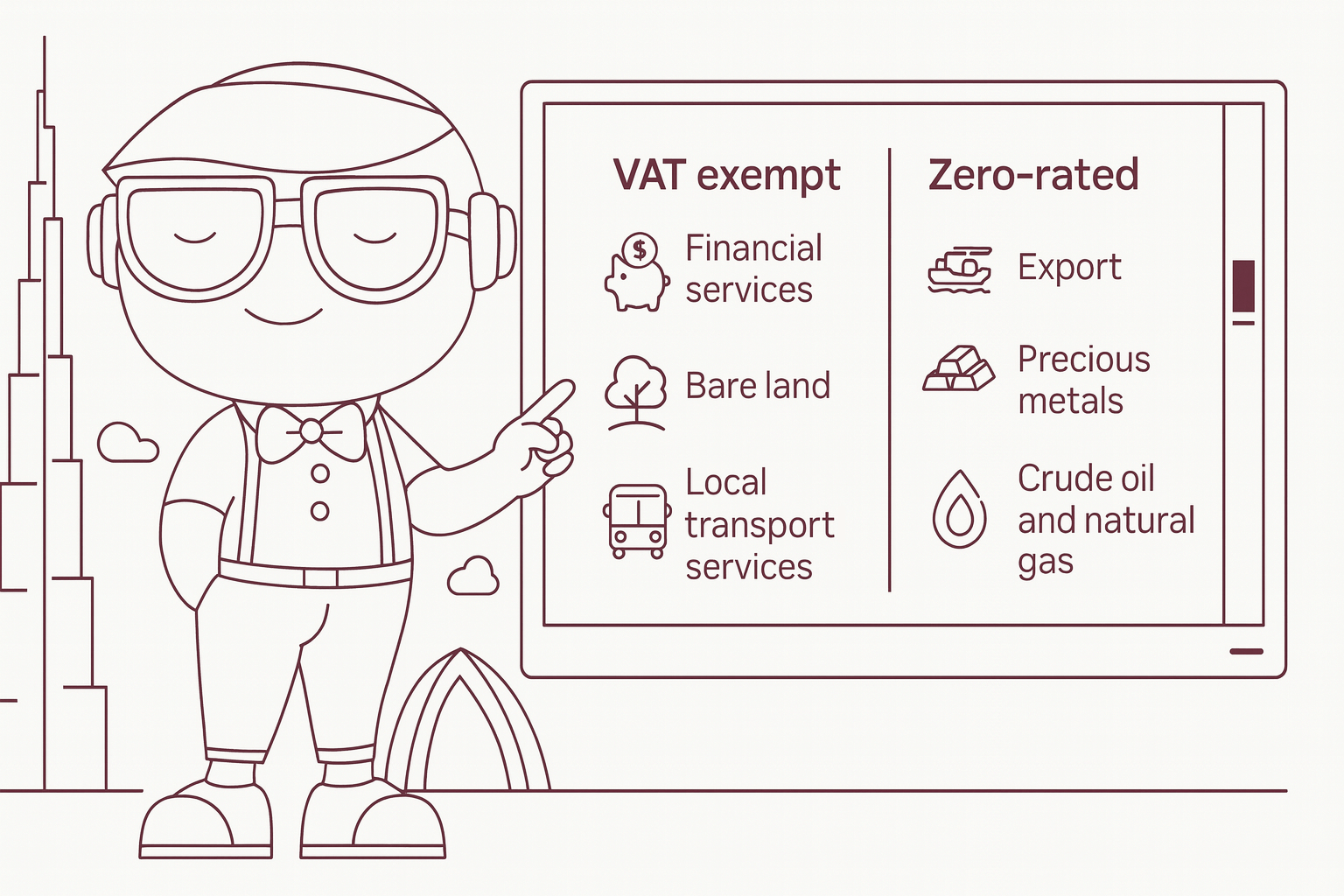
According to the Federal Tax Authority (FTA), an exempt transaction means that no VAT has been levied on it, and VAT on related purchases cannot be claimed. Examples include specific financial services and bare land.
Zero-rated supplies are different from VAT-exempt supplies. The main difference is the recoverability of the input VAT.
The incorrect categorization of standard-rated or zero-rated goods and services as exempt and recovering input VAT incorrectly can result in penalties.
| Category | VAT Rate | Input VAT Recovery? | Typical examples of goods and services in this category | Business/Cash‑Flow Impact |
|---|---|---|---|---|
| Zero‑Rated | 0% | Yes | Exports of goods/services outside the Gulf Cooperation Council (GCC), international transport, first supply of new residential building (within 3 yrs), and certain healthcare services | Allows input VAT recovery, improves cash flow, and mandates registration and filing of VAT returns |
| Exempt | N.A. | No | Bare land, resale of residential property after first supply, and certain financial services | Disallows input VAT recovery, but no registration is required if you only deal in exempt goods and services |
The FTA regulates the VAT exemption list in the UAE. Everything outside these exempt categories is usually either standard-rated at 5% or zero-rated, depending on the FTA rules.
Under the UAE VAT law, certain supplies that are exempt from VAT are:
Financial services are exempt from VAT when the consideration is implicit (for example, interest or a margin) and there is no separate, explicit fee or commission. Examples include issues of equity or debt instruments and life insurance. Advisory or brokerage fees charged by businesses usually attract the standard 5% VAT rate.
Zero rating can apply to the first sale or lease of newly constructed residential properties within three years of completion. Later sales or leases are exempt.
Example: A unit completed in January 2023 and sold in February 2025 would be zero-rated. If the buyer later leases the unit to a tenant, those lease payments are exempt from VAT.
Commercial properties, such as hotels or properties listed via Airbnb, must, in all cases, pay the 5% tax.
Transactions involving undeveloped lots are not subject to VAT. This rule applies regardless of the owner’s intention for future development.
Once the land is developed and a building is constructed, future supplies of that property are treated under the normal residential and commercial VAT rules.
Services exempt from VAT include the domestic passenger transport services, such as the Dubai Metro. By contrast, international transportation of passengers or goods is generally zero-rated.
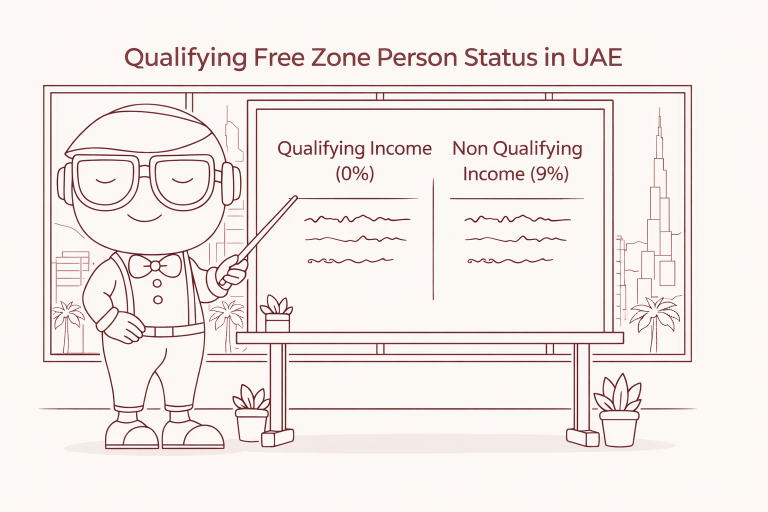
Here, we discuss the VAT treatment of transactions involving free zone and designated zone entities.
Designated zones are special free zones treated as outside the UAE for VAT treatment of many goods. Essentially, goods can move within or between designated zones without VAT in some cases. However, once goods are consumed in designated zones or transported to the mainland UAE, the standard 5% VAT normally applies.
In contrast, services in designated zones are treated just as services performed in the mainland UAE.
Any movement of goods under customs control and directly between free zones that are designated zones is outside the scope of UAE VAT. However, if either of the free zones is not a designated zone, the supplies generally attract the standard 5% VAT.
Services supplied by one free zone entity to another are subject to normal VAT rules.
Goods moving from designated zones to the mainland are treated as imports, requiring the mainland buyer to pay 5% VAT (usually via reverse charge). Goods and services from a normal free zone to the mainland are treated as standard-rated supplies.
The following tables cover a more comprehensive set of VAT treatment scenarios involving free zone and designated zone entities:
| Supplier location | Customer location | VAT treatment |
|---|---|---|
| Designated zone | Mainland | Transaction treated as an import
5% import VAT applicable Mainland customer accounts for VAT (reverse charge in VAT return if registered, or at customs if not registered) |
| Mainland | Designated zone | Treated as a normal domestic supply from a mainland supplier to a UAE customer
5% VAT is charged unless zero-rating or exemption applies |
| Designated zone A | Designated zone B | Outside the scope of VAT if conditions in Article 51 are met (direct movement, proper control, not released into mainland)
Otherwise, treated as a taxable supply (Assuming goods move under customs control) |
| Anywhere in the UAE (Mainland, any free zone, or designated zone) | Customer outside UAE & GCC | Treated as export and hence, zero-rated, provided that certain conditions are met, such as the supplier holding proper export evidence |
| Supplier location | Customer location | VAT treatment |
|---|---|---|
| Mainland | Designated zone | Treated as services performed within the UAE
5% VAT is charged unless zero-rating or exemption applies |
| Designated zone | Mainland | Normal VAT rules apply since the place of supply is in the UAE |
| Anywhere in the UAE (Mainland, any free zone, or designated zone) | Customer outside UAE & GCC (non-resident) | Treated as a service export
0% VAT applies if Article 31 conditions are met Otherwise, standard 5% VAT applies |
Many businesses make both taxable (standard‑rated or zero‑rated) and exempt goods and services. When that happens, overhead costs and general inputs are used for both activities. This triggers the partial exemption regime. Understanding this is critical for companies such as hospitals, banks, educational institutions, mixed‑use real‑estate groups, or crypto/financial services firms.
Such companies need to classify their expenses into the following groups:
Unless you have an approved special method or Specified Recovery Percentage (SRP), businesses with mixed supplies can use the following method to calculate input tax recovery:
exceeds AED 250,000; the actual-use method must be used as the basis for the year-end adjustment.
If your tax year is less than 12 months, you must prorate the AED 250,000 threshold accordingly.
Note
SRP lets you lock in a fixed recovery percentage (based on your prior year) after approval, helping reduce year-to-year volatility.
| Input Type | Amount (AED) | Recovery Status | Calculation |
|---|---|---|---|
| Input VAT attributable to pharmacy (taxable supply) | 50,000 | Fully recoverable | – |
| Input VAT attributable to hospital services (exempt supply) | 30,000 | Non-recoverable | – |
| Shared overhead input VAT | 20,000 | Partially recoverable (residual input) | – |
| Recovery percentage | – | – | 50,000 ÷ (50,000 + 30,000) = 62.5%
Adjusted to 63% |
| Recoverable portion of overhead input VAT | 20,000 × 63%
= 12,600 |
||
| Total Recoverable Input VAT | 50,000 + 12,600
= AED 62,600 |
||
Check the following thresholds to understand whether you need to or if you can voluntarily register for VAT in the UAE via the EmaraTax platform:
A business must register for VAT when:
Note: You must complete registration within 30 days of hitting the mandatory registration thresholds.
A business may choose to register for VAT early when either its taxable supplies or expenses are more than AED 187,500 over 12 months.
If the company supplies only exempted supplies, no registration is required since their supplies are not part of the VAT system.
Most VAT exemptions apply automatically if transactions fall within the four main categories determined by the FTA.
However, certain VAT treatments, such as special apportionment methods, partial input tax recovery mechanisms, and specific regulatory exceptions, require formal applications and FTA approval.
Similarly, to have VAT-related procedural or reporting obligations waived, you must apply for a VAT Administrative Exception in the UAE. While you can apply online easily through EmaraTax, approval often requires detailed justifications, supporting calculations, and, in some cases, professional advisory support. In this application, you may need to attach supporting documents such as:
Traditionally, in the UAE, tracking VAT compliance for an FTA audit has been a manual-heavy process that required VAT-registered businesses to keep records of all tax invoices, receipts, and contracts for at least 5 years.
But let’s be honest, for most company owners, navigating the ins and outs of UAE VAT exemptions and changing VAT regulations can be time-consuming.
Thankfully, in today’s AI-centric world, the process has become much simpler. With modern solutions like skrooge.ai, you can avoid compliance headaches and reduce the risk of indirect penalties, such as the AED 10,000 penalty for failure to maintain the required records (first offense).
Working with us makes it easy to:
According to the UAE VAT rules, zero-rated supplies have 0% tax, and businesses can reclaim input VAT. Exempt supplies are not part of the VAT system, and input tax recovery is not possible.
Financial services, residential buildings, local passenger transport, and bare land are the four VAT-exempt categories in the UAE.
No. If you are only selling goods or services that fall within the exempt supplies list, you are not required to register for VAT.
No, you are not allowed to reclaim VAT costs for business purchases related to exempt supplies.
No. Normal free zones are generally treated the same as the UAE mainland for VAT purposes, so there is no general VAT exemption. Designated zones have special VAT rules mainly for goods, where certain transactions may fall outside the scope of UAE VAT. However, this is not the same as being exempt, and services remain subject to the normal UAE VAT rules.
You can visit the EmaraTax website and go to the administrative exception request page. There, you must submit all the supporting documents, your licenses, invoices, and financial statements. Approval is entirely at the discretion of the FTA, and submitting a request does not guarantee that an exception will be granted.
The first supplies (sales or leases) of residential properties are zero-rated if such transactions happen within 3 years from completion of construction. Any subsequent supplies are VAT exempt.
Partial VAT exemption is used to describe businesses with mixed supplies, i.e., taxable and exempt supplies. In such cases, an apportionment input tax method is used to calculate the recoverable percentage based on input VAT attributable to taxable supplies and non-taxable supplies.
Late VAT registration attracts a penalty of AED 10,000, and late filing attracts a penalty of AED 1,000 for the first offense.
Thank you!
We've received your request and will get back to you shortly.
Loading...