
Requirements for Qualifying Free Zone Person (QFZP) status under UAE’s Corporate Tax Regime
Free zones in UAE provide advantageous benefits through tax advantages and economic benefits. These designated…
Creating a business from scratch is no easy feat, and while most processes are daunting, there is an air of excitement in finally landing your “dream job”. With Dubai quickly becoming the hottest business hub for global business expansion, entrepreneurs are flocking due to the economic freedom it offers. Capital incentives, fast moving infrastructure and tons of support all contribute to the economy, providing a good environment to turn opportunities into reality.
Business setup often starts with excitement due to all its possibilities. This quickly becomes confusing the deeper you dive into the system. New founders face unfamiliar terms, multiple authorities telling you what to do, and unclear cost structures. Capable founders still find stress with starting, mostly due to not knowing what decisions matter most early on. One wrong choice can lead to higher costs, restricted operations, or burden of restructuring later.
In this guide, we offer some clarity on trade licenses and why it matters in Dubai. We help you compare business license types to find what works for your setup. Hopefully, with an insight into realistic costs and timelines, you can make decisions confidently without much overwhelm.
This guide is based on Skrooge’s extensive experience assisting founders, SMEs, and international businesses with navigating Dubai’s trade license requirements. By combining advanced automation with deep local regulatory knowledge, Skrooge ensures certainty and transparency throughout the decision-making process for newcomers to the UAE business landscape.
A trade license is considered as the legal backbone of the business. It determines the business activities you’re legally allowed to do and ensures that your operations are legally protected under the law. The Dubai Department of Economy and Tourism (DET) (formerly known as the Department of Economic Development) is the primary authority responsible for regulating and issuing trading licenses for mainland businesses in Dubai; while respective Free Zone Authorities take care of license approvals in respective free zone areas.
Note
Contrary to popular belief, the Dubai Department of Economy and Tourism (DET) and Dubai’s Free Zone Authorities are emirate-level bodies that report to the Government of Dubai, not to a federal ministry.
Additionally, a trade license indicates whether you can trade locally or internationally, and signals your eligibility for bank accounts, tax registration, business contracts and even visa application.
Most entrepreneurs make a mistake due to:
Clarity upfront saves time and money. A correct license choice avoids amendments, fines and reapplications. Understanding the process can prevent delays in other important transactions such as banking, visa applications, and daily operations. A clear setup will allow long-term scalability instead of relying on short term shortcuts.
Generally, you have 3 main types of licenses available – trade license, which might be interchangeable in local vernacular with commercial license (take note that these two are not necessarily one and the same); professional license for service based businesses; and industrial license for manufacturing and production work.
To boost Dubai’s economy, there are also several common special programs and permits that vary by authority:
Note:
Also, special offshore companies (e.g., JAFZA Offshore / RAK ICC) are generally used for holding/international purposes and are not trade licenses for operating in the UAE market.
| Type of Trade License | Who needs to apply? | Typical Costs | Typical Activities Applicable | Limitations |
|---|---|---|---|---|
| Commercial | Businesses that buy/sell physical goods, retailers, wholesalers, local distributors who trade within mainland | For Mainland Dubai: about AED 10,000 and AED 25,000 for a commercial license For Free Zones: starts at about AED 5,500. Actual pricing varies depending on the area, the amount of visas you need and other factors based on the package you select. |
Import, export, retail, wholesale, delivery and supply of specific product categories (food, electronics, apparel etc.). The official list is defined by relevant authority | Requires correct activity code; may require physical lease and local sponsor depending on structure; regulated items need extra approvals. Costs vary with visas & workspace setup |
| General Trading Activities | Businesses that want to trade multiple unrelated product categories under one license (import/export/wholesale across several product lines). Popular for trading companies that want flexibility. | Mainland / Free zone examples: ranges cited vary widely: AED 12,000–50,000+ depending on number of activities, warehouse/setup needs and zone packages | Broad import/export, wholesale & retail across multiple product categories (electronics, garments, home goods, packaged food — regulated goods need approvals). Often allows multiple activity lines in one license. | Not a universal catch-all — restricted products (alcohol, pharmaceuticals, weapons, controlled chemicals, food) require additional approvals/permits. Costs increase with customs, warehousing and visas. |
| eTrader | Individuals (UAE nationals / in some programs GCC nationals) and small sellers who sell goods online through social media/marketplaces; small retailers testing market. | Apply for this via the portal on Invest in Dubai with a fee of AED 1,070 (license + knowledge and innovation fees) + AED 300 (Dubai Chamber membership payment). | Selling online via social media, marketplaces, home-based sales, small scale import/resale.
For corporate ecommerce licenses (not e-trader) can include warehousing, online storefronts, cross-border trade. |
E-Trader: restrictions — usually for UAE /GCC nationals only, limited visa quotas, limited to low-risk activities and small turnover; corporate ecommerce licenses require full documentation and may require physical lease |
DISCLAIMER
Please note that costs vary by local authority (mainland vs free zone), number of visas, space needs, and regulatory approvals; always check the issuing authority or a licensed business setup consultant for a precise quote.
To increase ease of doing business, the Dubai Department of Economy and Tourism has released the following processes. Think of it as similar to passport issuance, with both a standard process and fast tracked timeline. Each carry its own needs and limitations.
| Feature | Normal License | Instant License |
|---|---|---|
| Quick Description | Full compliance route and ideal for investors, regulated sectors and long-term business plans | Startup friendly, friction reduced entry point to the local market |
| License type | Any (commercial, professional, etc.) | Mainly commercial / professional applies |
| Activities | Flexible; you get to select the business activities | Limited to operations that do not need external government approvals (general trading & uncomplicated commercial / service); Hence, limited scope and eligibility |
| Speed | A few days to a few weeks | Issued as fast as within minutes via online website |
| Documents | Full set including the Memorandum of Association (MOA), Ejari/office lease and government approvals depending on activity | Minimal. No MOA or rental contract needed to begin |
| Office required | Yes, with exceptions | No physical space required initially; virtual allowed for first 12 months |
| Renewal | Normal renewal | Must renew and convert to normal license |
| Flexibility | High | Limited |
| Best for | Businesses that need: – a physical office – regulated businesses – multiple owners – complex setups |
Permits for: – first time founders – solo entrepreneurs – testing a business idea quickly – getting legal form fast to open a bank account and invoice |
If you are still confused about a) what business set up works for you and b) how much it would cost, you can check out this site by Invest in Dubai.
In this page, you can input the details that would apply to you (i.e. business details, solo vs partners, nationality, etc) so they can make recommendations on what would work for you.
By now you would have seen a lot on the terms “Mainland” or “Free Zone” areas. This is a classification for where to set up your company, and while both would result in legally selling within the UAE, there are significant advantages and disadvantages to each type. They can differ hugely in terms of market access, foreign ownership, setup requirements and strategic flexibility.
To clarify the differences on each type of license and their requirements, we have compiled the summary of each one here:
| Type of License | Mainland License | Free Zone License |
|---|---|---|
| Key Differences | Full access to the UAE market, including local customers and government contracts
Ability to trade freely |
Issued by designated free zones and is designed to attract international and foreign-owned businesses |
| Authority | Issued by Department of Economy and Tourism | Issued by relevant Free Zone Authority |
| Setup flexibility | Often physical or commercial lease required | Flexible requirements, like flexi-desks or virtual workspace |
| Pros | Full access to the UAE market, including local customers and government contracts | Tax advantages Lower cost of application and simplified setup packages |
| Cons | Higher setup and operational costs due to physical requirements and broader compliance obligations | Could access mainland via DET branch license / permit (Dubai) however subject to approvals and activity list, plus separate records requirement |
| Foreign Ownership allowed | Most mainland now allow 100% foreign ownership, as long as they are not on the restricted list that still requires Emirati ownership or special approvals | A restricted business activity may be 100% foreign owned if:
✅ The free zone explicitly lists the business sector as permitted ✅ The activity is confined to the free zone or international markets ✅ All federal approvals (if required) are obtained ✅ The activity does not involve direct mainland public access Common examples: In these cases, ownership is allowed, but market access is limited. |
| Market Access | Mainland market access allowed | Ability to sell internationally or within free zone. Local trade requires special permits or dual license. |
| Local Trading Activities | Suitable for inventory that need on-the-ground presence for walk-in customers | Restricted scope of operations allowed |
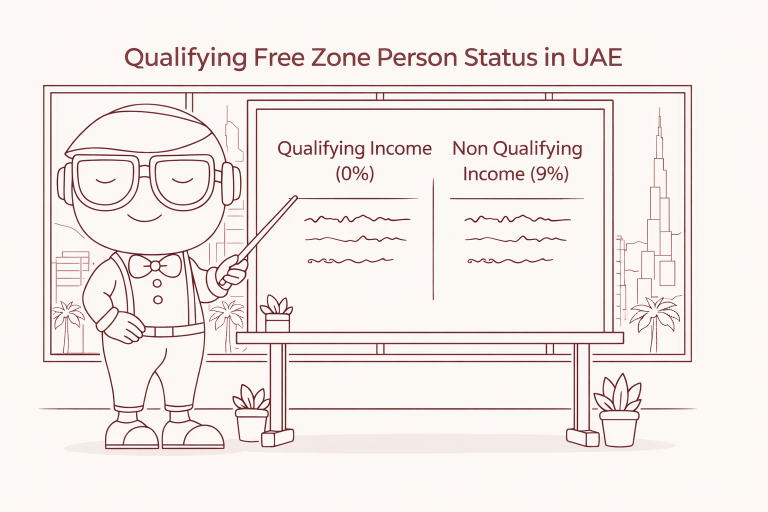
| Tax / Fees | Corporate Tax Mainland companies are subject to the Corporate Tax regime. Profits above AED 375,000 are generally taxed at 9%. VAT Both can apply in the UAE mainland, depending on the nature of the supply — not whether the business is in a free zone or mainland Import / Export Setup & Fees |
Corporate Tax Free zone companies can enjoy 0% corporate tax on qualifying income if they meet qualifying conditions (e.g., income specified by FTA and other criteria). Non-qualifying income and certain transactions (e.g., sales to mainland customers) may be taxed. VAT Zero-rated supplies are taxable at 0% and allow VAT recovery, while exempt supplies fall outside the VAT system and do not allow VAT recovery. Both can apply in the UAE mainland, depending on the nature of the supply — not whether the business is in a free zone or mainland Import / Export Setup & Fees |
| Sponsor Requirements | Depending on the business activity and legal structure, may include local sponsor or local service agent arrangements | No local sponsors needed |
When a business maintains both a free zone and mainland access, this setup is commonly referred to as a dual license. However, a dual license is not always two separate licenses. It can be one free zone company with approved mainland distribution rights.
Note
A dual license does not automatically apply to all zones. Each Free Zone is managed with their own regulations and authority.
Operating on a dual license carries the responsibility of complying to all regulatory requirements. This type is only allowed for less regulated, certain activities.
A dual license is useful when:
Both online and service-center routes follow the same regulatory system. The difference is whether you submit documents digitally or with public assistance.
Application Timeline:
The service will be completed within 20-60 minutes for a normal license and 5-10 minutes for an instant or eTrader License. After submission through the portal, approval for a normal license will take up to 20 business days.
Your legal form determines:
Some activities require approvals from competent federal/local regulators (e.g., health, financial services, telecom, transport, education), depending on the activity code.
In some cases, owners must enlist with the Chamber of Commerce of the Emirate where they are licensed before they can move forward.
Here are the locations that may be applicable to you:
The following are the core requirements needed to get the permits for all legal forms:
However, certain concessions are allowed for a normal license:
For an instant license, you will need your:
For an eTrader License you will need an ID number.
If you use an approved service center, you can submit all requirements via email, and the center will process the application on your behalf.
The fees for the service vary depending on the type of license and specific operational scope. For detailed and more accurate fee information, visit Business Set-Up Recommendations and input your details.
| Fee Component | What it Covers | Indicative Cost (AED) | Notes |
|---|---|---|---|
| License issuance (annual cost) | Permission to operate | AED 10,000–25,000+ (mainland); AED 5,500–25,000+ (free zone) | Varies by license type, activity, and authority |
| Trade name reservation | Reserving the business name | AED 620 | |
| Initial approval & registration | Preliminary government approvals | Included / varies | Often bundled in total costs but still a separate government step and payment needed |
| Activity fees | Adding approved scope to operations | ~AED 150–500 per activity | Total cost depends on number and type of activities |
| Chamber of Commerce membership | Mandatory registration in some cases | ~ AED 300–2,200 annually | |
| Establishment card (immigration file) | Enables visa sponsorship | ~AED 2,000 | Required before applying for visas |
| External approvals (if required) | Municipality, Civil Defense, sector regulators | Variable | Required for regulated industries only |
Hidden costs are sometimes overlooked, but based on our experience, this becomes apparent at setup and can affect total spend:
Skrooge can help you understand the total cost of launching your business in advance. We have a trusted network of business setup partners who can expertly guide you through the sometimes complex and not-so-straightforward process of establishing your company.
Trade licenses in Dubai must be renewed annually to maintain legal operations and visa eligibility. License renewal is directly linked to the immigration file managed by the General Directorate of Residency and Foreigners Affairs (GDRFA), and late renewal can result in fines, license suspension, and visa processing blocks.
| Type | Residence Visa possible? | Eligibility |
|---|---|---|
| Commercial | Yes | Standard |
| General Trading | Yes | Standard |
| e-Trading | No, with some possible workarounds | Depends on authority and nationality |
Tip
A valid trade license is a prerequisite for maintaining immigration files, managed by the General Directorate of Residency and Foreigners Affairs (GDRFA)
Failure to renew a trade license on time may result in:
While it is possible to apply independently, many founders work with partners like Skrooge —especially when setting up remotely or managing more complex structures.
If you want clarity on the right trade license Dubai option without overpaying or running into regulatory issues, our experienced team is here to assist you, working alongside a network of trusted professional business setup partners to ensure a smooth and compliant process.
This content is provided for general informational purposes only and does not constitute legal, immigration, or regulatory advice. Requirements and fees may change, and professional advice should be called for specific cases.
A trade license is the official approval that allows an individual or company to legally carry out business activities in Dubai and the wider UAE. Without a valid trade permit, a business cannot operate, invoice clients, or sponsor visas
Specific trading licenses depend on your scope:
1. Commercial – for businesses buying and selling physical goods, retailers, local distributors, wholesalers
2. General Trading – for businesses that want to deal with multiple unrelated product categories under one permit
3. eTrader – small sellers who sell goods online or testing the market
Other types of business licenses exist, including professional, industrial licenses and other specialized licenses outlined above.
Costs vary depending on the license type, location, and business setup. As a general guide:
1. Mainland trade licenses often start from around AED 10,000
2. Free zone licenses can start from AED 5,500
3. General trading licenses are typically more expensive, often starting at AED 12,000
Final costs depend on visa requirements, office space, regulatory approvals, and the issuing authority.
The application service will be completed within 20-60 minutes for a normal license and within 5-10 minutes for an instant or eTrader License.
After submission, approval for a normal license will take anywhere from 3 to 20 business days
The following are required for issuance of licenses for all legal forms:
– Initial approval and all the submitted documents receipt.
– Copy of the lease contract registration certificate.
– Duly certified memorandum of association
– Approvals by the other government authorities of the activity, if required.
– Proof of payment and payment receipt
However, certain concessions are allowed for a normal license:
– Approved Memorandum of Association
– Office or lease agreement (if applicable)
– External approvals (if required by activity)
For an instant license, you will need your Unified Number or Emirates ID. Typically no MOA or physical space required upfront.
For an eTrader License you will need an Emirates ID number
The key difference comes down to where and how a business can operate.
A mainland trade license allows a business to operate anywhere in the UAE, including directly with local customers and government entities. Mainland businesses need an Ejari registered physical office and are subject to broader regulatory requirements.
A free zone trade license allows a business to operate within the free zone and internationally. These licenses often come with simplified setup, bundled packages, and full foreign ownership, but they do not allow direct trading in the mainland unless additional arrangements are made.
In short, mainland licenses offer broader market access, while free zone licenses priorities ease of setup and ownership flexibility.
For mainland: yes, a physical office and registered lease are required.
For free zone: some setups may allow you to hold flexi-desk or virtual office arrangements for the first year.
A dual license lets a free zone company keep its free zone setup while legally operating in the mainland, either through a registered branch or an approved dual-license arrangement.
Yes, most commercial and general trading licenses allow business owners and employees to apply for residence visas.
eTrader licenses, however, usually do not support residence visas due to their limited scope. In some cases, alternative arrangements may be available depending on the authority and the applicant’s nationality, but this is not guaranteed.
Trade licenses must be renewed every year. Renewal is done through the same authority that issued the original license. Keeping your license active is important, as expired licenses can affect visa status, banking, and business operations.
Yes. In most cases, foreigners can legally own 100% of a trade license in Dubai, particularly for commercial and professional activities. Ownership rules depend on the specific activity and jurisdiction, but full foreign ownership is now widely permitted.
Thank you!
We've received your request and will get back to you shortly.
Loading...