
E-invoicing software UAE
What is e-invoicing software? Electronic invoicing (e-invoicing) software is a digital solution that enables businesses…
In 2026, the e-invoicing model is finally entering its pilot phase, nearly two years after the UAE government set the stage for its implementation in Federal Decree-Law No. 16 of 2024. Once the e-invoicing model is fully rolled out, almost all businesses must send electronic invoices and credit notes via accredited service providers (ASPs) for business-to-business (B2B), business-to-government (B2G), government-to-business (G2B), and government-to-government (G2G) transactions.
Cabinet Decision No. 106 of 2025 establishes a comprehensive framework of administrative penalties to enforce compliance with the electronic invoicing system under UAE VAT law. Most penalties for non-compliance only apply once a business enters the mandatory phase, starting in January 2027, according to the official implementation timeline.
Under this framework, businesses are exposed to the following penalties (monitored and enforced by the Federal Tax Authority):
| Violation | Penalty |
|---|---|
| Delayed implementation (including delayed appointment of ASP) | AED 5,000 per month of delay |
| Delayed e-invoices | AED 100/instance with a maximum penalty of AED 5,000 per month |
| Delayed electronic credit notes | AED 100/instance with a maximum penalty of AED 5,000 per month |
| Not informing the FTA about system failures within 2 business days | AED 1,000 per day of delay |
| Not informing the ASP of changes in FTA registration data within 5 business days | AED 1,000 per day |
While the word e-invoice typically insinuates an electronically generated invoice transmitted digitally via mediums like emails, under the UAE e-invoicing regulations, only invoices transmitted via Accredited Service Providers (ASPs) are considered e-invoices.
So, any invoice PDFs, spreadsheets, or images shared via email do not qualify as e-invoices. Needless to say, physical invoices shared in person or via post are also not considered as e-invoices.
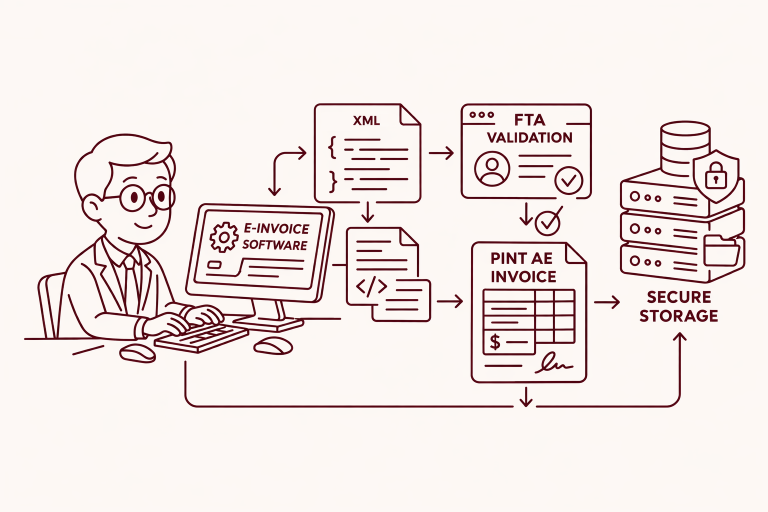
Under the UAE’s e-invoicing system, invoices must be created, exchanged, and reported electronically in the PINT AE format (stored as an XML file). This creates an electronic, machine-readable feed of invoices for the Federal Tax Authority (FTA).
The Ministry of Finance (MOF) and the Federal Tax Authority (FTA) are responsible for issuing and enforcing e-invoicing regulations. The e-invoicing initiative began in 2024, with the Federal Decree-Law No. 16 of 2024. Since then, UAE e-invoicing regulations have taken a more concrete form through the following legislation:
UAE e-invoicing fines are stipulated in Cabinet Decision No. 106 of 2025. This decision directly specifies the fines for delayed implementation, e-invoices, electronic credit notes, as well as not informing the FTA about system failures and delays in informing ASPs of changes in FTA registration data.
Cabinet Decision No. 106 of 2025 also refers to Federal Decree-Law No. 28 of 2022, which stipulates much larger penalties that can result from improper implementation of the e-invoicing model.
Separate from the specific e-invoicing penalties, more serious consequences can arise under the Tax Procedures Law where a person intentionally provides false information or documents to the FTA, or where conduct amounts to tax evasion. Deliberate falsification, concealment, or conduct that reduces the tax due can expose a business to significantly more serious criminal and tax-evasion penalties under the Tax Procedures Law.
You do not need to worry about e-invoicing penalties until your business’s ASP appointment deadline arrives. The first step in avoiding the delayed implementation penalty is to appoint an ASP by 31st July 2026 for a large or major company (revenue exceeding AED 50 million) and by 31st March 2027 for a small or medium-sized company (revenue up to AED 50 million) or a government entity.
Once the mandatory e-invoicing phase applies to your business, all other penalties will become applicable. In the case of large and major companies, this would be 1st January 2027; 1st July 2027 for small and medium-sized companies; and 1st October 2027 for government entities.
Let’s look at a few examples to understand how administrative fines in the e-invoicing system are expected to work:
Let’s assume that your large business did not appoint an ASP until 1st January 2027. Then, your administrative penalty can be calculated as:
Delayed implementation penalty = Total months of delay in appointing ASP × AED 5,000
= 5 × AED 5,000
= AED 25,000
Let’s assume that you delayed 15 e-invoices. Then, your administrative penalty can be calculated as:
Delayed e-invoice penalty = Total number of delayed e-invoices × AED 100
= 15 × AED 100
= AED 1,500
The same penalty would apply if you had delayed the same number of electronic credit notes. But, for each of these violations, there’s a cap of AED 5,000 per month.
Suppose you informed the FTA about a system failure in 5 business days. Then, you must pay the following administrative penalty:
Penalty for delays in informing FTA about system failures = (Days between system failure and informing FTA – 2) × AED 1,000
= (5-2) × AED 1,000
= AED 3,000
Suppose your business deregistered from the VAT framework, but you informed your ASP 15 days after confirmation. Then, you must pay the following administrative penalty:
Penalty for delays in informing ASP regarding FTA registration data changes = (Days of delay – 5) × AED 1,000
= (15-5) × AED 1,000
= 10 × AED 1,000
= AED 10,000
Here are five effective tips that can help you navigate the new e-invoicing model confidently:
Consider the following e-invoice implementation roadmap to ensure a smooth adoption:
Once the e-invoicing model is live, structured Tax Data from in-scope electronic invoices and credit notes will be reported to the FTA through the 5-corner model. This increases visibility for the tax authority and makes mismatches easier to detect.
The tax authority imposes tiered fines for non-compliance. For example, failing to securely store records, invoices, and other information required under the Tax Procedures Law and the Tax Law carries a fine of AED 10,000 for a first offense, rising to AED 20,000 for repeat violations.
To stay audit-ready, ensure all e-invoices and electronic credit notes are stored securely within the state for at least five years, as required under tax procedures laws. Your storage system must allow for easy retrieval by invoice number, date, and counterparty.
Additionally, reconcile your VAT returns against your e-invoice data before submission. Since ASPs forward invoice data directly to the FTA, any discrepancy between your submitted return and the transmitted invoice data is immediately visible and could be treated as misreporting under Federal Decree-Law No. 28 of 2022.
If managing e-invoicing compliance, audit readiness, and VAT reconciliation across separate tools feels overwhelming, skrooge.ai can bring all of it together. We offer integrated accounting, invoice automation, and audit support so your records are always compliant, reconciled, and ready for scrutiny.
Cabinet Decision No. 106 of 2025 is already in force. However, the decision does not apply to Persons using the Electronic Invoicing System on a voluntary basis. In practice, penalty exposure becomes relevant once the mandatory e-invoicing obligations applicable to your business category start to apply.
The e-invoicing mandate exposes UAE businesses to additional penalties and fines that were not stipulated as standard VAT administrative penalties. For instance, previously, there were no penalties for delays in reporting system failures, but once the UAE e-invoice model becomes mandatory, these penalties will be applicable.
Both the issuer and the recipient are responsible for reporting system failures within 2 business days.
Yes, PDF, email, and scanned format invoices do not qualify as e-invoices since they are not sent through intermediaries called Accredited Service Providers (ASPs).
Your business should start looking at e-invoicing demos for the pre-approved service providers so that it can appoint a reliable Accredited Service Provider (ASP) by the relevant deadline. Businesses should start preparing their systems, data, and ASP selection now. Where suitable, they may also consider voluntary implementation before their mandatory phase begins. Participation in the formal Pilot Program is handled separately through the Ministry’s Taxpayer Working Group process.
Thank you!
We've received your request and will get back to you shortly.
Loading...