

Requirements for Qualifying Free Zone Person (QFZP) status under UAE’s Corporate Tax Regime
Free zones in UAE provide advantageous benefits through tax advantages and economic benefits. These designated…
VAT has been part of doing business in the UAE since January 1, 2018, and the Federal Tax Authority (FTA) aims to build systems that make compliance straightforward.
Once you’re registered, you can legally claim input VAT, and file your VAT return through EmaraTax, the FTA’s online platform to simplify the whole taxation process.
However, with the new UAE VAT laws and tax procedures amended under Federal Decree-Laws No. 16 & 17 of 2025, and in effect starting 1st of January of 2026, it is natural for businesses to feel confused about what still applies, what has changed, and how to file correctly going forward.
Filing on time helps you avoid penalties, maintain a clean record, and keep your cash flow predictable. It also makes you more credible when working with partners and clients. Most mistakes arise because of timing or admin issues. We aim that by the end of this guide, VAT filing will feel like a familiar routine that protects your cash flow and reputation.
In this guide, we will walk you through how VAT filing in the UAE works based on real experience supporting businesses. And if you want an easier way to handle VAT, skrooge.ai can help you familiarize yourself with understanding VAT, and automate your preparation to reduce errors and remind you before each deadline.
NOTE:
New Federal Decrees and consequent changes effective 1 Jan 2026 affect refund limits, input tax recovery criteria, and reverse-charge invoicing rules — meaning you should plan ahead in your 2025 filings to avoid losing recoverable amounts.
A VAT return is the form your business files with the Federal Tax Authority (FTA) to report its VAT activity for a specific period. It shows the VAT you collected from customers, the VAT you paid on business costs, and the final amount owed to the FTA or eligible for refund.
VAT Filing is simply the process for preparing and submitting your VAT return, in line with obligations set by tax laws in effect after successful VAT registration.
In the UAE, VAT returns are submitted online through the FTA portal and can be filed either by the business itself or by someone authorized to act on its behalf, such as a tax agent or advisor.
At its core, a VAT return is the FTA’s way of checking in on your business activity during reporting cycles. It is essentially a structured summary of everything you charged and everything you paid in VAT, all wrapped into one report.
A VAT return includes three key pieces:
In practice, this means:
Once these conditions are satisfied, the recoverable VAT can be included in your VAT return as a deduction for the relevant reporting period.
IMPORTANT NOTE
If your business is registered for VAT and holds a TRN, filing this return is not optional. Even if you had no transactions in a tax period, the FTA still requires a nil return. To put it simply, even zero transactions in a taxable period require a nil return.
Reverse Charge Mechanism means the responsibility for reporting VAT shifts from the seller to the buyer. Instead of the supplier charging VAT on the invoice, the business receiving the goods or services calculates and reports the VAT itself in its tax return. This usually applies to imports or specific business-to-business transactions and helps ensure VAT is properly accounted for even when the supplier isn’t registered locally.
Under the reverse charge mechanism, the role is reversed — the buyer accounts for the VAT instead of the supplier.
The reverse charge mechanism ensures VAT is collected even when the supplier:
Imagine you are a UAE VAT-registered business:
In the UAE VAT tax system, RCM commonly applies to:
These specifics come from VAT law and executive regulations (Article 48 of Federal Decree-Law No. 8 of 2017 and related Cabinet Decisions).
To understand how the reverse charge supplies are treated in VAT return, you can refer to this table:
| Output VAT Scenario | Is the reverse charge treated as a deemed supply? | What the business must do |
|---|---|---|
| Imported services from non-UAE supplier | Yes | Report VAT as if you supplied it to yourself |
| Imported goods from abroad | Yes | Account for VAT on imports in your return |
| Certain local B2B sectors (e.g., electronics, oil, metals) | Yes (in specified cases) | Buyer accounts for VAT, not seller |
| Standard local sales | No | Supplier charges and reports VAT on sales |
To stay compliant, you must:
Once you understand these basics, the rest of the VAT return filing process becomes far more manageable. In principle, UAE filing is more about accurate reporting, ensuring consistency, clarity, and compliance.
For each tax period, a VAT-registered business must submit a VAT return. It must include the following details:
With respect to sales and other outputs, the following information needs to be reported:
With respect to purchases and other inputs, the Taxable Person should report:
The net of the following will be the tax payable or refund from the FTA.
| Case | Result |
|---|---|
| Output VAT > Input VAT | VAT payable to the FTA |
| Output VAT < Input VAT | VAT refund or credit |
| Output VAT = Input VAT | No due tax |
To make the landscape clearer, here are a few foundational terms you’ll see often:
Taxable supplies refer to goods or services provided by a VAT-registered business that are subject to VAT under UAE law. This includes supplies charged at the standard VAT rate as well as zero-rated supplies.
Even when VAT is charged at 0%, the supply is still considered taxable and must be included in the VAT return. These zero rated supplies typically include:
In contrast, exempt supplies (or simply “non-taxable supplies”) are the ones where no VAT is charged. Input VAT cannot usually be recovered but we need to report it in the VAT return. They are different from out-of-scope activities, which fall completely outside the VAT system and are not reported as “taxable” supplies.
Example of exempt supplies:
The UAE VAT framework is being updated under Federal Decree-Laws No. 16 and 17 of 2025, with most changes taking effect from 1 January 2026. These amendments aim to tighten timelines, clarify procedures, and place greater emphasis on documentation and transaction verification.
For businesses filing VAT returns in 2025 and beyond, understanding what applies before and after 2026 is key to staying compliant and protecting cash flow.
Key VAT Changes: Before vs starting 2026
| Area | Before 2026 | From 1 January 2026 | Why it matters |
|---|---|---|---|
| Claiming excess input VAT / refunds | No clearly defined long-stop deadline for claiming excess recoverable VAT in practice, leading many businesses to carry forward balances for extended periods. | Excess recoverable VAT must generally be claimed or used within five years from the end of the relevant reporting period, or the right to claim may lapse. | Delayed reconciliations could now result in lost refunds if claims are not made in time. |
| Reverse charge invoicing | In some reverse-charge scenarios, businesses were required to issue self-invoices to account for VAT. | Taxable persons will no longer be required to generate self-invoices for reverse-charge transactions, provided they retain appropriate supporting documentation. This simplifies compliance. | Less paperwork, but stronger supporting documentation is still required to justify VAT treatment. |
| Input VAT recovery conditions | Input VAT could generally be recovered if invoices and basic conditions were met. | The FTA may deny input VAT recovery where transactions are linked to tax evasion and the business did not take reasonable steps to verify the transaction. | Greater focus on supplier due diligence and transaction substance. |
| VAT audits and limitation periods | Audit and assessment timelines were not always clearly aligned with refund claims and carried-forward balances. | Limitation periods for audits and assessments are more clearly defined to the last 5 years, particularly in relation to VAT refunds and excess credits. Exception to the rule: for example, where a refund claim is filed in the final year of the five-year period, the FTA can extend the audit period to complete the assessment related to that claim (typically within two years of submission) | Better certainty on how far back the FTA can review VAT positions, especially where refunds are involved. |
| Voluntary Disclosure and Limitations | Taxpayers had to use Voluntary Disclosure for many errors, even when those errors had no impact on the tax due. | You no longer need to submit a Voluntary Disclosure for every mistake. In certain cases defined by the tax authority, it will still be required—but smaller or routine errors can now be fixed directly in the tax return. | This streamlines the process, making corrections faster and simpler. |
| Administrative penalties framework | Penalties applied under earlier Cabinet Decisions, with some inconsistencies across tax types. | Updated administrative penalties framework (with some provisions effective in 2026) aligns penalties across VAT and other federal taxes. | Reinforces the importance of timely filing, accurate reporting, and proper records. |
A tax period is a specific time frame for which the applicable tax and its transactions shall be calculated and paid. The standard tax period is defined as three calendar months ending on the specific date determine by the FTA.
The FTA may also, at its own discretion, assign a different tax period other than the standard one, to a certain group of taxpayers (i.e. in some business cases, business owners may be required to file tax returns on a monthly basis.)
| Filing Frequency | Who Qualifies | Deadline Example |
|---|---|---|
| A quarterly tax period covers three calendar months. You file four VAT returns per year.
Quarterly filing is the default unless the FTA assigns otherwise |
Most VAT-registered businesses in the UAE
Small and medium enterprises (SMEs) Businesses with annual taxable turnover below AED 150 million |
If your assigned quarter is: January–March → VAT return due by 28 April April–June → VAT return due by 28 July |
| A monthly tax period covers one calendar month. You file 12 VAT returns per year. | Large or high turnover businesses with annual taxable turnover exceeding AED 150 million
Businesses specifically assigned to monthly filing by the FTA due to: |
For monthly: January → VAT return due by 28 February February → VAT return due by 28 March |
IMPORTANT NOTE:
Current tax period refers to the period you are reporting on right now. All filing must be for transactions dated during this period and must be prepared accordingly.
Sometimes, you might see instructions for “previous tax period,” which usually refers to the period that ended before the current one. The filing must already be completed and filed promptly.
For example, assuming your VAT reporting periods are quarterly, this is what filing in the second quarter will look like:
| Period | Status |
|---|---|
| Jan–Mar | Previous tax period |
| Apr–Jun | Current tax period (being filed now) |
| Jul–Sep | Next tax period |
This clarification is to make sure that you are not confused and subject to penalties due to avoidable or technical errors.
For VAT, it does not change how often you file returns, but it does affect how your tax periods are grouped and scheduled. The FTA assigns VAT-registered businesses to a stagger (different quarterly cycles) to help spread filing deadlines across the year, avoid system overload, align VAT reviews with financial reporting, and overall help create a predictable compliance cycle.
Example for Quarterly filers:
If your tax year end is 31 December, your VAT periods may look like:
If your tax year end is 31 March, your VAT periods may look like:
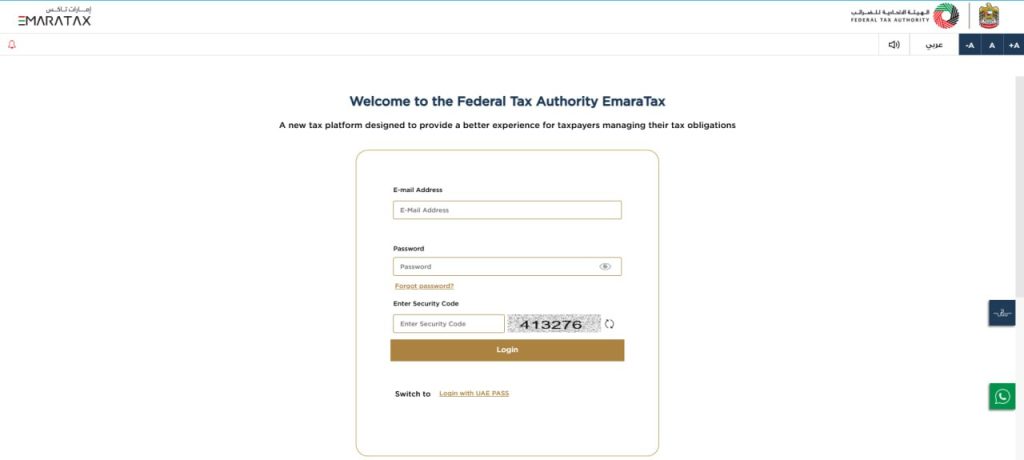
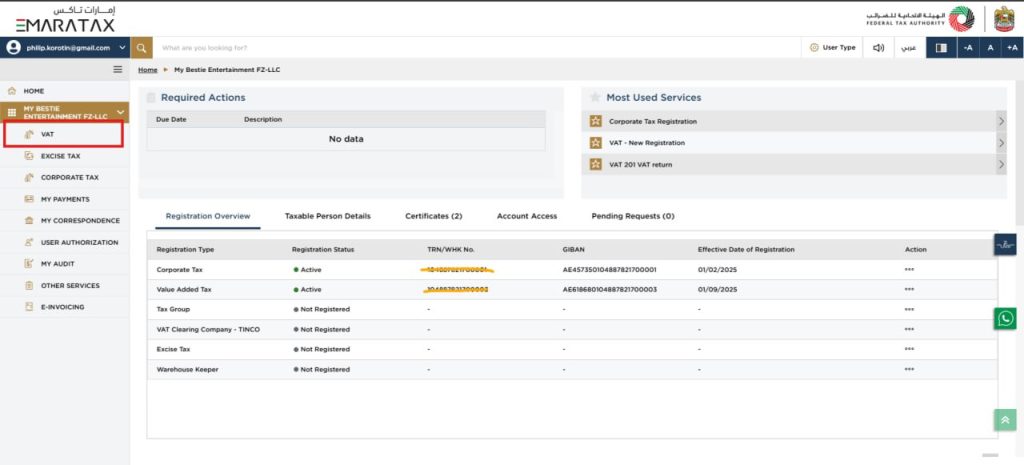
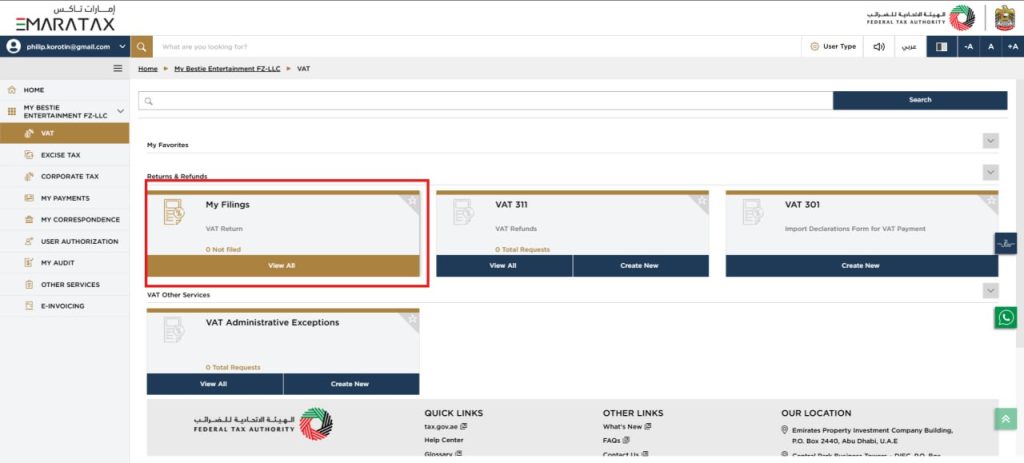
Now that the terminologies are clear, filing for a VAT return is simple using the EmaraTax portal. These are practical steps being pushed by the government – from logging in to confirming payment, they hope that this would make the process less painful for businesses to report.
Note:
When completing the form, you must make sure to round up the numbers to two decimal places, convert the amounts to AED, and use “0” where necessary (i.e. no amounts are to be declared).
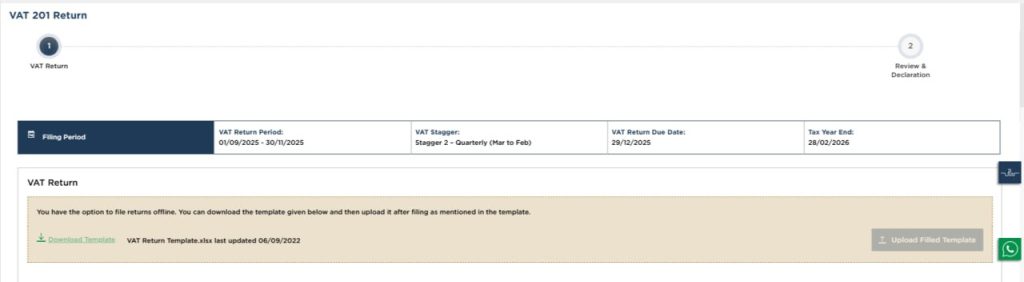
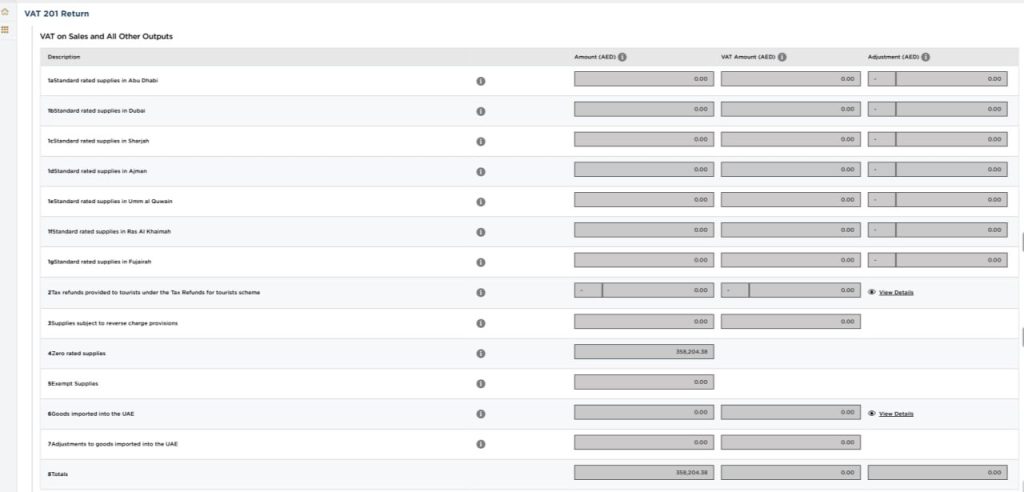


Profit Margin Scheme
You will be required to select “Yes” in the check box if you used and applied provisions for applicable Profit Margin Scheme goods during this period.
This is a crucial step, as most filings encounter an error at this process. Review carefully, and it is best practice to ask someone else in your team to take a third look to be sure.
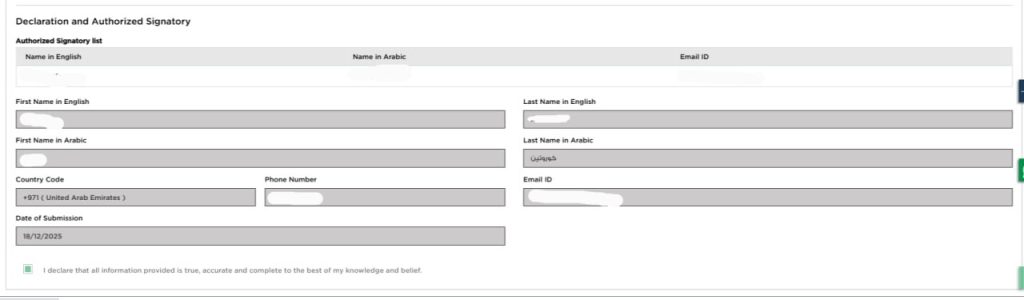
Congratulations! You just finished filing your VAT returns!
For e-commerce supplies, you can refer to the following guide for details in this infographic: Emirates’ VAT return period reporting in Relation to e-Commerce supplies.
You only need to prepare the following for the filing. People have different record keeping habits; thus, it helps to have a professional help you with keeping the business compliance ready and guide you smoothly.
NOTE:
With tightening on input-tax claims, retain strong documentation — especially with due diligence on VAT registered suppliers — because the FTA has clearer authority to deny recoverable tax credits tied to tax-evasion risk. It helps to read more about our guide on validating and verifying VAT number here.
In practice, VAT penalties are rarely the result of deliberate tax evasion. They are more often caused by missed deadlines, minor errors, or incomplete records.
The good news is that late filing penalties follow a clear structure and are largely preventable. With the 2026 rule changes, maintaining accurate VAT returns and transaction checks will play an even bigger role in avoiding issues.
| Common Mistake | What goes Wrong | How to Avoid it |
|---|---|---|
| Late VAT return filing | Penalty of AED 1,000 for the first offence; AED 2,000 if repeated within 24 months | Set calendar reminders, file a few days early, and confirm deadlines in EmaraTax |
| Late VAT Payment and/or Failure to pay full VAT liability | Currently at 2% + 4% monthly (maximum up to 300%)
Penalty will be levied on the unpaid tax From April 2026, it will be calculated as monthly penalty of 14% per annum on the outstanding tax amount, following the due date until the date of full payment |
Review the VAT payable figure carefully before submitting. Submit the return before the 28-day deadline even if payment will follow shortly |
| Incorrect VAT calculations | Under- or over-reporting VAT on sales or expenses | Reconcile invoices and totals before filing; use automated VAT calculations where possible |
| Using the wrong VAT rate | Charging or reporting VAT incorrectly (5%, 0%, or exempt) | Confirm the VAT treatment of each supply before invoicing; keep a VAT rate reference list |
| Misclassifying zero-rated vs exempt supplies | Loss of input VAT recovery or incorrect reporting | Clearly distinguish zero-rated and exempt categories; review FTA guidance when unsure |
| Poor recordkeeping | Difficulty supporting figures during audits or refund claims. In the event that a business fails to maintain the payment records, they can face AED 10,000 to AED 20,000 in fines. | Maintain organized digital records of invoices, contracts, and customs documents |
| Ignoring reverse charge requirements | VAT not accounted for on imports or specified transactions | Flag import and overseas supplier transactions for reverse-charge review |
| Missing supporting documents | Recoverable tax claims rejected or delayed | Ensure valid tax invoices and evidence are retained before claiming VAT |
| No reconciliation before submission | Discrepancies between VAT returns and accounting records | Reconcile sales, purchases, and VAT balances before submitting the return |
| Wrong VAT Return Period Reference Number
VAT return period reference is the identifier for that period in the FTA system. It prevents payments or filings from being applied to the wrong period. Example Monthly filer |
In EmaraTax, this reference is auto-generated and shown when: you file the VAT return, or you generate a payment reference (especially for GIBAN payments) Using the wrong period may result in payments being treated as unallocated or late. |
Ensure your VAT payment is matched to the correct return
You can also use this as reference as required when paying via GIBAN bank transfer |
With the last of this year’s reporting approaching, you must plan your 2025 reporting with these in mind:
By reducing manual steps and standardizing how VAT data is prepared, Skrooge helps businesses stay compliant without relying on last-minute checks or memory-based processes. Skrooge’s AI runs as your always-on compliance pro. Together with our VAT experts, we minimize the bookkeeping service burden on your team so that you could focus on growing your business.
We believe numbers are your best decision asset; as your steady numbers partner, we help you with:
Our transparent service and pricing starts at AED 1,499 for VAT return filing services. You can get started by contacting us here.
Businesses must file quarterly, unless annual turnover exceeds AED 150 million, which requires monthly filing.
All VAT returns must be submitted within 28 days after the end of the tax period.
You can file your VAT return yourself in EmaraTax, appoint a registered tax agent, or use a professional consultant to prepare the return and then submit it yourself.
Late filing penalty: AED 1,000 (first time), AED 2,000 (within 24 months).
You need the following supporting documents for filing:
✔ Sales invoices, Purchase invoices
✔ Customs import & export declarations (via Dubai Customs / UAE Customs)
✔ Debit/credit notes
✔ Tax calculation worksheets
✔ Expense logs
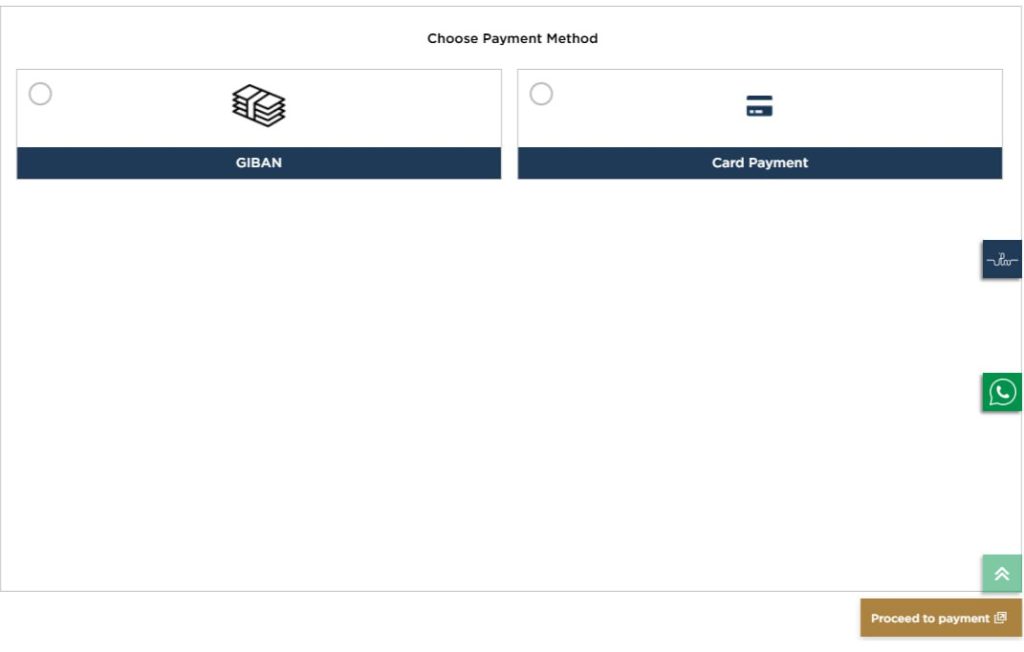
You can make payment using the EmaraTax portal. The following options are available.
-> GIBAN transfer – Make sure to generate a unique payment reference number and save this for manual transfer using GIBAN.
-> Use MagnatiPay to make online payments
eDirham has been transitioned to MagnatiPay as the new payment gateway. It accepts payments made using any Visa or Mastercard prepaid, debit or credit card. For remaining eDirham balances, you can contact your issuing bank.
Output VAT: VAT collected on sales.
Input VAT: VAT paid on purchases; can be reclaimed if eligible.
The difference will define if you have to pay VAT to the FTA or are eligible for VAT refunds. Both will need to be disclosed in your VAT 201.
The impact of your mistake depends on type and size of the mistake
1. For Minor or non-material errors -> may be corrected in a subsequent VAT return, if allowed
2. For Material errors or errors affecting net VAT payable /refundable -> Required to file a Voluntary Disclosure (VAT211)
Possible consequences include 1) Additional payable tax (if VAT was underreported); 2) delay or reduction in VAT refunds; 3) Administrative penalties, depending on severity and timing
In the 2026 amendment update, voluntary Disclosure is no longer mandatory for all errors. The FTA may specify which cases require disclosure and some errors can now be corrected directly through the VAT return
Yes — if your total recoverable tax is greater than your sales tax for the specific VAT period, you can claim the difference back from the FTA. You will be required to file your VAT return first. Once your return reflects an excess of input tax over output tax, you can proceed with a refund application using Form VAT 311 on EmaraTax portal.
Zero-rated supplies: Taxable at 0% (you can recover tax)
Example:
Exports of goods outside the UAE (including GCC, subject to conditions)
International transportation of passengers or goods (subject to conditions)
Certain healthcare services, such as basic medical treatment
Certain educational services, including approved nursery, school, and higher education services
Newly constructed residential buildings (first supply within a specific timeframe)
Investment precious metals (e.g. gold, silver of qualifying purity)
Exempt supplies: No VAT charged (you cannot recover tax)
Example:
Granting loans or credit where income is earned through interest or margins
Residential property leasing for long-term accommodation
Sale of residential property after the first supply
Sale or lease of bare, undeveloped land
Local passenger transport within the UAE (such as taxis, buses, and metro services)
Life insurance and reinsurance services
Yes. You must file a Nil VAT Return if you are VAT registered.
EmaraTax is the UAE FTA’s official online tax platform, helping taxpayers register, file returns, pay taxes, and manage obligations easily in one place.
Thank you!
We've received your request and will get back to you shortly.
Loading...