

EmaraTax Corporate Tax Filing Walkthrough UAE 2026
Calculating Taxable Income The starting point for calculating the taxable income is to determine the…
Corporate Tax was introduced in the UAE quite recently in 2023. The new rules created two new action items for businesses. Firstly, you must register for Corporate Tax, and secondly, you need to file Corporate Tax returns for every financial year beginning on or after 1st June 2023.
These tax compliance considerations introduced under the UAE Corporate Tax regime also meant the introduction of two new administrative penalties. An AED 10,000 penalty for late registration was introduced under Cabinet Decision No. 10 of 2024. Similarly, a penalty for late filing of CT returns was also introduced.
Unlike VAT, which allows voluntary registration in certain cases, Corporate Tax registration is mandatory for all taxable persons. Natural persons are only within Corporate Tax where they conduct business / business activities and cross AED 1 million in turnover in the previous calendar year.
Recognizing the practical challenges businesses faced in completing Corporate Tax registration on time, an FTA Penalty Waiver program was announced.
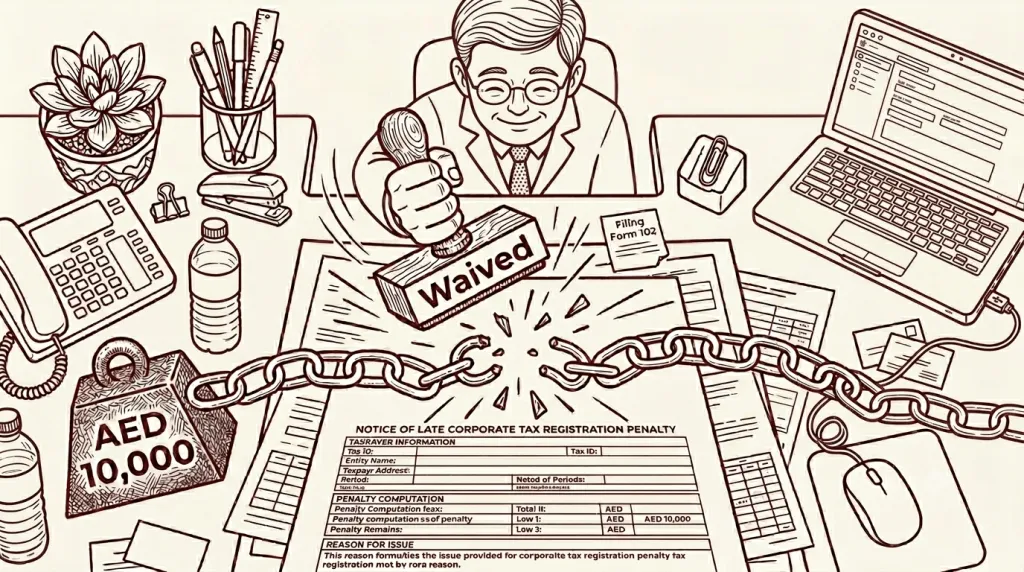
The late Corporate Tax registration waiver initiative was announced in 2025. To qualify for relief from the AED 10,000 penalty, taxable persons had to file the Corporate Tax return for their first tax period within 7 months from the end of that tax period. Filing deadlines for CT returns are typically 9 months from the end of the tax period. So, you must file the first CT return 2 months earlier than normal to qualify for the penalty waiver.
Let us explore the eligibility conditions in the 5 possible scenarios.
| Scenario | Registration | Penalty | Tax return | Is the penalty waiver available? If so, how? |
|---|---|---|---|---|
| 1 | Late registration | Not paid yet | Filed within seven months from the end of the first tax period | Penalty is waived |
| 2 | Late registration | Not paid yet | Not filed yet | Penalty is waived only if you file the tax return or annual declaration within seven months from the end of the first tax period |
| 3 | Late registration | Paid | Scenario 3 covers both situations (filed as well as not yet filed) | Penalty is refunded only if the tax return or annual declaration is filed within seven months from the end of the first tax period |
| 4 | Late registration | Paid | Filed within seven months from the end of the first tax period | Penalty will be refunded |
| 5 | Not registered yet | Not paid | Not filed | Penalty waiver applies if you file the tax return or annual declaration within seven months from the end of your first tax period |
As you can see, the penalty waiver is not limited to only unpaid penalties. A paid penalty for late registration is also waived through refunds.
We can classify penalty waivers as the ones that are applied automatically, given that certain conditions are met, and ones that are extended only when the applicant can prove that non-compliance occurred because of reasons outside their control. The former are called automatic waivers, and the latter are called reasonable cause waivers.
The waiver for the penalty for late CT registration is a form of automatic waivers. If a business completes registration and files the returns for the first tax period within seven months from the end of its first tax period, it can avail the penalty waiver. There is no need to prove that non-compliance was the result of reasons beyond the business’s control.
The fact that the late registration penalty waiver is an automatic waiver is an advantage for UAE businesses. With reasonable cause waivers, subjective factors play a key role in waiver approvals.
The FTA has not published a separate fixed processing timeline for the late Corporate Tax registration penalty waiver. In practice, the timing may depend on whether registration is complete, whether the first return or annual declaration has been filed within the seven-month period, and whether the FTA system has applied the waiver or refund automatically. Businesses should monitor their EmaraTax account and tax account balance after filing.
As mentioned earlier, the late CT registration penalty waiver is an automatic waiver under UAE Corporate Tax Law. To benefit from this initiative, businesses simply need to complete their CT registration and file the CT returns for the first tax period within seven months from the end of the same tax period, subject to the FTA’s applicable procedures. The waiver is intended to operate automatically once the prescribed eligibility conditions are satisfied.
That being said, this penalty waiver is a new initiative, and hence, administrative errors may still occur. Hence, if your late registration penalty waiver is rejected, you can appeal this Federal Tax Authority decision in the following manner.
If you think your late registration penalty waiver is incorrectly rejected, you can file a Penalty Reconsideration Request within 40 business days of the FTA notifying you of their decision. In this application, you need to submit documentary proof validating the factual and legal grounds of the request and any relevant tax advice received. You must ensure that the required documents are uploaded as Word, Excel, PDF, JPG, PNG, or JPEG files, and each file should be up to 5 MB.
Typically, the FTA takes 45 business days to process reconsideration requests. However, they can extend the deadline to make a decision.
In connection with your reconsideration request, the FTA may request additional information via an Additional Information Notification if it finds the submitted documents insufficient for making a decision.
After reviewing the facts, the FTA will notify you of the approval or rejection of the application. If your Penalty Reconsideration Request is rejected incorrectly, you can approach the relevant Tax Disputes Resolution Committee (TDRC) within 40 business days of the notification.
In this application, you will be required to submit the following details:
The Tax Disputes Resolution Committee (TDRC) is formed by the decision of the Minister of Justice, chaired by a member of the Judicial Authority, and includes two tax experts. In the UAE, the three TDRCs are located in Sharjah, Abu Dhabi, and Dubai. The Sharjah TDRC reviews tax decisions appealed by registrants from Sharjah, Ras Al Khaimah, Ajman, Fujairah, and Umm Al-Quwain. The Abu Dhabi TDRC reviews tax decisions appealed by foreign companies with no UAE address. Other appeals are reviewed by the Dubai TDRC.
Important
When you file a case with the relevant TDRC, you must ensure that the application and all the supporting information are in Arabic. TDRCs do not entertain cases where:
The TDRCs process applications within 20 business days, but can extend the timeline to make a decision. The taxable person and the Federal Tax Authority (FTA) both have the right to appeal TDRC verdicts in courts. However, the decision of a TDRC is considered final if the total tax and penalty due do not exceed AED 100,000, and you cannot approach courts for penalty reviews unless the case has been reviewed by a TDRC.
Businesses are required to complete their Corporate Tax registration within 3 months to avoid the AED 10,000 penalty for late registration. However, if you submit the CT returns within seven months from the end of your first tax period, you may qualify for a waiver of the late Corporate Tax registration penalty.
You can apply for a waiver of the Corporate Tax registration penalty only if you submit your first tax returns within seven months from the end of your first tax period, which is 2 months earlier than the typical deadline.
The FTA has not published a fixed processing timeline for the automatic waiver or refund. Once the taxpayer meet all criteria within the seven-month deadline, the taxpayer should monitor the EmaraTax account to confirm whether the penalty has been waived or the paid amount has been credited.
For the waiver itself, the key requirements are completing Corporate Tax registration and submitting the first Tax Return or annual declaration within seven months from the end of the first Tax Period or first Financial Year. If the taxpayer later files a reconsideration request because the waiver or refund was not applied correctly, supporting documents may include the FTA penalty reference, proof of registration, proof of Tax Return or annual declaration submission, payment proof if the penalty was already paid, and documents explaining why the taxpayer meets the waiver conditions.
Yes, if your late Corporate Tax registration penalty waiver is rejected, you can file a Reconsideration Request. If your Reconsideration Request is also rejected, you can approach the relevant Tax Disputes Resolution Committee (TDRC). After that, the final available escalation is approaching the courts.
Common reasons the waiver may not apply include failing to complete Corporate Tax registration, failing to submit the first Tax Return or annual declaration within seven months from the end of the first Tax Period or first Financial Year, or not being within the category of persons covered by the waiver initiative. The penalty does not need to have been paid first for the waiver to apply; paid penalties may be refunded to the taxpayer’s tax account where the conditions are met.
Thank you!
We've received your request and will get back to you shortly.

Loading...
 Thank you!
We've received your request and will get back to you shortly.






 Contact Us


