
How to File Corporate Tax Returns in UAE
The UAE’s Corporate Tax Law (Federal Decree Law No. 47 of 2022) establishes a legislative…
Electronic invoicing (e-invoicing) software is a digital solution that enables businesses to create, send, receive, and store e-invoices in a structured, machine-readable format. Unlike standard accounting tools that generate PDF invoices for manual or email-based delivery, a dedicated e-invoicing platform automates the entire invoice lifecycle, from data capture and validation to transmission and archiving.
Software for e-invoicing is not simply a tool that produces invoices electronically. In the UAE context, it specifically refers to solutions that can generate invoices in the PINT AE format, validate them against regulatory requirements, and facilitate secure transmission via the Peppol network. A PDF generated by your accounting software and emailed to a buyer does not qualify as an e-invoice under the new regulations.
Businesses can typically rely on an e-invoicing platform for the following purposes:
The UAE is transitioning to a digital tax system that requires businesses to issue, store, and report invoices electronically in a structured format, as per FTA regulations. E-invoicing will become mandatory for all businesses by 2027, and the pilot phase of this model will start on 1st July 2026.
By the end of the same month (31st July 2026), large companies, defined as those with revenue exceeding AED 50 million, must appoint an Accredited Service Provider (ASP). If you fail to appoint an ASP before said deadline, you will face a penalty of AED 5,000 for each month of delayed appointment.
Other business and government entities can avoid this fine by appointing an ASP by 31st March 2027.
The UAE government expects that implementing the e-invoicing model will enhance government performance by catalyzing the adoption of the latest digital infrastructure, which is one of the four key pillars of the “We the UAE 2031” vision. The UAE’s e-invoicing model is designed for future scalability and cross-border interoperability.
If you are looking for an in-depth discussion of e-invoicing implementation considerations, rollout timeline, and penalties, click here.
Note
E-invoicing is mandatory regardless of your VAT registration status. Once the e-invoicing model is fully rolled out, you must issue e-invoices for all B2B, B2G, G2B, and G2G transactions. However, certain transactions, like to or from consumers (natural persons not in Business) are out of scope.
Some of the expected benefits of the e-invoicing model are:
Since e-invoicing will be mandatory for B2B transactions, it will limit the scope for unreported transactions and income.
Electronic recordkeeping will make for smoother audits as it enables software-based reconciliation, ensuring a higher degree of transparency and improved accuracy for tax authorities as well as shareholders.
E-invoicing software is specifically designed to ensure tax compliance by streamlining e-invoicing, tax reporting, and related processes. In the e-invoicing model, tax data will be shared with the Federal Tax Authority (FTA) in real-time. This is expected to streamline processes like the VAT refund mechanism.
Real-time access to invoicing data will allow the UAE government to have a better grasp of the nation’s economic health and the efficiency of its financial systems. This will enable the government to fine-tune fiscal policies and address vulnerabilities directly.
E-invoicing is exponentially faster than paper invoices that must be handed over in person or delivered via post or by employees. As a result, businesses recognize their bills payable much faster, eliminating unintended delays. Ultimately, this connects to businesses in the UAE getting paid faster.
Centralized data and automated processes in e-invoicing allow finance teams to focus on strategic activities, saving significant time and resources.
Note
In the long run, the e-invoicing model can also be expected to accelerate fraud detection, as regulators will have a real-time feed of invoicing data. However, whether this benefit is realized depends on how well the e-invoicing infrastructure and monitoring systems are designed.
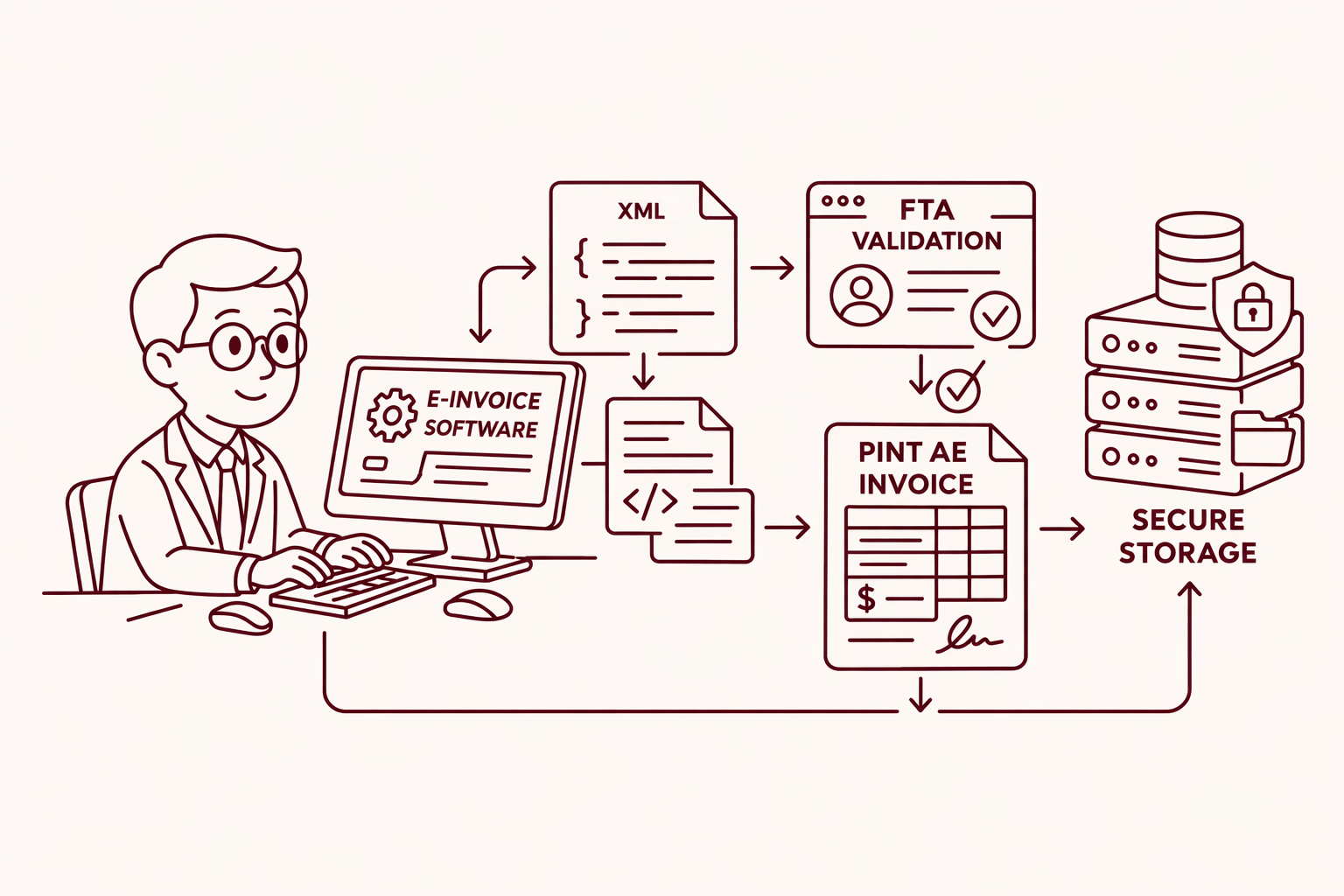
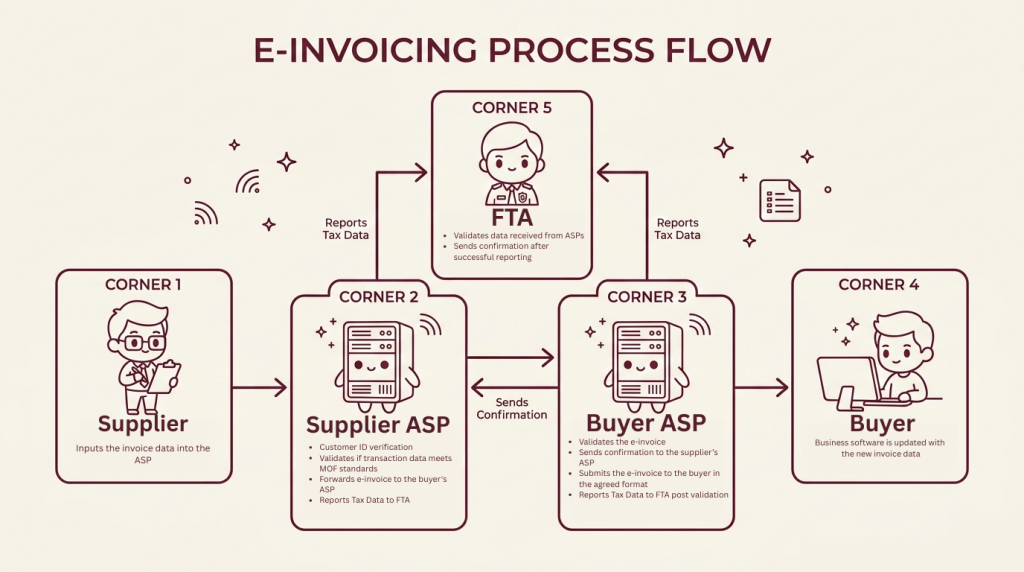
Your e-invoicing software (officially known as the Accredited Service Provider or ASP) will prepare e-invoices in the PINT (Peppol International) AE format with all 51 mandatory fields, store them as XML files, validate the invoice data, and then, share them with the buyer’s ASP as well as the Federal Tax Authority (FTA). Then, the buyer’s ASP will validate the invoice data and forward it to the buyer and the FTA. In parallel, the FTA will also validate the invoice data and archive it.
The different parties involved in the e-invoicing process are denoted as Corners 1 to 5 in the following manner:
You can also refer to the following infographic to understand how the e-invoicing model works.
📖 What exactly is Peppol?
In this framework, the e-invoice data is transmitted via Peppol (Pan-European Public Procurement On-Line), an international, open network for exchanging business documents. Peppol has been adopted across various European and Asian countries, such as Germany, Denmark, Japan, and Singapore. This network aims to enable borderless trade by standardizing business documents and transmitting them electronically. So, the UAE’s e-invoicing adoption is also a step towards smoother international trade.
One of the most common misconceptions among businesses preparing for the UAE mandate is that generating a well-formatted PDF invoice is sufficient. It is not. Under the UAE’s evolving tax regulations, the distinction between a PDF and a true e-invoice is fundamental.
A PDF is an unstructured representation of invoice information. Even if it looks identical to a spreadsheet invoice, the financial data and tax details within it cannot be automatically extracted, validated, or reported to the FTA without manual intervention. This is precisely the inefficiency that the UAE’s e-invoicing model is designed to eliminate.
An e-invoice, by contrast, is a structured data file. Specifically, it is an XML file prepared according to the PINT AE (Peppol International UAE) specification. Every field in the file is defined, labeled, and machine-readable, which allows ASPs, the FTA, and buyer systems to process and validate the data automatically. Software for e-invoicing must therefore be capable of outputting invoice data in this exact format, not just producing a visual representation of an invoice.
The PINT-AE format has 51 mandatory fields that are validated by supplier and buyer ASPs, as well as the FTA. These fields are categorized as invoice details, seller details, buyer details, document totals, tax breakdown, and invoice line. Click here for a more comprehensive list.
Tip
Many businesses currently do not capture all 51 fields in their existing invoicing workflows. Auditing your master data and invoice templates against the PINT AE mandatory fields is one of the first practical steps in any e-invoicing software UAE implementation project.
Yes, appointing an e-invoicing provider is a legal requirement, not an optional upgrade. Under the UAE’s e-invoicing framework, businesses cannot transmit invoices through the DCTCE system unless they have appointed an Accredited Service Provider (ASP).
Businesses are required to appoint an ASP by 31st July 2026 if their revenue exceeds AED 50 million, while other businesses must appoint an ASP by 31st March 2027. If you fail to do so, you may have to pay a fine of AED 5,000 per month of delayed appointment.
An ASP is a software solution provider that has been officially certified by the Ministry of Finance to receive, validate, and transmit e-invoices on behalf of businesses.
This creates an important distinction between any existing e-invoicing platforms and an ASP. Not every invoicing software tool qualifies. Only providers that have passed the MOF’s stringent accreditation process, including technical, capital, and security requirements, are authorized to act as ASPs in the UAE.
Your ASP does not need to be a separate, standalone tool. If your existing accounting software vendor is among the list of pre-approved e-invoicing solution providers, you may be able to negotiate a higher-tier plan that includes e-invoicing functionality, avoiding the operational disruption of adopting an entirely new system. If your software provider is not accredited, you can still keep your existing accounting system and integrate it with an accredited ASP to generate and transmit compliant e-invoices. In practice, most major accounting/ERP platforms are expected to offer ASP integrations as the UAE rollout progresses, but you should confirm availability and timelines with your vendor and the ASP.
Not all invoicing tools are equipped to meet the technical and regulatory demands of the UAE’s DCTCE model. When evaluating the best e-invoicing software for your business, the following feature categories are non-negotiable:
The most foundational requirement for any top e-invoicing software is Peppol certification. To operate as an e-invoicing platform in the UAE, a solution provider must pass the OpenPeppol conformance tests, confirming that their system can exchange invoice data correctly with other Peppol-connected access points. Without this certification, an e-invoicing service provider cannot be accredited by the MOF, and without MOF accreditation, they cannot legally transmit invoices on your behalf.
Practical adoption of e-invoicing software solutions depends heavily on how well they integrate with your existing technology stack. Your e-invoicing software provider should offer seamless integration options for ERP and accounting systems, point-of-sale (POS) systems, and e-commerce storefronts.
In addition to transmitting invoices, e-invoicing software in the UAE is also required to validate them. So, when you are choosing an e-invoicing software, confirm that the solution:
Note
E-invoicing software in the UAE is still an evolving product category. As the pilot phase progresses, the desired feature set will expand and become clearer. In the meantime, you must ensure that your business is not over-reliant on your ASP for catching manual errors and VAT-compliant invoicing.
Article 9 of Ministerial Decision no. 64 of 2025 requires ASPs to meet the Peppol Service Provider Product information security standards, which are summarized below:
Beyond security, business continuity is equally important. This is underpinned by the fact that the MOF requires ASP applicants to submit proof of paid-in capital. Choosing an inexperienced or underfunded ASP can leave you exposed to all sorts of e-invoicing and VAT-related penalties in the worst case scenario, where the ASP shuts down.
Implementing an e-invoicing solution for UAE businesses is not as straightforward as switching on a new software subscription. It requires process mapping, data preparation, system integration, and staff training. The following step-by-step roadmap is designed to help businesses in Dubai and across the UAE implement e-invoicing software systematically and without unnecessary last-minute pressure.
Before selecting any e-invoicing software, you need a clear picture of the gap between your current invoicing process and the mandated standard.
Using your e-invoicing software, you will need to generate invoices with all 51 mandatory PINT AE fields. Start by checking whether your current systems capture all of these fields in your master data.
Your e-invoicing software solutions will also need to support the following process timelines, which you must build into your internal workflows:
Finally, map your invoice volumes by transaction type (B2B, B2G, G2G) to determine the scale of automation required. High-volume businesses will need direct API integration, while lower-volume operations may find middleware adapters sufficient.
Be mindful of your ASP appointment deadline. If your current accounting or ERP software vendor is in the process of applying for accreditation, it is important to verify their application date. The accreditation process takes 90 working days. If fewer than 90 working days exist between your vendor’s application date and your ASP appointment deadline, you will need to appoint a different e-invoicing provider in the interim.
When evaluating e-invoicing solution providers, prioritize the following criteria in addition to MOF accreditation status:
Once you have selected your ASP, you will need to appoint them via EmaraTax. The ASP will then verify your identity and tax details and help you obtain your Peppol participant identifier / electronic address for e-invoicing on the Peppol network as part of their onboarding process. The detailed technical onboarding steps may vary by provider.
From 1 July 2026, (i) a Pilot Program starts for selected Persons contacted by the Ministry (participation is by written agreement), and (ii) voluntary implementation is available for all Persons. Administrative penalties apply only from the date a Person becomes mandatorily subject to e-invoicing. Use this period purposefully to:
Tip
Even after the pilot phase ends, your e-invoicing software provider should offer a sandbox or test environment for testing. If they do not, treat this as a significant red flag.
Once your mandatory e-invoicing phase begins, your e-invoicing software solutions must operate reliably under live conditions. At this stage, you must focus your attention on three operational priorities:
Set up alerts for invoice rejections, transmission failures, and missing data in real time. Delayed e-invoices attract a penalty of AED 100 per invoice, capped at AED 5,000 per month, so early detection of issues is directly linked to cost avoidance.
Define a clear internal escalation process for invoice errors, system outages, and ASP communication failures. Every team member involved in invoicing should know their role in the exception-handling workflow.
Keep your master data current. If your FTA registration data changes, for example, due to VAT deregistration or a change in business address, you must inform your ASP within 5 business days of the FTA confirming the amendment. Delays attract a penalty of AED 1,000 per day. Your e-invoicing software should, ideally, flag registration data discrepancies automatically to prevent inadvertent violations.
Choosing the best e-invoicing software for your business requires an honest assessment of the true cost of an e-invoicing platform.
Most pre-approved ASPs have not published their pricing; however, typically, such solutions are offered on a monthly subscription basis, tiered based on transaction volumes. So, you will need to list the ASPs by monthly subscription cost for your transaction volume.
If your ERP or accounting software requires custom development or middleware to connect with an ASP, these integration costs can significantly exceed the subscription fee. Request a detailed demonstration of the integration process from any e-invoicing software provider before signing a contract.
Staff training is not a one-time event. As the e-invoicing model matures and regulations are refined post-pilot, your team will need periodic updates. Factor in the value of your ASP’s training resources and documentation quality in your purchasing decisions.
A delayed implementation fine of AED 5,000 per month, combined with per-invoice penalties and failure-reporting fines, can quickly exceed the annual cost of a costly but seamless e-invoicing software solution. The right investment in the right platform is, in this sense, a risk management decision as much as an IT procurement one.
The UAE’s e-invoicing regulations are still evolving. Ensure your provider commits to updating their software to stay compliant with future regulatory changes without passing the full cost of those updates on to you.
With the current list of pre-approved e-invoicing service providers (updated periodically; 18 as of the date of publication) and more likely to be accredited over time, selecting the best e-invoicing software for your business requires a structured evaluation approach. Use the following criteria as your e-invoice software selection framework:
Any e-invoicing software provider you appoint must hold MOF accreditation.
The best e-invoicing software for your business is the one that integrates most smoothly with your existing systems. Poor integration compromises data integrity, which leads to invoice rejections and penalties.
Confirm that the provider can generate and validate all 51 mandatory fields in the correct XML format. Ask for a demonstration using your own invoice data if possible.
If your business is growing or operates across multiple Emirates, ensure your chosen e-invoicing service provider can handle high transaction volumes and related party transactions (RPTs).
Given the 2-business-day window for FTA notification of system failures, your provider’s reliability and their incident response procedures are directly tied to your compliance exposure.
The pilot phase will surface gaps and refinements in every provider’s offering. Choose a vendor who communicates openly about their development roadmap and has a credible track record of delivering timely compliance updates in other jurisdictions.
The cheapest e-invoicing software provider is not always the most cost-effective. Factor in integration complexity, support quality, and the financial exposure of a poorly executed implementation when comparing options.
Use the following checklists to assess your business’s readiness for mandatory e-invoicing in the UAE. This can also serve as an internal tracking tool to manage your implementation progress.
E-invoicing will become mandatory in the UAE for large businesses (revenue exceeding AED 50 million) on 1st January 2027, for small businesses on 1st July 2027, and for government entities on 1st October 2027. After these deadlines, all B2B, B2G, G2B, and G2G transactions must be processed through the e-invoicing system.
An accredited service provider (ASP) is a software solution provider that meets all the certification, capital, and technological requirements for enabling e-invoicing in the UAE. All businesses must appoint an ASP within the appropriate deadlines to avoid penalties for delayed implementation.
No, PDF invoices are not considered e-invoices under the new UAE e-invoicing regime. E-invoices are invoices prepared in the PINT-AE format and saved as XML files before being shared via an Accredited Service Provider (ASP).
UAE-PINT or PINT-AE is a set of 51 mandatory e-invoice fields that are categorized as invoice details, seller details, buyer details, document totals, tax breakdown, and invoice line. Many businesses do not issue such extensive invoices and thus must compile a master data file for speedy invoice generation once e-invoicing becomes mandatory.
When you appoint an ASP, they will complete onboarding by verifying your identity and tax details and helping you obtain the Peppol participant identifier / electronic address needed for e-invoicing. The detailed technical onboarding steps may vary by provider.
If a software solution provider has been accredited by the UAE government, they will have already passed stringent data security standards. So, you may only need to ask the e-invoicing provider if they are an Accredited Service Provider (ASP).
If your accounting software isn’t an accredited service provider (ASP), you may need to rely on a third-party ASP for e-invoicing and connect it with your existing tech stack via APIs or middleware. You should choose your e-invoicing software integration approach based on your transaction volume. APIs are generally preferable for high transaction volumes. However, smaller teams without dedicated IT staff, such as law firms, repair shops, and other service businesses, may find middleware connectors more convenient.
Since e-invoicing software is currently an evolving product category, there’s limited clarity in implementation timelines. However, given the wide gaps between ASP appointment deadlines and go-live dates for mandatory e-invoicing, you should expect e-invoicing implementation to take anywhere between a few weeks and a month.
Thank you!
We've received your request and will get back to you shortly.

Loading...