
E-invoicing software UAE
What is e-invoicing software? Electronic invoicing (e-invoicing) software is a digital solution that enables businesses…
The UAE government is currently undertaking an initiative to digitalize the invoicing process. The objectives of this initiative are not as simple as reducing paper usage. Instead, e-invoicing in the UAE focuses on standardizing invoice data, transmitting it in a secure manner, and automating tax data collection.
In contrast to e-invoicing, PDF and paper invoices are not shared with the Federal Tax Authority (FTA) when transactions are executed or settled. A UAE e-invoice is not just a PDF or scanned invoice. The UAE e-invoicing model requires structured invoice data (using the prescribed format and data elements), whereas PDFs and scanned invoices are unstructured representations and do not, by themselves, meet the e-invoicing data standard. Also, the data in such invoices is not always standardized. As a result, the tax authorities must examine tax returns and request invoices in case any discrepancies are found as part of audits. Thus, the current invoicing process creates significant audit strain on tax authorities.
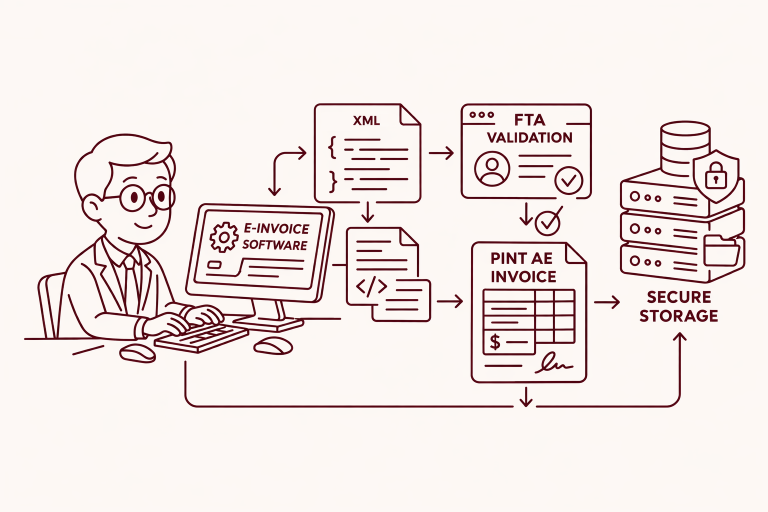
Under the new e-invoice model, businesses are not required to keep paper copies, but they must store digital invoices securely in their digital systems so that they are easily recoverable in audits.
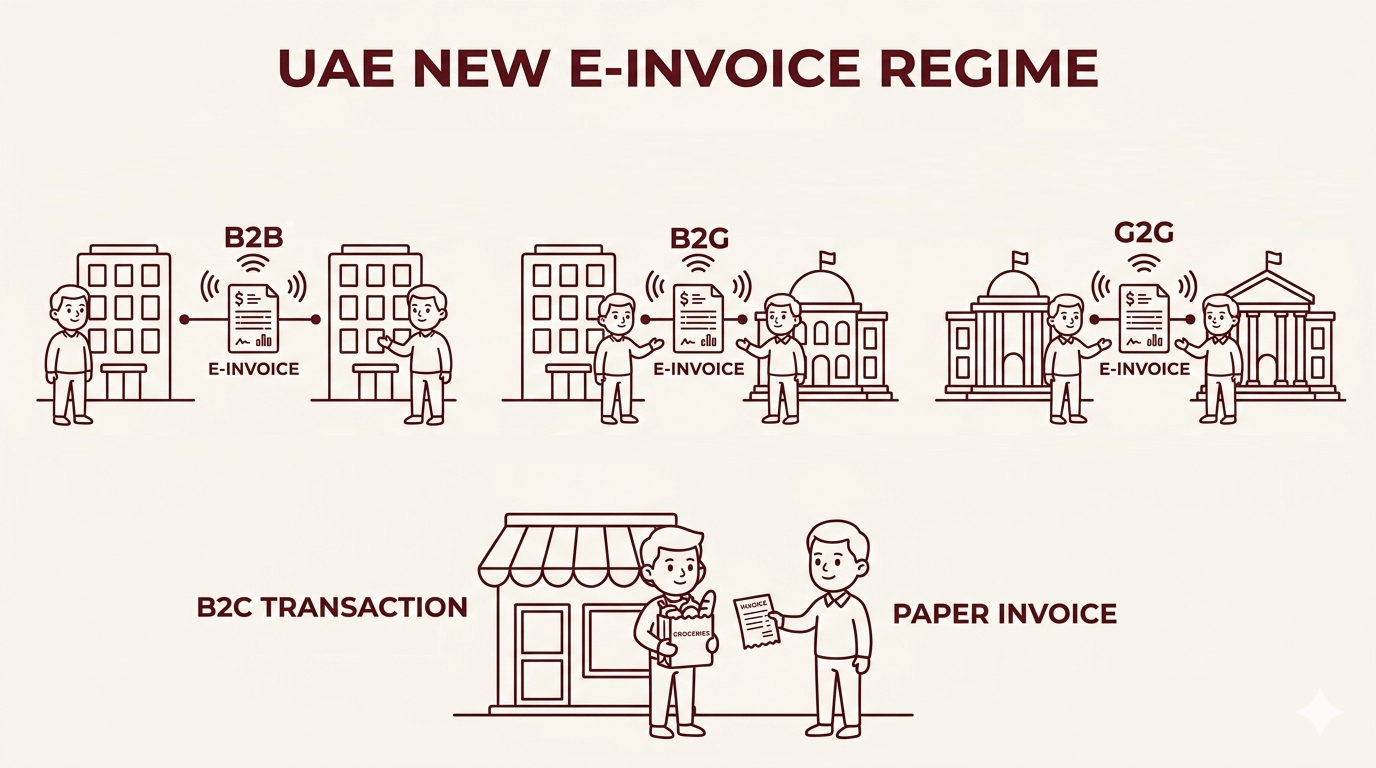
E-invoicing is being introduced in the UAE on a phased basis, not all at once. Under the current phased implementation decision, the first mandatory phase starts on 1 January 2027 for businesses with annual revenue exceeding AED 50 million, the next phase starts on 1 July 2027 for other businesses, and government entities follow from 1 October 2027. The framework also includes exclusions, including certain B2C transactions and other excluded cases set out in the Ministerial Decisions.
The UAE has announced a phased rollout of the Electronic Invoicing System, starting with a pilot program and voluntary implementation from 1 July 2026, followed by mandatory phases from 2027 onward for Persons and Government Entities within scope.
UAE e-invoicing is being rolled out in the following manner, according to the official e-invoicing implementation timeline:
| Phase | Period |
|---|---|
| Pilot program | From 1 July 2026 |
| Companies with at least AED 50 million in revenue | ASP appointment by 31 July 2026;
Mandatory e-invoicing from 1 January 2027 |
| Other businesses | ASP appointment by 31 March 2027;
Mandatory e-invoicing by 1 July 2027 |
| Government entities | ASP appointment by 31 March 2027;
Mandatory e-invoicing by 1 October 2027 |
Note
E-invoicing is available only through Accredited Service Providers (ASP). Click here to view the list of pre-approved e-invoicing ASPs.
Businesses that wish to test the UAE e-invoicing model before full rollout can do so through the pilot program that goes live in July 2026. To participate, you must submit an official letter of intent and inform the Ministry of Finance (MOF) of the ASP you have selected for the pilot. You will also be asked to share your implementation timeline, key milestones, and testing procedures. Accordingly, the MOF and FTA will coordinate and communicate with you throughout the pilot phase to enhance the success of the full rollout. At the same time, businesses will have an opportunity to understand e-invoicing documentation needs and procedures.
UAE e-invoicing requirements, which will form a part of UAE VAT regulations, will be applicable to all businesses and government entities with a few notable exceptions. These exceptions include:
If all your business activities are excluded from mandatory e-invoicing, you can choose whether you want to participate voluntarily.
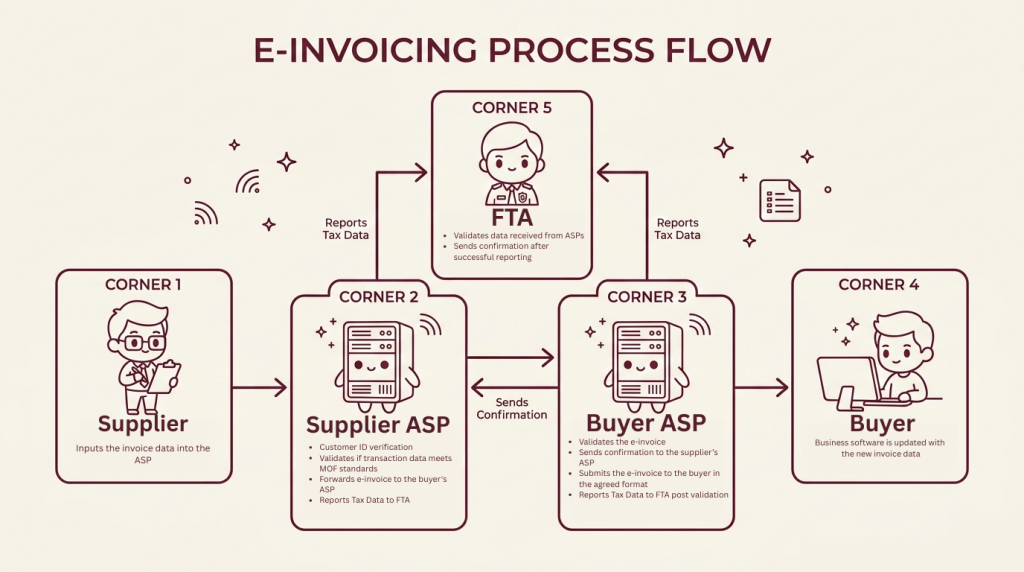
The UAE e-invoicing model, officially known as the Decentralized Continuous Transaction Control and Exchange (DCTCE), covers the entire e-invoicing process, including transmitting, validating, and storing invoice data across 5 key points, or corners, which are defined as:
Note
As a general rule, an e-invoice or e-credit note must be issued and transmitted within 14 days from the Date of Business Transaction. If the Issuer is VAT-registered, the normal VAT invoicing timelines apply instead.
To send an e-invoice in the UAE, you must prepare the invoice in the Peppol International (PINT) AE format. In this format, there are 51 mandatory fields for an electronic tax invoice. These mandatory fields can be classified into 6 categories, which are invoice details, seller details, buyer details, document totals, tax breakdown, and invoice line. You must fill these fields and store the invoice in XML format.
Another key consideration is that the invoice must meet VAT requirements. If required fields or validation checks are not met, the invoice may be rejected or require correction before successful transmission. Businesses should not rely on the ASP to “fix” tax or source data issues automatically – the issuer remains responsible for accurate invoicing data.
However, we are talking about unexplored features of unreleased compliance software for completely new regulations. So, initially, businesses must be careful not to be over-reliant on ASPs for invoice creation. Once the ASP validates that the e-invoice meets the PINT AE specifications and VAT compliance requirements, it will send the e-invoice to MOF, FTA, and the buyer’s ASP.
To prepare a UAE-compliant e-invoice, you must capture the following mandatory fields of the PINT AE format.
|
Category |
Field |
|---|---|
|
Invoice Details |
|
|
Seller Details |
|
|
Buyer Details |
|
|
Document Totals |
|
|
Tax Breakdown |
|
|
Invoice Line |
|
E-invoicing implementation is not as simple as buying a new SaaS subscription. It also requires process changes, internal coordination, and compliance readiness. Here’s a practical breakdown of how UAE companies can prepare for e-invoicing:
Use this comprehensive checklist to assess your business’s readiness for e-invoicing compliance.
|
Process |
ERP systems |
Internal controls |
|---|---|---|
|
|
|
Building the right e-invoicing system starts with choosing an Accredited Service Provider (ASP) that fits your business size, tech stack, and compliance needs. Selecting the right e-invoicing solution is critical for seamless invoice submission, validation, and reporting according to FTA standards.
Your e-invoicing partner must be officially accredited by the Ministry of Finance (MOF). Beyond accreditation, evaluate them on ERP integration flexibility, support for the PINT AE format, uptime guarantees, and how they handle system failure reporting.
Depending on your setup, there are broadly three integration models to consider. You could leverage API integrations wherein your ERP software would communicate directly with no manual steps. This is the ideal choice if you have a large number of invoices.
If API administration is too complex for your team, you could rely on a third-party tool that collects data from your ERP and then communicates with the ASP, acting like an adapter plug.
Another choice would be letting the ASP handle most of the technical burden. This is the simplest option for businesses without dedicated IT teams. However, we will learn if this alternative is viable only after the pilot phase.
Our recommendation
Subscribing to different SaaS tools for accounting and invoicing creates tech stack overload. Instead, consider relying on skrooge.ai. We offer comprehensive accounting and audit services, along with invoice automation to always stay compliant with UAE regulation.
As we approach the rollout of e-invoicing, these are the new key compliance risks businesses are exposed to:
Partnering with an ASP is a key requirement of the e-invoicing framework. Violating or delaying this requirement doesn’t just attract an administrative penalty on its own, but it also exposes you to delayed e-invoices and electronic credit notes, which attract new administrative penalties.
Once e-invoicing is fully rolled out, all businesses and government entities must adopt e-invoicing for B2B, B2G, G2B, and G2G transactions. Additionally, you must issue an electronic credit note via the e-invoicing portal if any transaction is cancelled, the consideration is changed or returned (fully or partly), or an administrative or numerical error has occurred in the e-invoice.
The Federal Tax Authority (FTA) can access all e-invoicing data and share it with other government entities (UAE as well as foreign). Thus, businesses should expect a higher degree of scrutiny once the e-invoicing model goes live.
The UAE has introduced specific administrative penalties for e-invoicing violations under Cabinet Decision No. 106 of 2025, effective from 1 January 2026. Key penalties relevant to implementation and ongoing compliance include the following:
| Violation | Administrative penalty |
|---|---|
| Delayed implementation of the e-invoice system (including delays in appointing ASP) | AED 5,000/month of delay |
| Delay in issuing e-invoices | AED 100/e-invoice with a maximum penalty of AED 5,000 per calendar month |
| Delay in issuing electronic credit notes | AED 100/electronic credit note with a maximum penalty of AED 5,000 per calendar month |
| Failing to inform the FTA about system failures within 2 business days
(applicable to the recipient as well as the issuer) |
AED 1,000/day |
| Delay in informing ASP of changes in FTA registration data | AED 1,000/day |
E-invoicing carries various benefits beyond just maintaining compliance. Some of which are as follows:
Electronic invoicing eliminates the lags experienced in paper invoices that must be printed, delivered via post, and validated manually. In contrast, e-invoices are validated electronically and transmitted in real-time. Thus, e-invoices compress cash conversion cycles for businesses.
The need for e-invoicing is partly driven by the inconsistency of unstructured invoice data. Standardizing invoice data across all transactions significantly reduces keying errors, mismatched amounts, and disputed invoices.
Because e-invoice data is validated and transmitted to the FTA in real time, your tax records are effectively always audit-ready. This reduces the risk of unexpected audit findings and the administrative burden of responding to FTA data requests.
Structured, validated invoice data makes it easier to accurately calculate and substantiate input tax credits, potentially accelerating VAT refunds.
There are no emirate-specific variations in the UAE e-invoicing regulations. Businesses in Dubai follow the same DCTCE model, PINT AE format requirements, ASP appointment deadlines, and penalty framework as businesses in any other emirate.
That being said, Dubai-based airline businesses and financial service providers should check if all of their transactions are exempt from e-invoicing. Also, if your business operates in multiple emirates, you must ensure that your ERP and ASP setup can handle invoices across all registered branches under a unified VAT compliance framework.
In short, if you are based in Dubai, your e-invoicing obligations and timeline are identical to those of businesses across the rest of the UAE.
E-invoicing is fundamentally different from a PDF invoice because e-invoice data is validated by Accredited Service Providers (ASPs) and shared with the Federal Tax Authority (FTA) and the Ministry of Finance (MOF) in a standardized format. In contrast, a PDF invoice may just be exchanged between buyers and suppliers.
The UAE e-invoicing Pilot Program begins on 1 July 2026 and is run through a Taxpayer Working Group selected by the Ministry. Separately, any Person may choose to implement e-invoicing voluntarily from 1 July 2026, subject to the applicable technical requirements.
Under the current phased implementation decision, the first mandatory phase applies from 1 January 2027 to businesses whose annual revenue exceeds AED 50 million. Subsequent phases apply to other businesses and government entities on later dates.
Accredited Service Providers (ASPs) are software solution providers authorized to receive e-invoices, validate e-invoice data, and transmit them to the opposite party’s ASPs, as well as the Ministry of Finance (MOF) and the Federal Tax Authority (FTA). You cannot participate in the e-invoice model unless you appoint an ASP.
Peppol International (PINT) AE (short for the United Arab Emirates) format contains all the 51 mandatory fields for e-invoices. You must prepare an e-invoice as per the PINT AE specifications and store this data in XML format.
If a business fails to implement e-invoicing on time, including failing to appoint its Accredited Service Provider (ASP) within the required deadline, the penalty is AED 5,000 for each month of delay or part thereof. Separate penalties apply for other violations, such as delayed issuance of e-invoices or delayed reporting of system failures.
If there is a technical failure in transmitting or receiving an e-tax invoice or e-tax credit note, the affected person (issuer or recipient, as applicable) must notify the FTA within 2 business days. Delays in notification may trigger the applicable daily administrative penalty.
No. There are no variations in e-invoicing regulations across the Emirates.
Thank you!
We've received your request and will get back to you shortly.
Loading...