
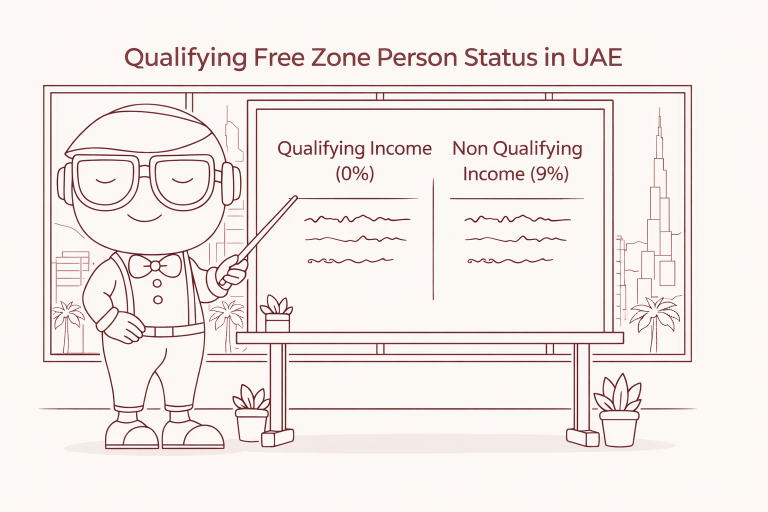
Requirements for Qualifying Free Zone Person (QFZP) status under UAE’s Corporate Tax Regime
Free zones in UAE provide advantageous benefits through tax advantages and economic benefits. These designated…
Despite the fact that the UAE has minimal taxation, companies can still benefit from accounting solutions that maintain books in accordance with the UAE Federal Corporate Tax Law, handle complex VAT treatments, and enable WPS-compliant payroll.
However, the right accounting software is not just a compliance necessity but also a profit driver. The right software can improve profitability by tightening job costing, reducing manual work, and giving management better visibility over project-level margins. This is real evidence that choosing the right tools for the right job matters, even for something as mechanical as accounting.
Construction-specific platforms address industry needs like job costing, project tracking, and multi-entity management, while enterprise solutions may be better suited for very large organizations with broader requirements.
Ultimately, construction accounting software will provide better operational oversight, streamlined bookkeeping, and more relevant insights from the data construction companies already collect.
Accounting for contractors is fundamentally different from accounting for retail or service businesses. In the construction industry, you must simultaneously juggle long project timelines, milestone-based billing, subcontractor payments, equipment depreciation, and retainage.
Manual bookkeeping for such complex and unique financial operations is not only inefficient but also exposes construction firms to errors that compound over a construction project’s lifecycle.
Contractors seeking accounting services in the UAE also navigate a particularly demanding set of financial regulations, such as value added tax (VAT) law, wherein tax treatment varies by project type and timing of sale.
Maintaining compliance with international accounting standards is another ongoing challenge that has intensified since the introduction of corporate tax in the UAE.
Understanding your business needs in this regulatory context is the starting point for choosing the right accounting software in the UAE.
Generalist accounting software tends to fall into one of two traps. Such software is either too narrow to serve contractors effectively, or it bundles features you don’t need and charges you for all of them.
Most businesses end up choosing such ill-fitted generalist accounting software because they do not have clarity about their accounting needs.
Key accounting services for contractors include job costing, cash flow management, payroll, and VAT-compliant billing and reporting. The right construction accounting platform transforms complex financial data into actionable insights, helping to control costs, improve cash flow, and maximize profit margins. Additionally, construction accounting software should automate purchase orders, link bills to projects, manage retainage and progress billing, and generate project P&L reports.
Let’s discuss these needs in more detail.
Job costing involves assigning expenses to specific jobs to determine per-project profitability. Accurately allocating costs for labor, materials, equipment, and subcontractors is something construction professionals likely already do to manage budgets, identify profitable jobs, and place informed bids. The question is whether your construction accounting software helps or hinders job cost accounting.
When evaluating platforms, your baseline should be real-time access to financial data and, at a minimum, weekly updates on project performance. A solid platform should let you pull a profit and loss account by project, generate reports that reflect your company’s financial health, and run cash flow analysis across active jobs.
Work-in-progress (WIP) tracking is another essential feature that monitors project status to enable accurate revenue recognition and helps avoid cost overruns.
Construction invoicing is unlike most other industries. For instance, rather than billing upon delivery, contractors typically follow progress billing, wherein invoices are generated upon completion of successive project stages. Also, in many contracts, a percentage of each invoice is withheld as retainage until project completion.
So, construction accounting software should handle the following billing arrangements and documentation requirements:
Most construction firms rely on a mix of direct employees and subcontractors, each with different payment structures and compliance requirements. Maintaining accurate financial records across both requires:
Missed payment notifications and manual data entry based on bank statements create reconciliation gaps and undermine day-to-day operations. You also need to consistently monitor cash inflows and outflows so that you can maintain liquidity for ongoing operations. In practice, this means your accounting system needs to stay in sync with your bank accounts.
The result is a more accurate cash flow statement, cleaner financial documentation, and a faster month-end or quarter-end VAT filing.
Compliance is arguably the highest-stakes feature category for UAE contractors. Many leading accounting software for contractors now include compliance tools that help ensure adherence to UAE VAT and corporate tax reporting requirements, streamlining compliance-related processes.
Here is what your construction accounting software needs to cover:
An integrated platform or unified platform that combines financial management, project tools, and construction-specific features into a single, cloud-based solution can significantly reduce disconnects between field and office teams.
However, if such comprehensive solutions do not meet your needs or fit your budget, you will need to use separate software for accounting, ERP, project management, and procurement.
Incompatible systems create more problems than they solve. If you’re spending more time transferring data between software solutions than actually using them, the software is working against your business operations.
Look for seamless integrations with the tools you already use.
Here’s a breakdown of the different types of accounting software, their strengths, and their limitations.
| Type | Best for | Key limitations |
|---|---|---|
| Cloud/online | Small to mid-size contractors with remote teams appreciate the flexibility and scalability of cloud solutions | Could lack deep construction-specific modules since such software companies typically aim for widespread adoption rather than solving industry-specific challenges |
| Desktop | Desktop software is the perfect fit for construction firms with data control or offline requirements | Integrations can be cumbersome, and updates can be much more infrequent than cloud solutions, which ultimately exposes you to compliance challenges |
| ERP | Land developers can benefit from cloud-based ERP solutions that provide real-time visibility and comprehensive feature sets | Such software is often extremely complex and hence requires your team to set aside a significant amount of time for training, which increases the true cost of implementation |
Another key consideration is your accounting partner’s familiarity with the software. If you work with an accounting firm that specializes in UAE construction, their software preferences should carry weight. They will typically extract more value for you when they use platforms they know well.
Note
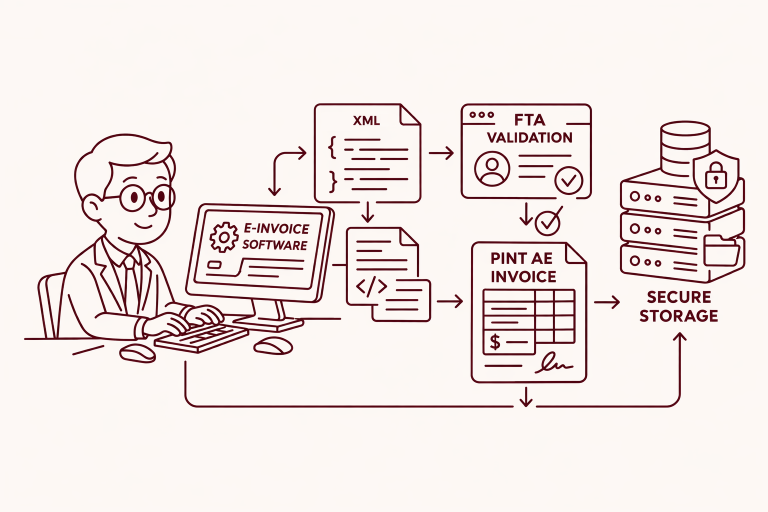
UAE-based contractors using cloud-based accounting software should confirm that the system supports UAE VAT / Corporate Tax compliance and that required records remain securely retrievable for FTA review.
Getting the most from your accounting software depends as much on implementation as on the software itself. Here is a practical step-by-step implementation plan:
Note
Maintaining accurate accounting records is challenging for contractors in the UAE due to how quickly tax regulations are evolving. So, you should regularly review your accounting software’s compliance support instead of treating it as a one-time setup check.
Here’s how you should evaluate an accounting software’s total price:
| Cost category | What to watch for |
|---|---|
| Basic licensing | Do they charge a per-user fee, or are they offering a flat rate? What is the cost of any necessary add-ons? |
| Implementation | Do they offer migration support? |
| Training | Do they simply issue a user guide, or are they also providing video tutorials, webinars, and highly-responsive phone support? |
| Integrations | Does the software integrate smoothly via free APIs, or is there a need to purchase third-party connector software? |
| Compliance updates | Do they offer prompt updates as and when UAE tax law changes? |
| Support | Does the response time promised in the Service Level Agreement (SLA) meet your business needs? |
Another accounting cost you must take note of is the cost of in-house accounting teams. No matter how advanced the accounting software is, you will require the expertise of a professional accountant from time to time.
However, not every business’s scale justifies full-time in-house accounting teams.
That’s why construction companies in Dubai choose outsourced accounting services. It essentially allows them to access advanced technologies and the ability to engage experts without the overhead of full-time staff.
A sales demo will always show you the best-case scenario. Your job is to stress-test it. Here’s a list of things to check before making your purchase:
During the demo, confirm:
When reviewing vendors:
The right accounting platform, configured correctly, will reduce administrative burden, improve project-level profitability, and keep you compliant with the UAE’s tax regulations.
To recap, here’s what you should prioritize:
However, simply purchasing the right accounting software without having an expert accountant to leverage it is like investing in state-of-the-art power tools without hiring a skilled subcontractor.
That’s why Skrooge’s accounting services package makes sense for contractors. Our expert accountants will handle most of the accounting functions, from day-to-day transaction capture and categorization to registration and filing for value added tax (VAT) and corporate tax. At the same time, you can maintain oversight over the financial records and generate custom reports via Zoho Books for free.
Fortunately for contractors, construction accounting software comes equipped with job costing and real-time WIP tracking features. So, you no longer need to look for features that act as midway solutions and require you to manually perform job costing and project profitability assessments.
General tools are capable of handling day-to-day bookkeeping, but they lack in-built support for FIDIC contract billing, retainage, WIP tracking, and job costing. For UAE contractors managing multiple projects, construction-specific software or a construction-focused module will save you a lot of time by automating accounting functions unique to UAE construction contractors.
Progress billing should be linked directly to project milestones, with retainage automatically calculated and tracked as a liability until released. Your system should also track change orders so that you can confidently address billing-related disputes.
It should, but verify. Look for software that handles differentiated VAT rates, generates compliant tax invoices, and produces corporate tax reports aligned with Federal Tax Authority (FTA) requirements. Also, confirm the software is actively updated as the UAE tax law evolves.
For IT contractors and independent contractors who bill by time or milestones, accounting software that generates invoices after tracking time spent on projects as well as project milestones is arguably the best setup.
Advanced reporting capabilities in accounting software for contractors enable you to review detailed financial and operational reports. This means you can identify jobs that are not cost-efficient before going over the budget. As a contracting business owner, you should keep an eye on weekly financial reports such as WIP reports, job costing reports, cash flow forecasts, and accounts receivable (AR) reports to avoid cost overruns.
A basic implementation involving a chart of accounts setup, tax configuration, and user onboarding typically takes 1-3 weeks. Full data migration, including project cost history, can extend this to a couple of months, depending on data quality and system complexity.
Thank you!
We've received your request and will get back to you shortly.

Loading...