

Best restaurant accounting services in UAE
Why bookkeeping for restaurants is different (and why it matters) There probably aren’t any industries…
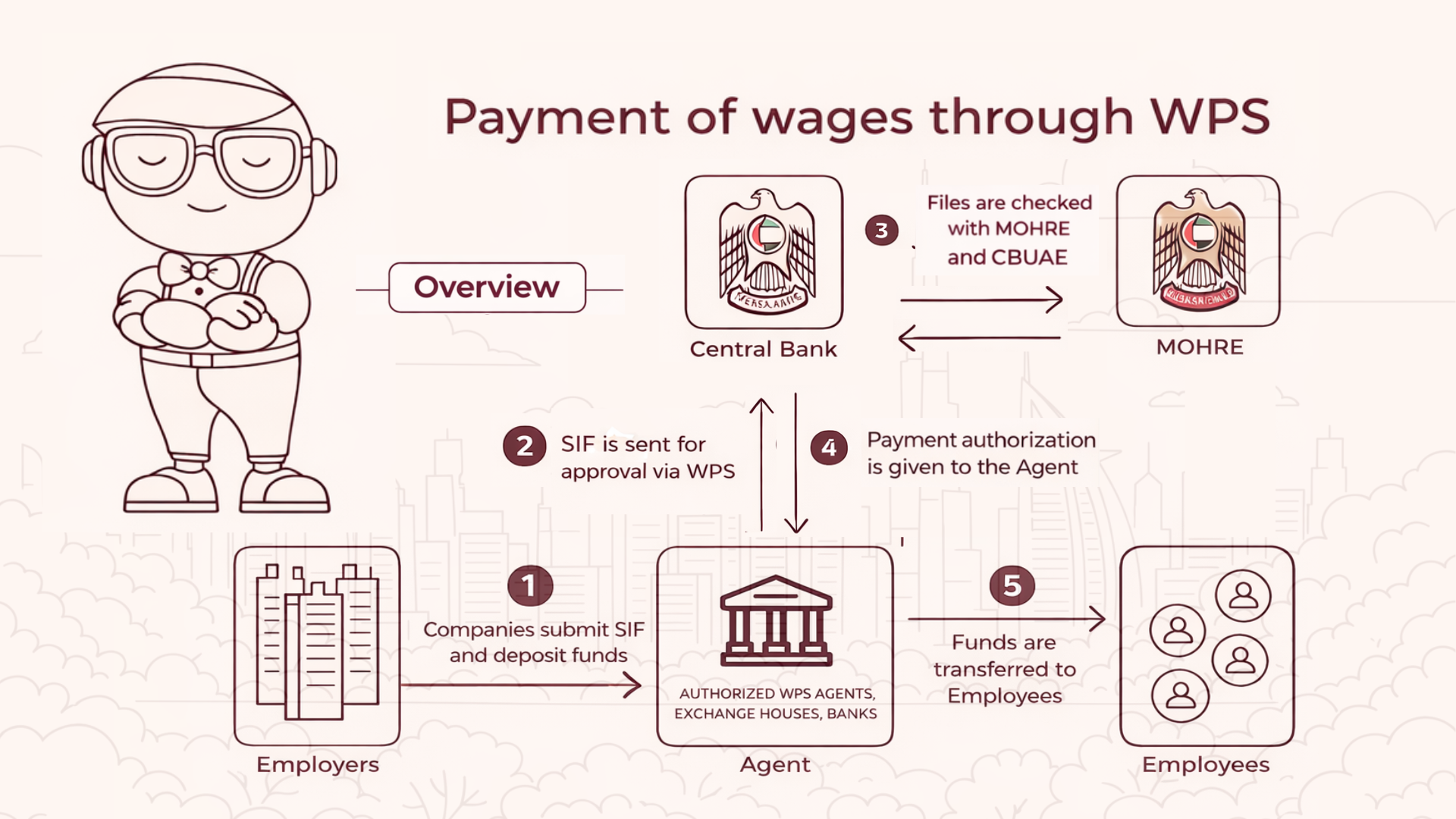
The Wage Protection System (WPS) is an electronic salary transfer system that ensures employees in the UAE receive their wages on time and in full.
It allows employers to pay salaries through approved financial institutions (e.g. banks, exchange houses, and other payment providers) authorized by the Central Bank of the UAE.
WPS was introduced in July 2009 by the UAE Central Bank and the Ministry of Human Resources and Emiratisation (MOHRE).
Recently, MOHRE introduced system updates to reinforce monitoring, including data integration with financial institutions and automated reminders for employers.
The Wage Protection System was first introduced by the Ministry of Human Resources and Emiratisation (MOHRE) to increase transparency and employees’ rights.
Employers must process employee salaries through banks, exchange houses, and financial institutions authorized by the Central Bank under the WPS.
Private sector employees should receive wages through approved channels on the due date stated in the employment contract, or at least once per month if no date is specified. Employers are considered late if wages are not paid within 15 days of the due date.
Note
WPS ensures that salaries are paid on time. However, it does not control wage payments or the terms of employment.
The wage terms contained in the employee’s employment contract that is registered with MOHRE must be followed when paying salaries.
WPS applies to all private sector companies registered with MOHRE.
As a rule, salaries must be paid either:
During that time, businesses need to submit documentation proving salary payments and process salaries through approved payment channels.
Note
A separate Ministerial resolution extends WPS to certain categories of domestic workers. Employers must pay wages through WPS for:
Effective April 2023, WPS has been updated as mandatory registration for these professions.
Apart from avoiding disputes, the WPS exists to enable the UAE central bank to monitor salary transfers through correct channels.
WPS also protects vulnerable workers and supports a digitized payroll system where employers manage office documents, excel, word, and pdf records in a way that is fully compatible with financial reporting requirements.
By standardizing wage payments, WPS helps businesses maintain clean financial records and ensure that their money moves in a traceable manner.
WPS generally applies to private-sector establishments registered with MOHRE. Mainland employers are usually within scope, while companies operating under separate free-zone employment regimes should check the rules of their own authority rather than assuming MOHRE WPS applies.
Many Dubai free zones (e.g., DIFC, ADGM and others with independent regulators) operate outside MOHRE jurisdiction. Even if WPS is not mandatory, some free zones may encourage or allow WPS for standardization and audit purposes.
Employers must pay wages in line with the current MOHRE wage payment framework and the applicable ministerial resolutions governing WPS compliance and enforcement.
Separate rules apply to some worker categories. For example, new employees are temporarily excluded from WPS compliance checks during the initial period, while certain domestic work professions were later brought into mandatory WPS coverage under updated resolutions.
Typical employer setup for compliance include:
WPS allows for salary payments in Emirati Dirham (AED) or any other currency agreed upon in the employment contract.
The registration process for WPS requires employers to submit a Salary Information File (SIF) containing details of employee wages, allowances, and deductions.
Employers need to confirm access to a valid salary account. This can either be credited directly to bank accounts or payroll cards.
Accurate private sector employee data must be maintained, including:
Include details such as:
The SIF is a standardized electronic file format (typically a .txt file) and follows the fixed structure including a header with the company’s details. The bank or WPS agent may reject the file if the format is incorrect.
Under WPS, salary refers to the total agreed compensation including basic wage, allowances (e.g. housing, transport, or other fixed benefits), and any approved variable components stated in employment contract.
An establishment is generally considered compliant with WPS wage payment requirements if more than 80% of the total wages of eligible employees are transferred through the system. Deductions must be legally documented to avoid any issues.
Regardless of your preferred channel, ensure that transactions are always aligned with the official payment order submitted through the SIF. Make sure also that all channels are approved by the UAE Central Bank.
Employers are considered late in paying wages if the payment is not made within the first 15 days after the due date.
Penalties for late or non-payment of salaries may include downgrading of the company’s classification in the MOHRE system.
If wages are not paid within the required timeframe, authorities may:
Here’s a breakdown of the typical timeline:
| Date | Action Taken |
|---|---|
| Upon Due Date | Monitoring begins |
| 3 to 10 days after the due date | Employers receive reminders and notifications |
| 17 days after the due date | MOHRE may suspend issuance of new work permits For companies with more than 50 employees: Inspection may be scheduled and violations may be escalated to competent authorities |
| 45 days after due date | Legal action may be initiated and the case may be referred to the public prosecutor |
| Repeat violations within six months | This can lead to: 1. Administrative fines 2. Downgrading of the company’s classification category |
Common Mistake |
What Happens |
How to Fix this |
|---|---|---|
Incorrect SIF Format or structure |
|
Clarify and ensure SIF template is validated with your preferred payment channel |
Mismatch between SIF and employment records |
Salary amounts, IDs or bank details don’t match MOHRE records. |
Always ensure payroll documents align. Typically a key member of the team is responsible for this |
Missing or incomplete data fields |
Required fields are missing and file gets rejected during validation |
Ensure deductions are legally recorded and reflected in pdf or payroll records |
Incorrect wage calculations or deductions |
Net does not align with declared wages or deductions are not supported by proper documents |
Use structured templates and standardize payroll in one platform. Avoid manual edits in word processor formats. |
Failure to meet 80% transfer of wage payments or late submission of SIF |
Employer may fall out of WPS compliance |
Set internal deadlines ahead of official due dates and use automated reminders |
Using unapproved payment channels |
Files may be rejected or flagged by the UAE Central Bank |
Always process through approved channels and ensure alignment between your corporate bank account and WPS setup |
Poor internal documentation and over reliance on manual processes can put the stress on managers when it comes to payroll management. There are third party providers that you can outsource to. These services are especially valuable for businesses scaling quickly and managing complex payroll structures.
Outsourced services typically include:
How to choose the right provider?
For service providers like Skrooge, we help you maintain accurate payroll documents that supports high quality content and reduces the risk of errors that could impact tax and regulatory filings.
WPS payroll is not just a back-office task.
Consider it as a critical function that sustains your business and employee’s health. The right provider acts as both an operator and safeguard for your business to stay compliant, efficient, and ready to scale.
Questions? Book a consultation with us by leaving your number here. Our experts will call you right back to answer your queries.
WPS stands for Wage Protection System, an electronic transfer system that ensures private sector companies pay their workers on time and in full.
You can check your bank account or salary card if the money is credited. This largely depends on the details you gave to your company during onboarding.
You can also review your payslip or payroll records, or simply ask your employer or HR team for confirmation.
If a Free Zone entity is registered with MOHRE, then WPS applies. Example of free zones, requiring payment through WPS: DMCC (Dubai Multi Commodities Centre), Jafza (Jebel Ali Free Zone).
Many Dubai free zones (e.g., DIFC, ADGM and others with independent regulators) operate outside MOHRE jurisdiction on the other side.
Even if WPS is not mandatory, some free zones may encourage or allow WPS for standardization and audit purposes.
Yes, exchange houses recognized by the Central Bank are accepted as an alternative payment channel to bank accounts.
A rejected SIF means the salary payment order was not processed through WPS, so immediate action is required to avoid delays and penalties.
Check the error message first and if there is a reason given for the rejection. You can then review and fix the payroll data and regenerate the SIF for resubmission. Use internal checks to pre-verify using our checklist.
WPS setup requires verified company registration details (including appropriate signatories and other licenses), banking integration, and accurate employee and payroll documents.
To learn more how to register for WPS, visit our article here.
Thank you!
We've received your request and will get back to you shortly.

Loading...